Le Salon de 1874
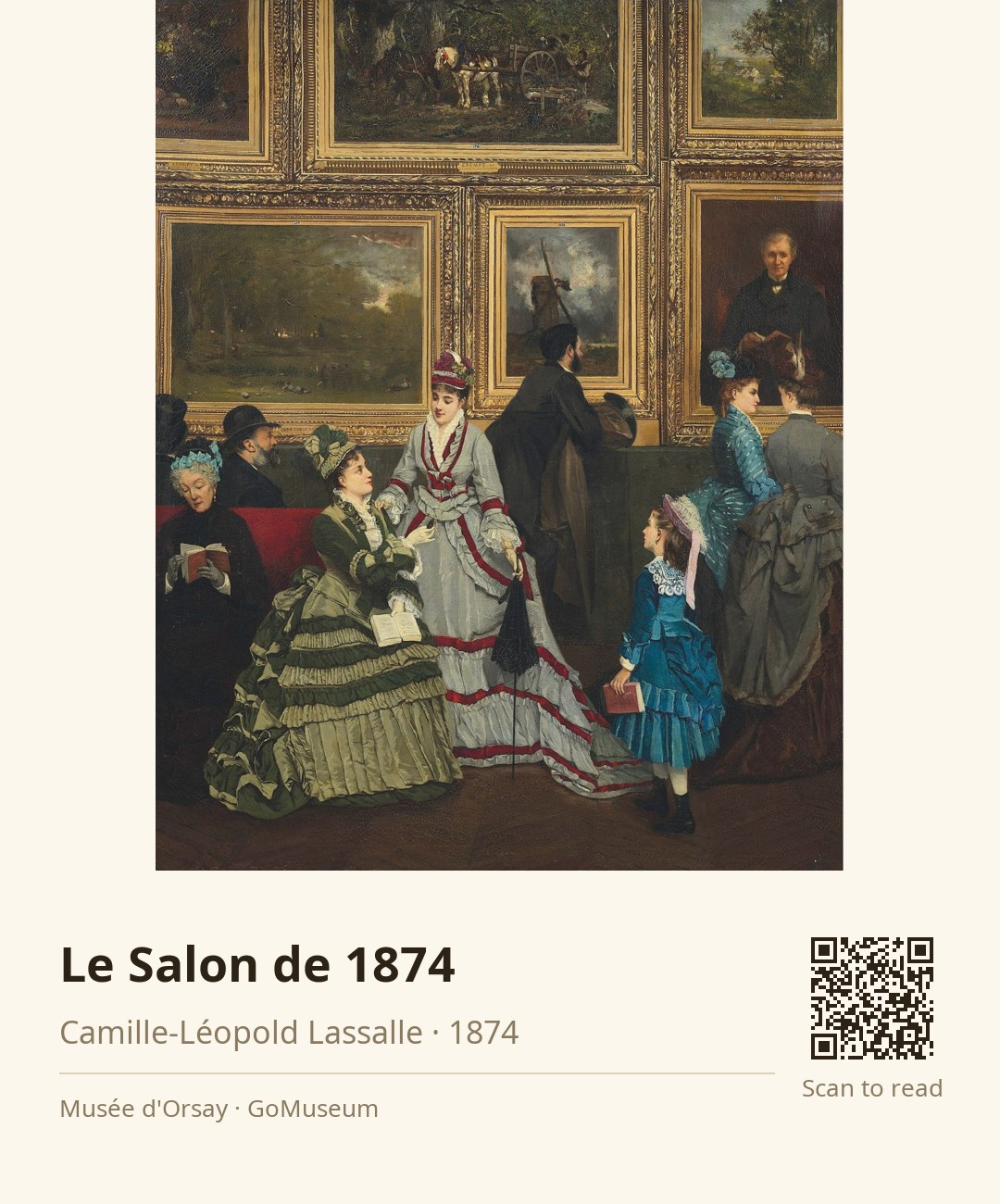
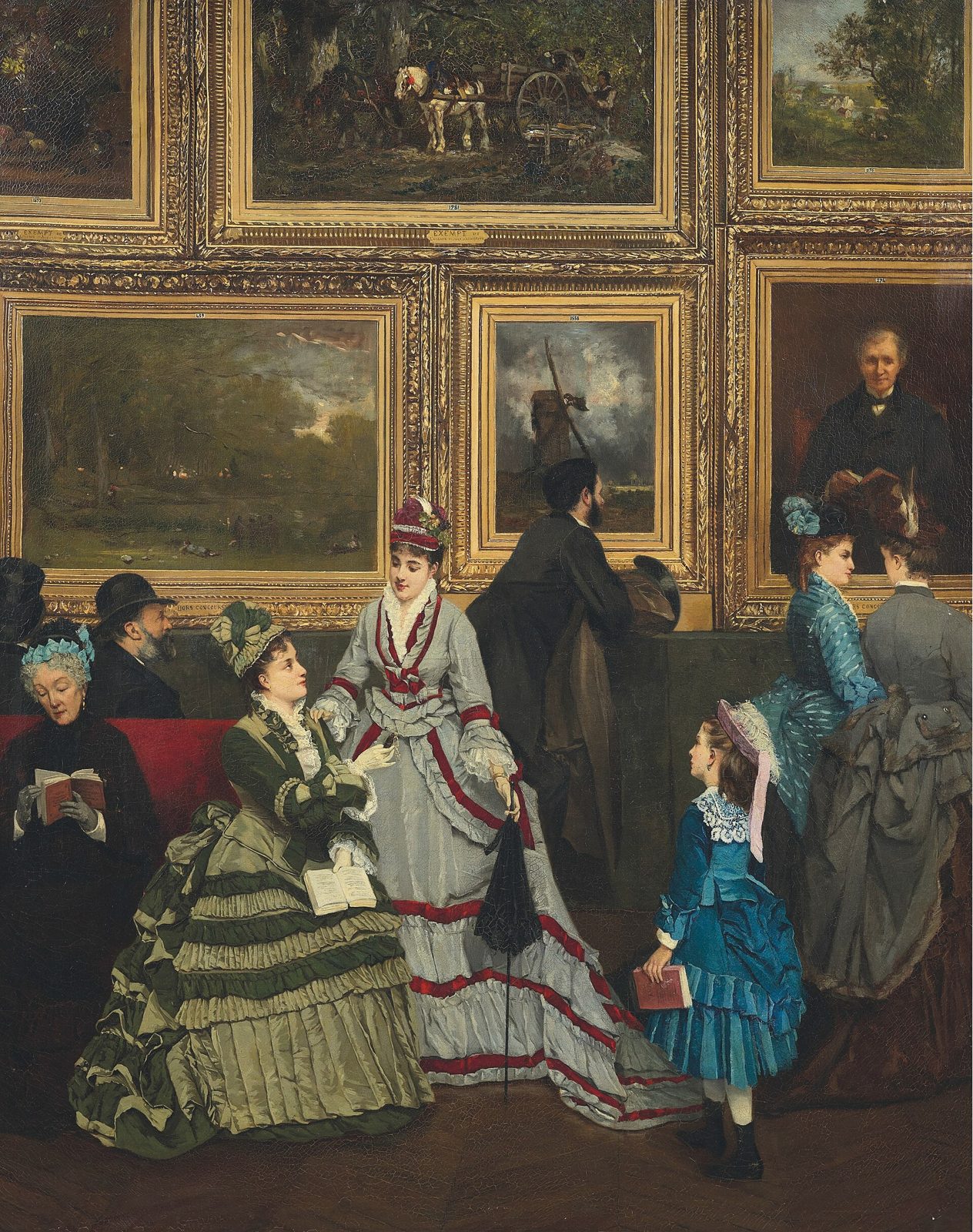
🎧 This work has audio narration — listen in the appA woman in a stunning green dress stands in conversation with another elegantly attired figure in gray, her black parasol adding a touch of sophistication to the scene. Nearby, a young girl in blue clutches a book, while an older woman in black reads quietly, embodying the cultured atmosphere of this gallery setting. The lively interactions among these figures reflect the social dynamics of the 19th-century Parisian art world.
This painting, titled *Le Salon de 1874*, captures a moment of anticipation as visitors engage with the artwork displayed at the Salon, an important annual exhibition in Paris. The rich earth tones and vibrant colors illustrate not only the textures of the fabrics but also the opulence of the environment. Each figure is carefully rendered, showcasing the artist's attention to detail and the luxurious lifestyle of the bourgeoisie during this period.
Created by Camille-Léopold Cabaillot-Lassalle, this work is a collaborative piece featuring contributions from six other French painters, each represented in miniature within the gallery scene.
Camille-Léopold Cabaillot, known as Cabaillot-Lassalle, was a French painter born in Paris on September 8, 1839. He was the son of Louis Simon Cabaillot, a painter recognized for his naïve genre scenes. Cabaillot-Lassalle adopted his father's pseudonym, adding his own name to create a unique identity in the art world. After training under his father, he further honed his skills at the Écouen painters' colony with Pierre Édouard Frère.
Cabaillot-Lassalle specialized in interior genre scenes, capturing the lives of bourgeois women and their children engaged in domestic activities. His works reflect the opulence of the Belle Époque, a period marked by stability and prosperity for the bourgeoisie. His paintings, often small to medium-sized, are characterized by a focus on refined interiors and the subtleties of domestic life, though with less intricate detail than his contemporary Alfred Stevens.
Exhibiting at the Salon from 1864 to 1889, Cabaillot-Lassalle gained recognition for his engaging depictions of everyday life. His notable works include "Le Salon de 1874," which cleverly showcased an exhibition space filled with paintings, including those by other artists. Cabaillot-Lassalle's legacy lies in his ability to capture the essence of bourgeois life, making him a significant figure in 19th-century French art. He passed away in Paris on January 9, 1902.
In 1874, Camille-Léopold Cabaillot-Lassalle, alongside six fellow painters, created *Le Salon de 1874*, a unique piece that captures the essence of the art world at that time. This collaborative work was not just a painting; it was a reflection of the vibrant Parisian art scene, displayed at the prestigious Salon de peinture et de sculpture held at the Palais des Champs-Élysées. The exhibition was a significant event for artists, showcasing their works to the public and critics alike.
Cabaillot-Lassalle's technique in *Le Salon de 1874* is a masterclass in capturing the opulence of the bourgeois lifestyle. The brushwork is meticulous, with each stroke bringing to life the intricate textures of the fabrics worn by the elegantly dressed figures. The rich earth tones and vibrant colors create a warm atmosphere, inviting viewers into this bustling gallery. The composition is dynamic, with figures arranged in a way that draws the eye across the canvas, mimicking the movement of visitors in an actual gallery.
The miniature paintings depicted within the scene were actually created by the artists whose works were featured in the Salon that year, making this painting a fascinating snapshot of the artistic community of the time. This unique collaboration highlights the camaraderie and competition among artists, as they not only showcased their own work but also celebrated their peers in a shared artistic endeavor.
Cabaillot-Lassalle's work is closely related to that of Alfred Stevens, a Belgian artist known for depicting the Parisian bourgeoisie.