Blossoming Tree
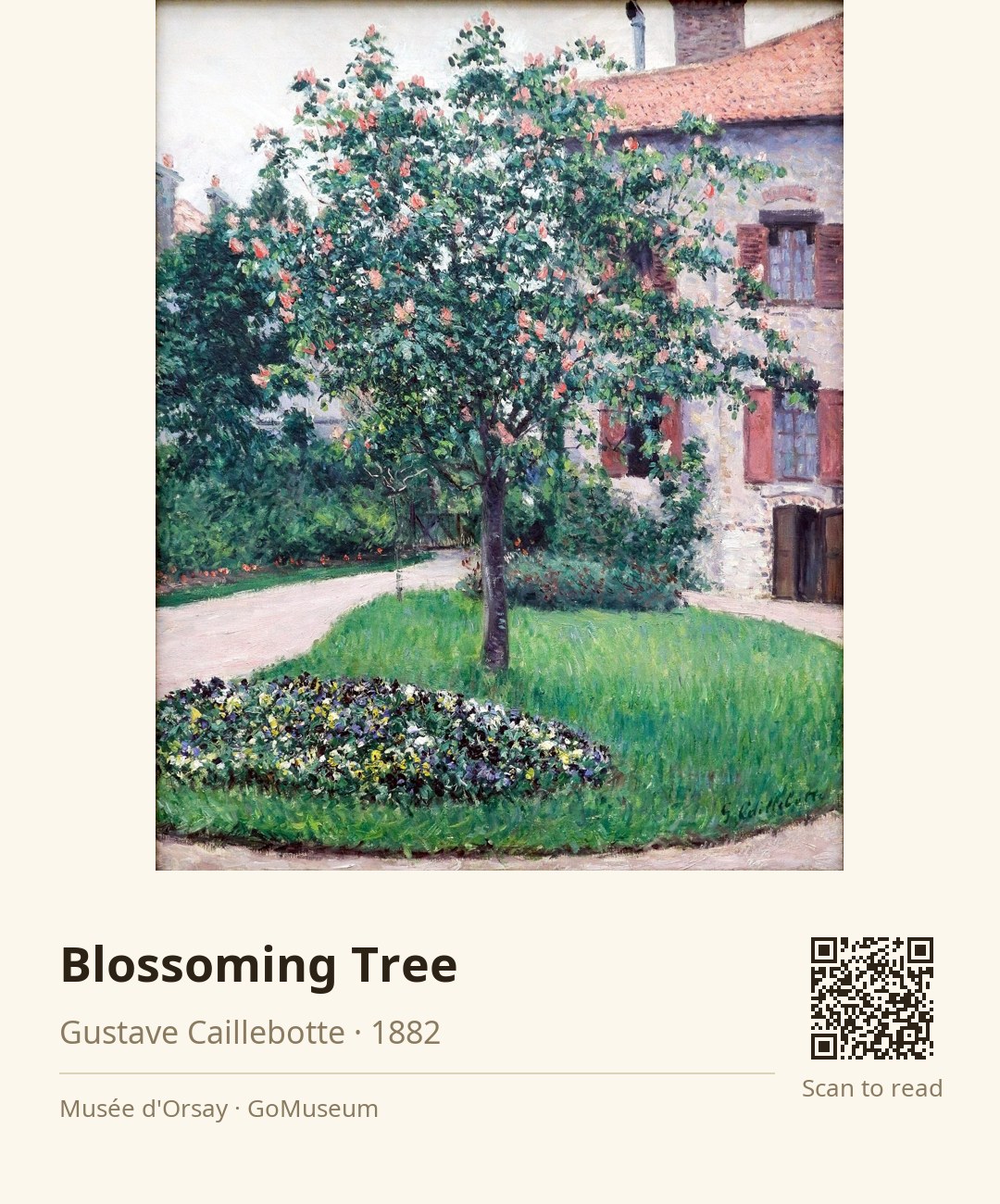
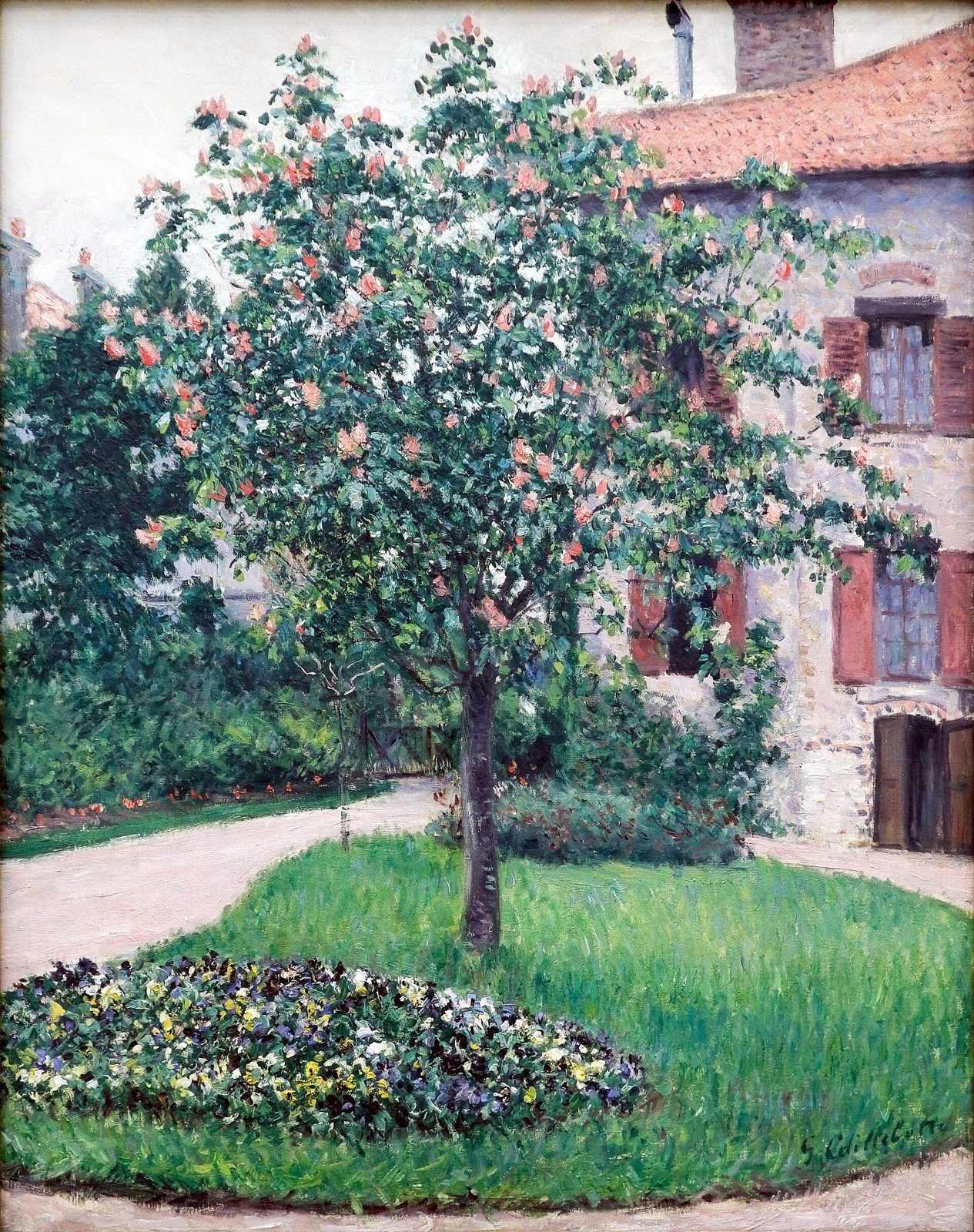
🎧 This work has audio narration — listen in the appThe flowering tree at the center of Gustave Caillebotte's "Blossoming Tree" bursts with vibrant pink blossoms, surrounded by lush green foliage that creates a sense of life and renewal. In the foreground, a carefully arranged flower bed showcases a delightful mix of white, yellow, and purple blooms, drawing the eye into this serene garden scene.
This juxtaposition of the tree's exuberance against the well-tended flowers highlights Caillebotte's skill in capturing the beauty of nature while also reflecting a cultivated landscape, suggesting a harmony between the wild and the manicured. The curved pathway leading to a partially obscured gate invites viewers to imagine the journey beyond the garden, while the rustic stone building with its red-tiled roof adds a charming backdrop that grounds the scene in a specific time and place.
Caillebotte, a prominent figure in the Impressionist movement, often blended realism with the softer, more atmospheric qualities of Impressionism. His works, including this one created in 1882, reveal a fascination with everyday life and the natural world, reflecting his unique perspective as both an artist and a patron of his contemporaries. The painting is part of a collection that showcases the evolution of Impressionism, a movement that sought to capture fleeting moments and the effects of light in the late 19th century.
Gustave Caillebotte was a French painter born on August 19, 1848, into an affluent Parisian family. His upbringing afforded him the luxury of pursuing art, which he began seriously after serving in the Franco-Prussian War. Caillebotte's early works reflected a realistic style, often capturing contemporary life with a focus on urban scenes and laborers, as seen in his notable painting "The Floor Scrapers." His artistic journey was intertwined with the Impressionist movement, where he played a dual role as both a creator and a patron, supporting fellow artists like Monet and Degas.
Despite his contributions, Caillebotte's work was often overshadowed by his more famous contemporaries, and he did not receive significant recognition until long after his death on February 21, 1894. His collection of Impressionist works, bequeathed to the French state, became a cornerstone of the movement's legacy. Caillebotte's unique perspective, blending realism with the emerging Impressionist style, positioned him as a pivotal figure in art history, though it took a century for his contributions to be fully acknowledged through retrospectives and exhibitions. His legacy continues to resonate, illustrating the complexities of artistic recognition and the evolution of modern art.
Caillebotte, both a painter and a patron, was instrumental in promoting his fellow artists. The reception was mixed, as was often the case with Impressionist works, but Caillebotte's unique blend of realism and impressionism drew attention. After his death in 1894, he left behind a significant collection of Impressionist works to the French state, which became a cornerstone of the movement's legacy. His contributions were not fully recognized until much later, with a retrospective of his work finally held in 1994, a century after his passing.
In 'Blossoming Tree,' Caillebotte employs oil paint on canvas to create a vivid garden scene that feels almost tangible. His brushwork is both precise and expressive, allowing the vibrant pinks of the blossoms to pop against the lush greens of the foliage. The layering of paint gives depth to the flowers and leaves, capturing the texture of nature with remarkable fidelity. The composition is carefully balanced, with the flowering tree commanding attention at the center, while the curved pathway leads the viewer's eye deeper into the scene. This pathway, partially obscured by greenery, adds an element of mystery, inviting speculation about what lies beyond.
One surprising aspect of Caillebotte's life is his early interest in photography, which was quite unusual for painters of his time. He believed that photography could enhance his painting skills, and he often used it as a tool to study light and composition. This dual passion for painting and photography allowed him to develop a unique perspective on capturing the world around him, blending the two mediums in ways that would influence his artistic style.