 Image: Francesco Bini
Paysage du Midi
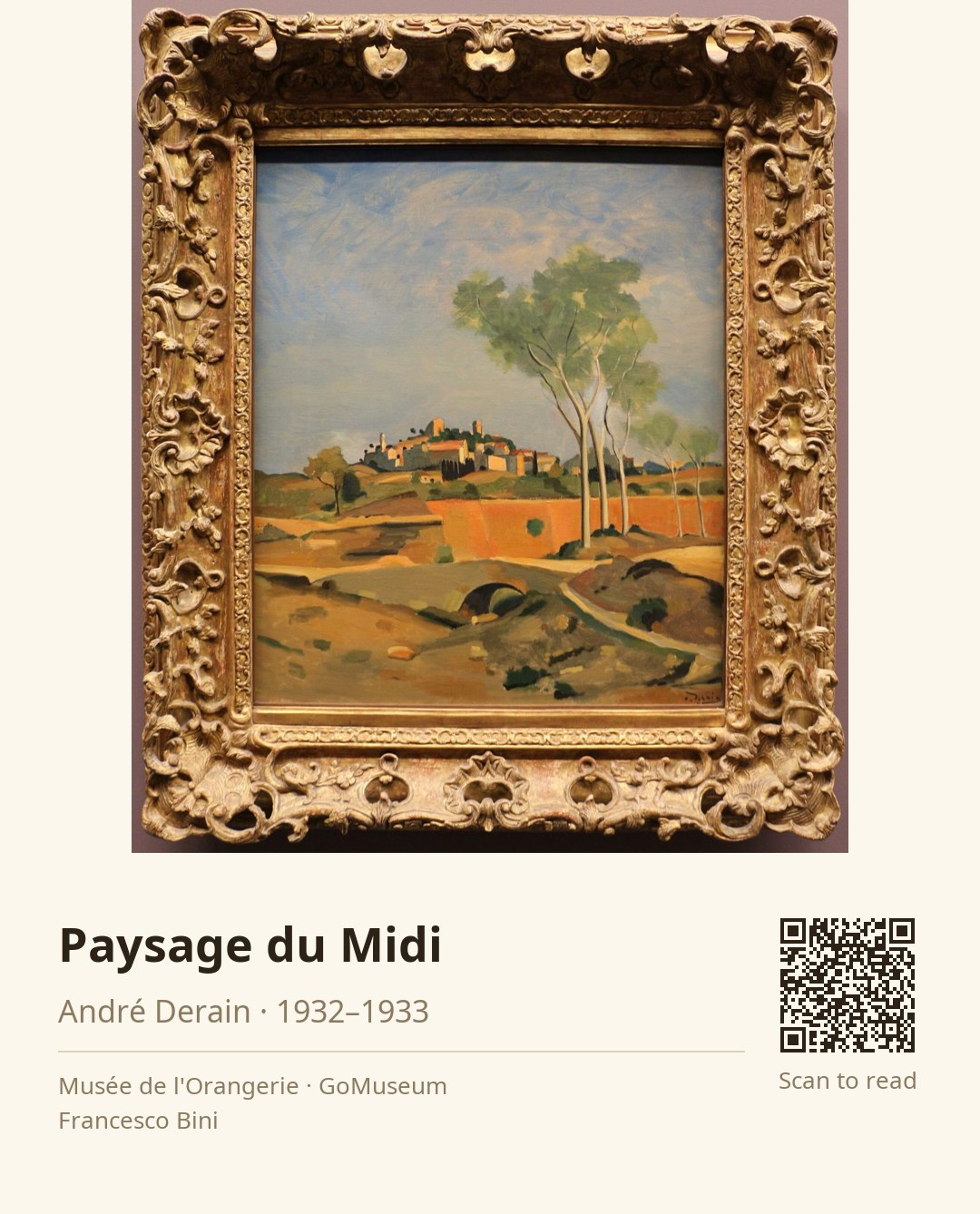
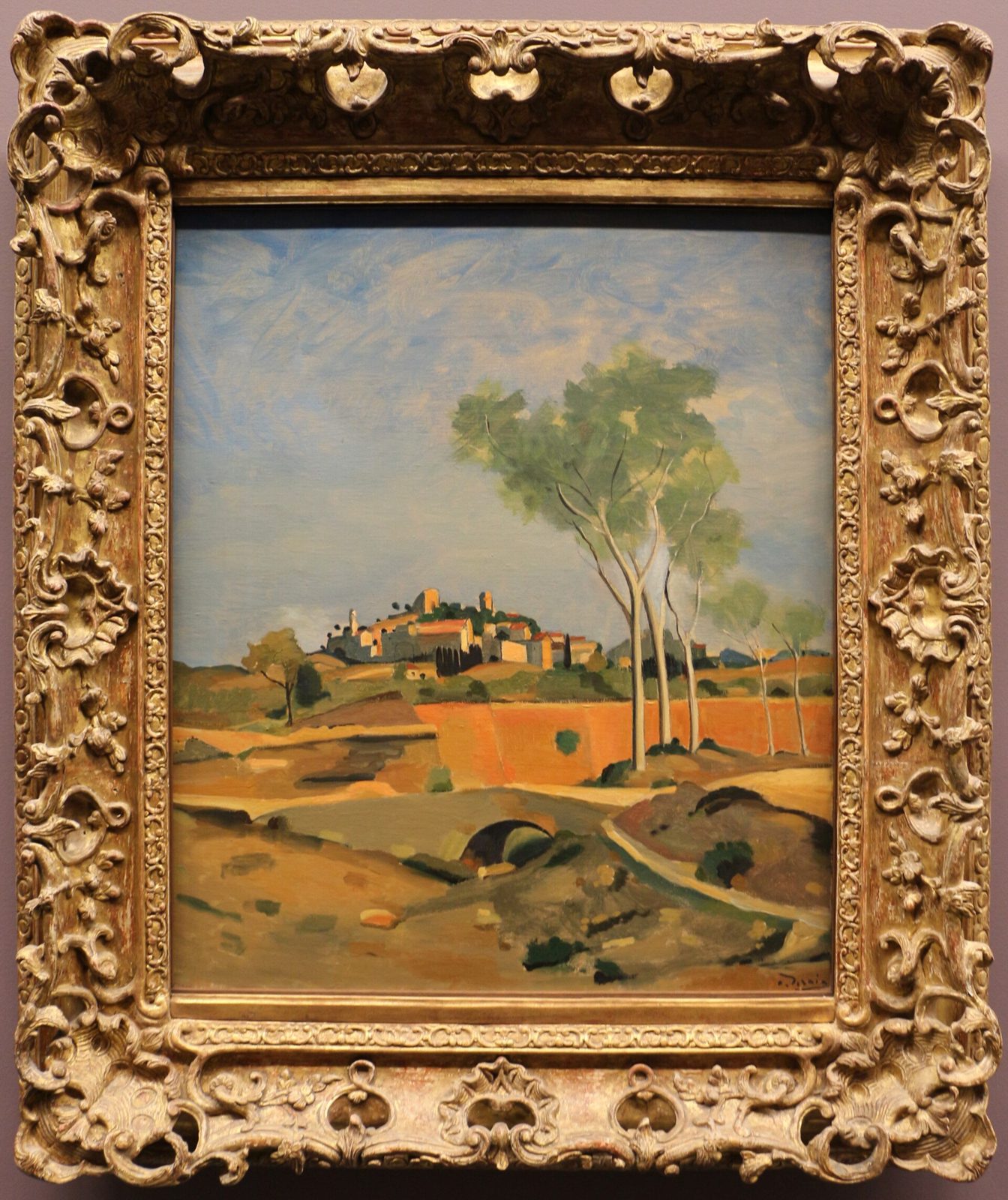
🎧 This work has audio narration — listen in the appLook at the small arched bridge sitting at the center, its dark opening framed by low green shrubs. Above it, the sky is pale blue, but it is not smooth; thin white strokes swirl through it like wind over water. Those brushmarks are never hidden. The paint is thin and fluid, and you can follow each stroke back to the hand that laid it down.
The bridge and the wall work together as the picture's quiet anchor. The bridge gives a human scale to a wide, open landscape, while the wall of saturated orange pushes the eye back toward the hilltop of cream and red-roofed houses. The strokes in the sky keep the whole surface alive, so that even the emptiest area still feels worked and moving.
What the material tells us is modest but solid. The painting is an oil on canvas, measuring 65 by 54 centimetres, and it is known in Paris as Paysage du Midi. It belongs to the museum's collection under the inventory number RF 1963-39, and it was earlier owned by Guillaume Paul and later by Mme Walter, widow of Jean Walter. It was shown at the Carnegie Institute in Pittsburgh in 1936, at the Musée national d'art moderne in Paris in 1954, and at the Wildenstein gallery in London in 1957. Derain painted it in the early 1930s, a period when he had moved away from the bright colours of his youth toward a more ordered, traditional manner. The subject is a landscape of the south, and the place named in the record, Eygalières, is a village in Provence where the painter spent time.
The landscape you see is the work of a man who had learned to balance intensity of colour against careful structure.
André Derain was a pivotal French artist born on June 17, 1880, in Chatou, near Paris. He co-founded the Fauvist movement alongside Henri Matisse, known for its bold use of color and expressive brushwork. Derain's early works from 1905-1906 showcased vibrant hues that challenged traditional aesthetics, earning the moniker "les Fauves" or "the wild beasts." His time in London further evolved his style, where he produced a series of striking paintings that captured the essence of the city with innovative techniques.
After World War I, Derain shifted towards a more classical approach, influenced by the Old Masters and a desire for order in art. This transition marked his emergence as a leader in the renewed classicism movement, where he combined his theatrical interests with visual arts. Despite facing criticism post-war, he remained a significant figure in the interwar period, contributing to ballet and theater design.
Derain's legacy is marked by his ability to bridge movements, from Fauvism to classicism, leaving an indelible mark on 20th-century art. He passed away on September 8, 1954, remembered as a complex artist who navigated the tumultuous changes of his time.
Derain painted this canvas in 1932 or 1933, and the record gives that span as its date. It has passed through two hands before reaching the museum: it was owned by Guillaume Paul, and later by Mme Walter, widow of Jean Walter. The museum holds it today under inventory number RF 1963-39. Before the museum, it was shown three times: at the Carnegie Institute in Pittsburgh in 1936 as number 190 in its catalogue, at the Musée national d'art moderne in Paris in 1954 as number 82, and at the Wildenstein gallery in London in 1957 as number 60. The record also points to a later catalogue raisonné entry, the Hoog catalogue of 1990, number 38.
The canvas is oil on canvas, 65 by 54 centimetres, so it is a small, upright picture, close to the size of something you would hold on your lap. Its surface is built from earthy, dry colours in the foreground, ochre, tan and olive laid broadly across the ground, while the wall behind the bridge is a saturated orange that is by far the loudest note in the painting. The sky is a pale blue, and across it run thin white strokes that curl and swerve. The paint is described as thin and fluid, with brush marks left visible rather than blended away, which makes the surface look quick rather than polished. A pale track curves through the lower right, and at the far right tall slender trees with pale trunks lean into the sky, while a single small tree stands at the far left edge.
No, the record gives a span rather than a single year: the painting dates from 1932 or 1933.
Yes, it was shown in the United States, France and Britain, at Pittsburgh in 1936, Paris in 1954 and London in 1957.
Yes, the two painters worked together in summer 1905 in the Mediterranean village of Collioure, where Derain completed Mountains at Collioure.