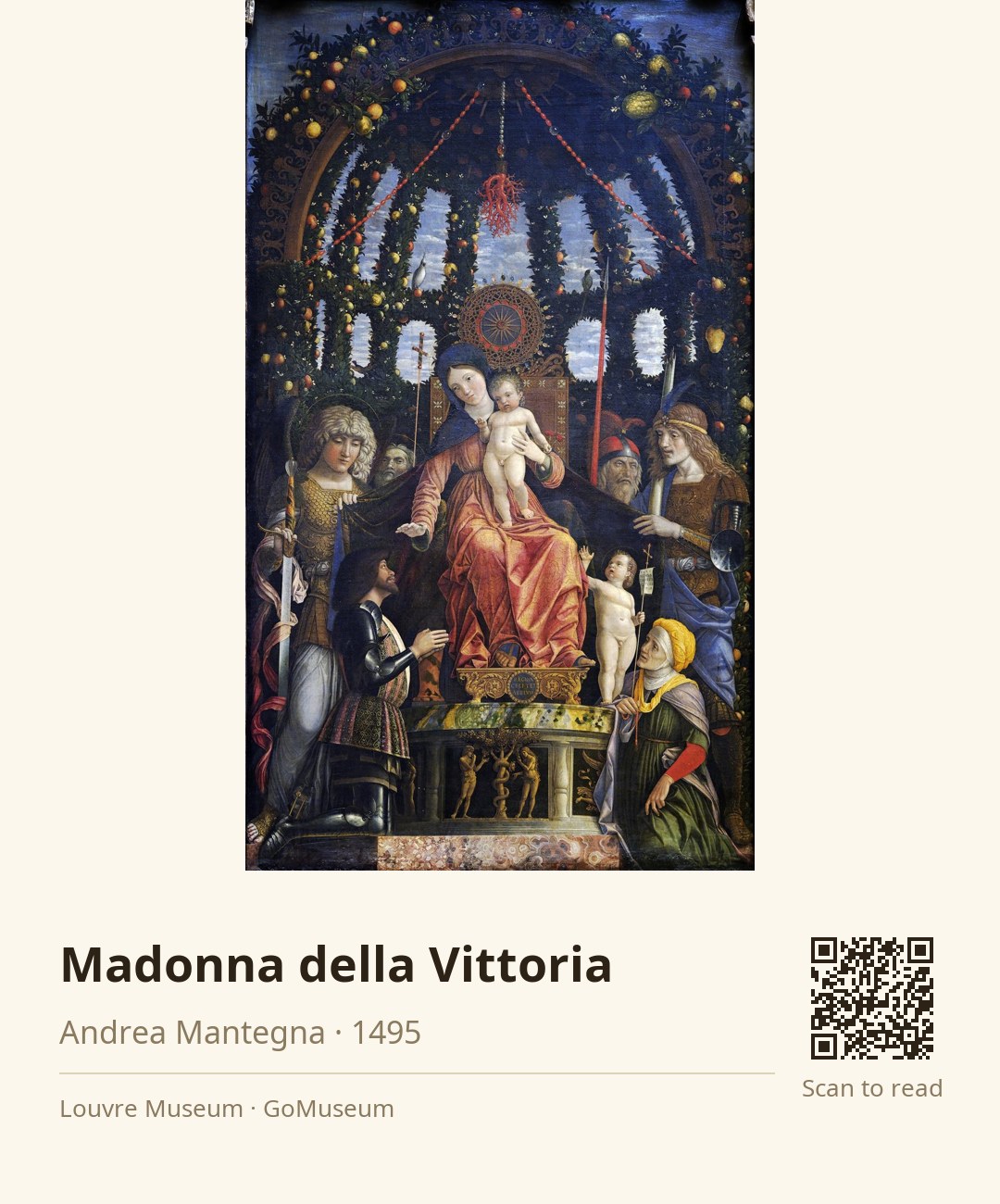
Madonna della Vittoria
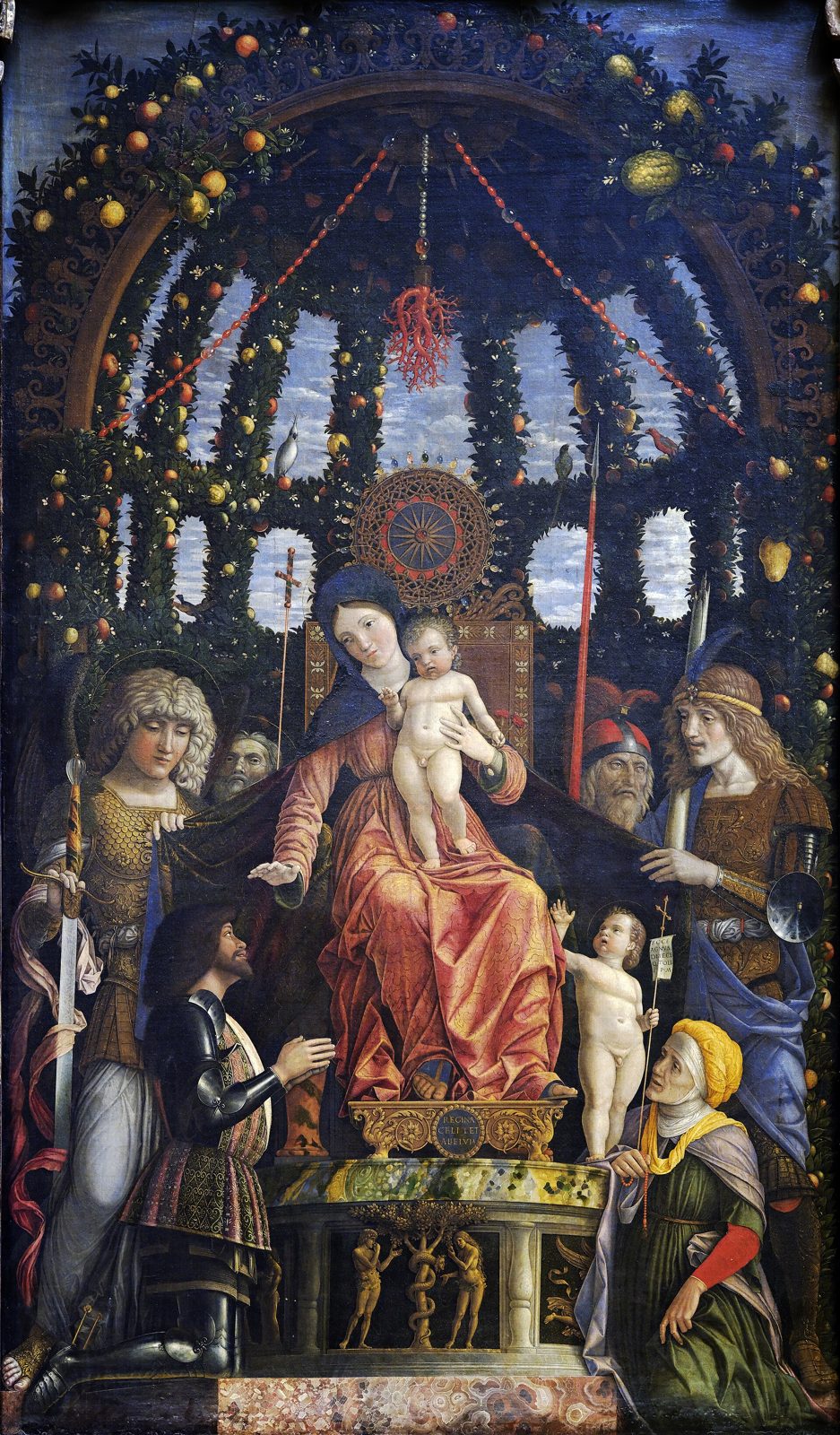
🎧 This work has audio narration — listen in the appAs you stand before the "Madonna della Vittoria," let your eyes linger on the intricate details of the throne where Mary sits. Notice the lion-paw feet and the rich marble inlays that elevate her presence. These elements aren’t just decorative; they symbolize strength and divinity, anchoring Mary as the protector of Mantua, especially during a time of conflict.
This painting was commissioned by Francesco Gonzaga to celebrate his victory at the Battle of Fornovo in 1495, a pivotal moment when the Italic League pushed back against French forces. Mantegna's work captures this moment of gratitude and reverence, as Gonzaga kneels before Mary, receiving her blessing. The mantle that envelops him signifies her protection, a powerful reminder of faith in turbulent times.
Mantegna, a master of perspective and detail, painted this piece not just as an artwork but as a testament to the resilience of his city. The vibrant colors and the serene expressions of Mary and the child Jesus invite you to reflect on the hope and strength that faith can provide.
As you take in this scene, think about the stories that have unfolded in this very space. What does victory mean to you, and how does faith play a role in your own life?
Andrea Mantegna, born around 1431 in Isola di Carturo, was a pivotal figure in the Italian Renaissance, renowned for his innovative approach to perspective and his sculptural style. Apprenticed to Francesco Squarcione, he absorbed a passion for classical antiquity, which profoundly influenced his artistic vision. Mantegna's early works, including the frescoes in the Ovetari Chapel, showcased his mastery of dramatic perspectives and detailed architectural elements, although many were tragically lost during World War II.
His marriage to Nicolosia, daughter of Jacopo Bellini, further anchored him in the vibrant artistic community of Venice. Mantegna's distinct style, characterized by flinty landscapes and statuesque figures, often drew criticism for its rigidity, yet it marked a significant departure from Gothic traditions. He was instrumental in elevating the status of the artist in society, embodying the Renaissance ideal of the creative genius. Mantegna's legacy endures, influencing generations of artists and cementing his place in art history as a master of both painting and printmaking. He passed away in 1506, leaving behind a rich body of work that continues to inspire.
The 'Madonna della Vittoria' was commissioned by Francesco Gonzaga in the wake of the Battle of Fornovo on July 6, 1495. This battle was a significant clash between the French army, led by Charles VIII, and the Italic League, which included various Italian states united against French dominance. Although the battle ended without a clear victor, the Italians claimed a moral victory by capturing French supplies. In a twist of fate, during Gonzaga's absence, a Jewish banker named Daniele da Norsa replaced a sacred image of the Virgin Mary on his house with his own coat of arms, igniting local outrage. Upon Gonzaga's return, he mandated that Daniele fund a chapel and a painting by Mantegna, which was unveiled in 1496 at the church of Santa Maria della Vittoria, built over the ruins of Daniele's house. The painting was later looted during the Napoleonic invasions and has resided in the Louvre since 1798, never to return to Mantua.
Mantegna's 'Madonna della Vittoria' showcases his masterful command of perspective and detail. The throne of Mary, adorned with intricate marble inlays and lion-paw feet, creates an imposing presence that elevates her divinity. Notice how the light interacts with the rich colors, casting a warm glow that enhances the serene expressions of Mary and the child Jesus. The composition is structured to draw your eye to the central figures, with Gonzaga kneeling in gratitude, enveloped by Mary's mantle, symbolizing divine protection. George, with their ornate armor, against the softness of the Virgin's attire creates a dynamic tension, emphasizing the blend of earthly and heavenly realms. Mantegna's technique of layering colors and using fine brushwork gives the painting a vivid, almost tactile quality, inviting you to feel the weight of the moment.
The base of Mary's throne features a medallion with the inscription 'REGINA/CELI LET./ALLELVIA,' which translates to 'Queen of Heaven, rejoice, Alleluia.' This detail not only emphasizes Mary's divine status but also connects the painting to the broader tradition of Marian devotion in Renaissance art.
The 'Madonna della Vittoria' was installed in the church of Santa Maria della Vittoria, which was built over the ruins of Daniele da Norsa's house, the Jewish banker whose actions sparked local outrage. This placement serves as a physical reminder of the tensions and conflicts surrounding its commission.