Portrait of Alof de Wignacourt and his Page
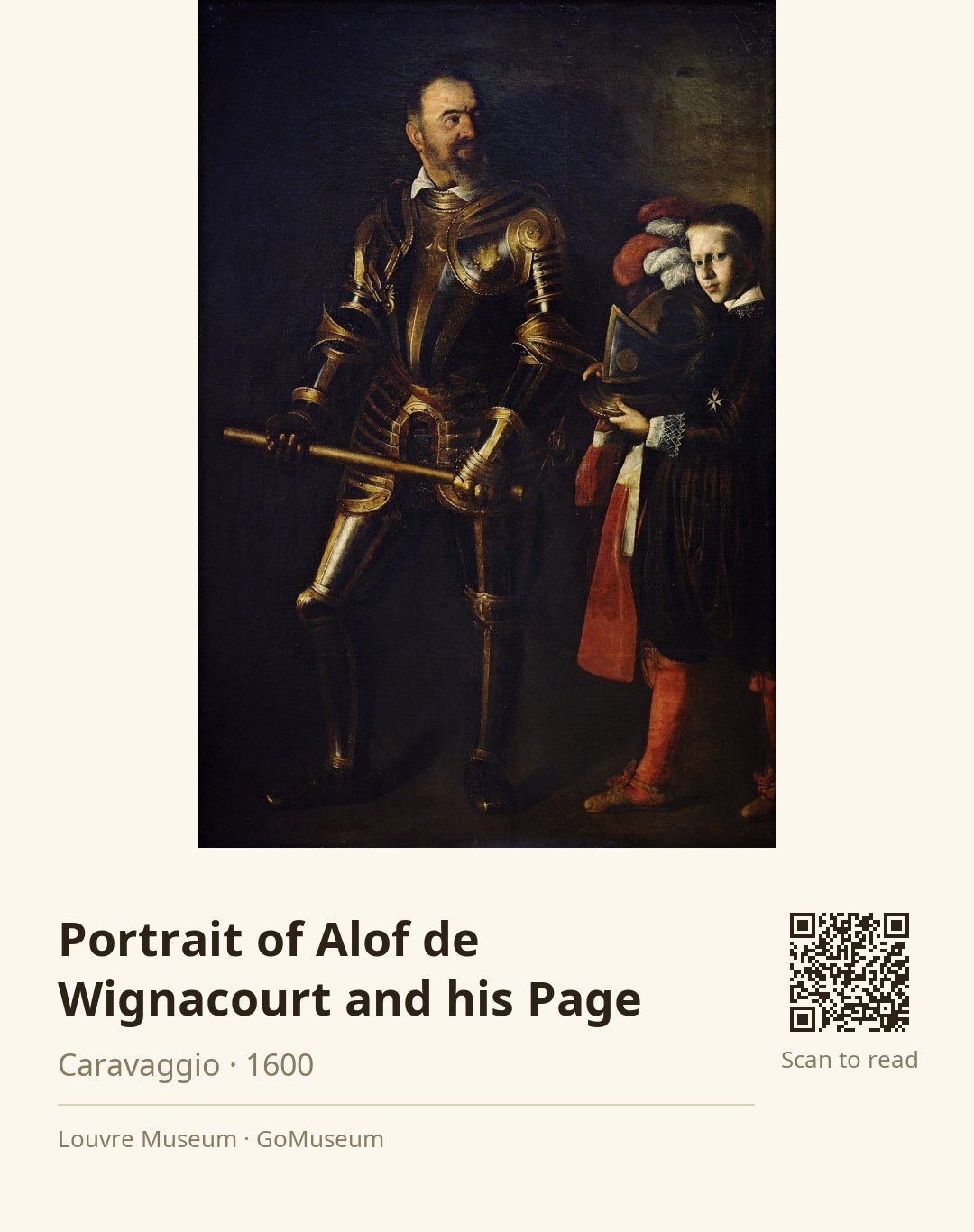
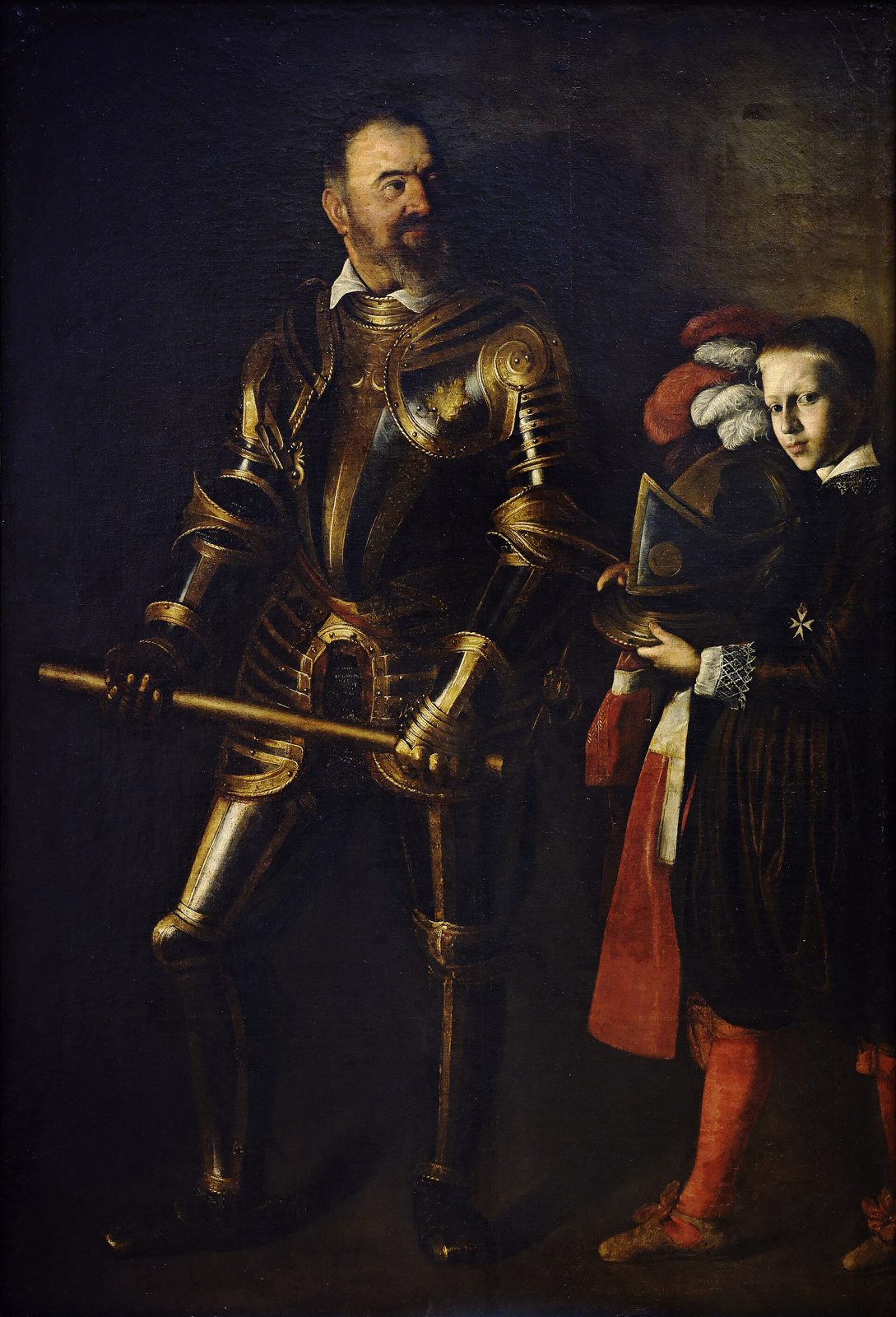
🎧 This work has audio narration — listen in the appAlof de Wignacourt stands tall in his gleaming black and gold armor, holding a baton of command that signifies his authority as Grand Master of the Knights of Malta. Beside him, a young page, likely Nicholas de Paris Boissy, holds a helmet adorned with vibrant red and white feathers, his attentive expression contrasting with Wignacourt’s dignified gaze directed off to the left.
This striking juxtaposition of the two figures highlights the power dynamics within the Order of St. John, where Wignacourt, at around sixty years old, represents military might and governance, while the page symbolizes the youthful energy and nobility that surrounded him. Caravaggio’s choice to include the page not only humanizes the composition but also reflects the trend of noble courts to surround themselves with young attendants, enhancing the Grand Master’s stature and the court’s prestige.
The painting eventually became part of the royal collection of Louis XIV in France by 1670, solidifying its historical significance.
Michelangelo Merisi da Caravaggio, born in Milan in 1571, became one of the most influential figures in Baroque art. His early life was marked by tragedy and hardship, losing family members to the plague and growing up in poverty after his mother’s death. Caravaggio trained as a painter in Milan, where he developed a keen eye for realism, influenced by the naturalism of Lombard art and the dramatic compositions of the Counter-Reformation.
Moving to Rome in the early 1590s, Caravaggio's career flourished as he gained recognition for his innovative use of chiaroscuro, known as tenebrism, which brought a striking emotional depth to his subjects. His paintings often depicted intense moments of struggle and suffering, reflecting both physical and psychological states. However, his tumultuous personal life, marked by violence and legal troubles, led to his exile from Rome after killing a man in a brawl.
Despite his troubled existence, Caravaggio continued to produce powerful works in Naples, Malta, and Sicily until his untimely death in 1610. His legacy, initially overshadowed by his notorious reputation, was rediscovered in the 20th century, cementing his status as a precursor to modern painting. His influence is evident in the works of many artists, and he remains a pivotal figure in the history of Western art.
This was a strategic moment for Wignacourt, who aimed to bolster the prestige of the Knights following their victory against the Turks. The painting was well-received, reflecting Wignacourt's desire to showcase his authority and the might of the Order. Interestingly, the portrait quickly made its way to France, becoming part of King Louis XIV's collection by 1670, and eventually found its home in the Louvre. The painting's journey through history highlights its significance in the context of power and artistry in the early 17th century.
In this painting, Caravaggio employs his signature tenebrism, using stark contrasts of light and shadow to create a dramatic effect. Notice how the Grand Master’s armor gleams under the light, emphasizing his military prowess, while the shadows around him deepen the sense of authority. This juxtaposition draws the viewer's eye across the canvas, from the imposing figure of Wignacourt to the lively expression of the page. Caravaggio's technique of painting from live models, even when they weren't present together, adds a layer of complexity to the relationship depicted. The overlapping elements in their poses suggest a connection that transcends the physical space, inviting you to ponder the narrative behind their expressions.
Caravaggio's work marked a turning point in the art world, influencing not just his contemporaries but generations of artists to come. His innovative use of chiaroscuro and realistic portrayal of human emotion laid the groundwork for the Baroque style. The 'Caravaggisti,' artists who emulated his techniques, proliferated across Europe, reshaping the visual language of painting. This portrait, in particular, stands as a testament to the blending of power and humanity, a theme that resonated deeply in the art that followed. It’s not just a depiction of a leader; it’s a reflection on the nature of authority and youth, a duality that continues to inspire discussions in art history.
One intriguing detail about this painting is that Caravaggio often painted his subjects separately, which is evident in the awkward positioning of the page next to Wignacourt. This practice stemmed from his preference to work directly on the canvas without preliminary sketches, leading to unique compositional challenges. The page’s lively demeanor contrasts sharply with the Grand Master’s stoic presence, highlighting Caravaggio's ability to capture complex human relationships even when his models were not physically together.
At the time of creating this portrait, Caravaggio was in exile from Rome after committing a murder in a duel. He sought refuge in Malta, where he was welcomed by the Knights of Saint John, and this painting marked a significant moment in his turbulent life.
The page depicted in the painting is believed to be Nicholas de Paris Boissy, a French aristocrat who later became Grand Prior of France. His lively expression and youthful demeanor captured the attention of later artists, leading to several copies of his likeness.
Caravaggio's practice of painting subjects separately resulted in an awkward positioning of the page next to Wignacourt, creating a visual tension. This technique was a hallmark of Caravaggio's style, allowing him to work directly on the canvas without preliminary sketches, but it also led to unique compositional challenges.