The Entombment of Atala
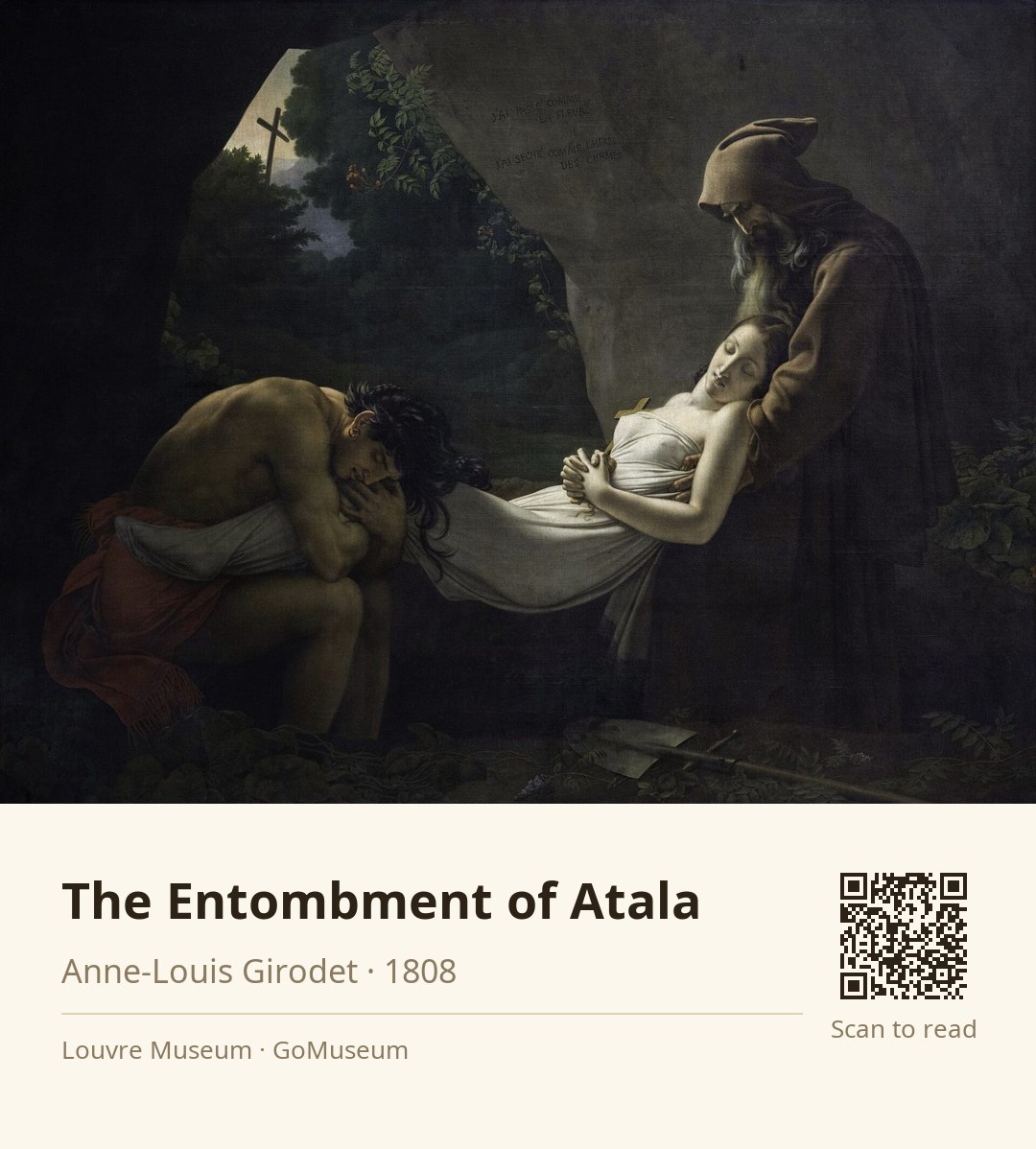
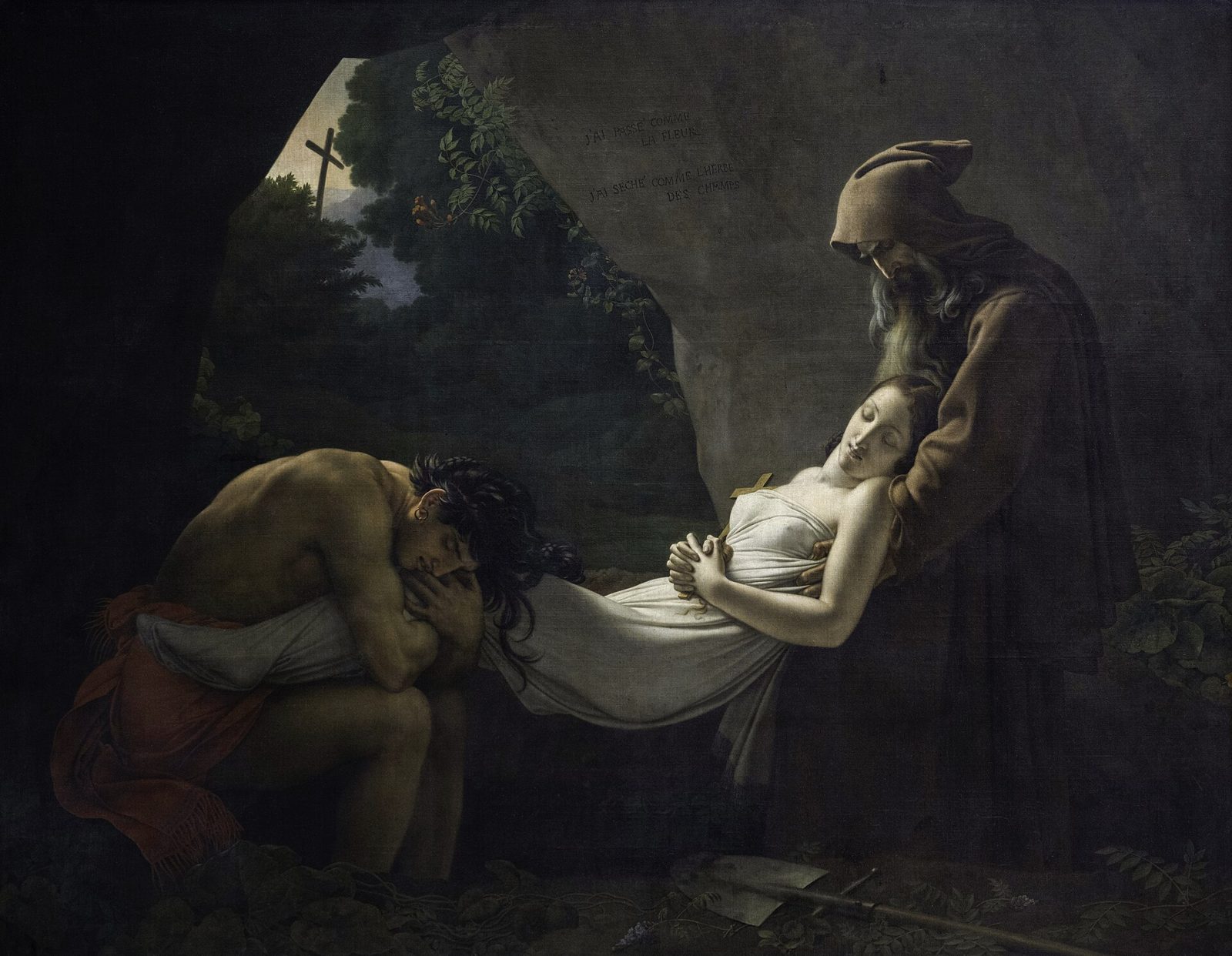
🎧 This work has audio narration — listen in the appTake a moment to really look at "The Entombment of Atala." Can you feel the weight of the moment? In the center, Atala lies in a white shroud, her face serene yet haunting, holding a crucifix as if in prayer. Notice how the light falls on her, almost ethereal, contrasting with the darkness of the cave around her.
This isn’t just a funeral scene; it’s a powerful statement about love and sacrifice. Atala’s tragic choice to end her life rather than betray her vow of chastity speaks volumes about the conflict between desire and duty. Girodet captures this tension beautifully, blending Neoclassical precision with Romantic emotion, making us feel the depth of her sorrow and the intensity of her love for Chactas, who clings to her legs in despair.
Created in 1808, this painting draws from Chateaubriand's novel, which was pivotal in reviving Christian themes in art during a time when secularism was on the rise. Girodet, a student of Jacques-Louis David, took a bold step away from the heroic ideals of his mentor, focusing instead on the raw, intimate emotions of his characters.
As you stand here, think about the moment captured in this painting. What does Atala’s choice say about the nature of love and sacrifice? How does it resonate with your own experiences of love and loss?
Anne-Louis Girodet de Roussy-Trioson, born on January 29, 1767, in Montargis, was a pivotal figure in the transition from Neoclassicism to Romanticism in French art. A talented pupil of Jacques-Louis David, he gained recognition for his precise style and innovative approach, incorporating elements of eroticism and emotional depth into his works. After losing both parents in his youth, he was adopted by his guardian, Dr. Benoît-François Trioson, whose influence shaped his career.
Girodet's artistic journey began with a focus on architecture before he shifted to painting, winning the prestigious Prix de Rome at just 22. His time in Italy profoundly impacted his style, leading to acclaimed works like "Endymion" and "Hippocrates Refusing the Gifts of Artaxerxes." Upon returning to France, he painted notable portraits, including members of the Bonaparte family, and won the decennial prize for "Scène du déluge."
Despite his success, Girodet faced personal challenges, including declining health in his later years. His final works, such as "Pygmalion and Galatea," reflected a deterioration in his artistic vigor. He passed away on December 9, 1824, in Paris, leaving behind a legacy that bridged classical ideals and Romantic sensibilities, influencing future generations of artists. His contributions were later celebrated in major exhibitions, affirming his place in art history.
This piece was first unveiled at the Salon of 1808, where it garnered significant acclaim, marking a pivotal moment in Girodet's career. The painting was later acquired by King Louis XVIII in 1818, solidifying its status as a masterpiece of the era. Its journey continued as it found a permanent home in the Louvre Museum in Paris, where it remains today. The work is deeply rooted in the themes of Chateaubriand's novel, Atala, which was published just a few years earlier in 1801. This novel played a crucial role in reviving Christian themes in art during a time when secularism was gaining ground, and Girodet's interpretation of Atala's tragic story resonated with audiences, reflecting the emotional and spiritual struggles of the period.
As you gaze at The Entombment of Atala, notice how Girodet masterfully blends Neoclassical precision with Romantic emotion. The brushwork is both meticulous and expressive, capturing the tension of the moment. The figures are arranged within the confines of a cave, creating an intimate yet dramatic composition. Atala, draped in a white shroud, is illuminated by a soft light that seems to emanate from her, contrasting starkly with the dark, shadowy background. This use of light not only highlights her serene expression but also imbues the scene with a sense of ethereal beauty. The careful handling of color enhances the emotional weight; the warm tones of Atala's skin juxtaposed against the cooler hues of the cave evoke a poignant sense of loss. The positioning of Chactas, clinging desperately to Atala's legs, adds to the painting's emotional depth, while the inscription on the cave wall serves as a haunting reminder of mortality. Girodet's technique here is a dance between the classical and the romantic, capturing the raw essence of grief and love.
This creative freedom allowed him to explore the emotional landscape of the characters, showcasing his ability to blend narrative and visual art in a way that was innovative for his time. Additionally, Girodet's work was not just a reflection of personal sentiment; it was also a response to the cultural climate of post-Revolutionary France, where artists were beginning to challenge the established norms of representation.
The painting was well received at its debut in the Salon of 1808, marking a significant moment in Girodet's career and establishing him as a notable artist of his time.