The Angels Kitchen
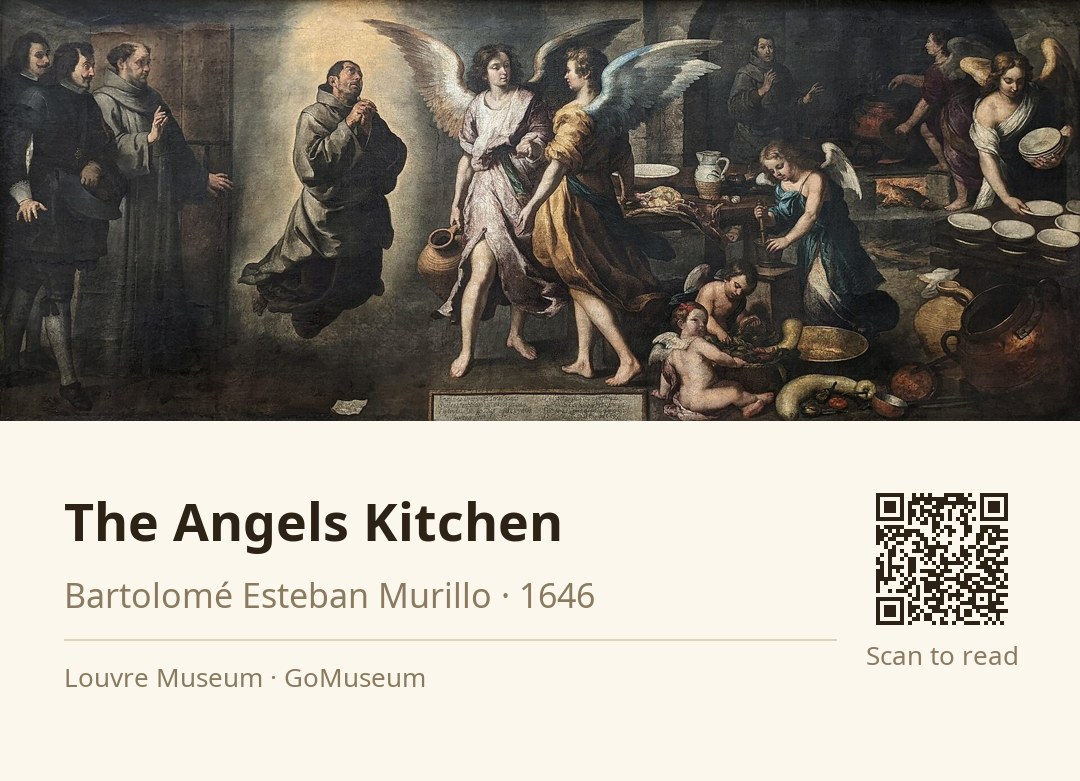
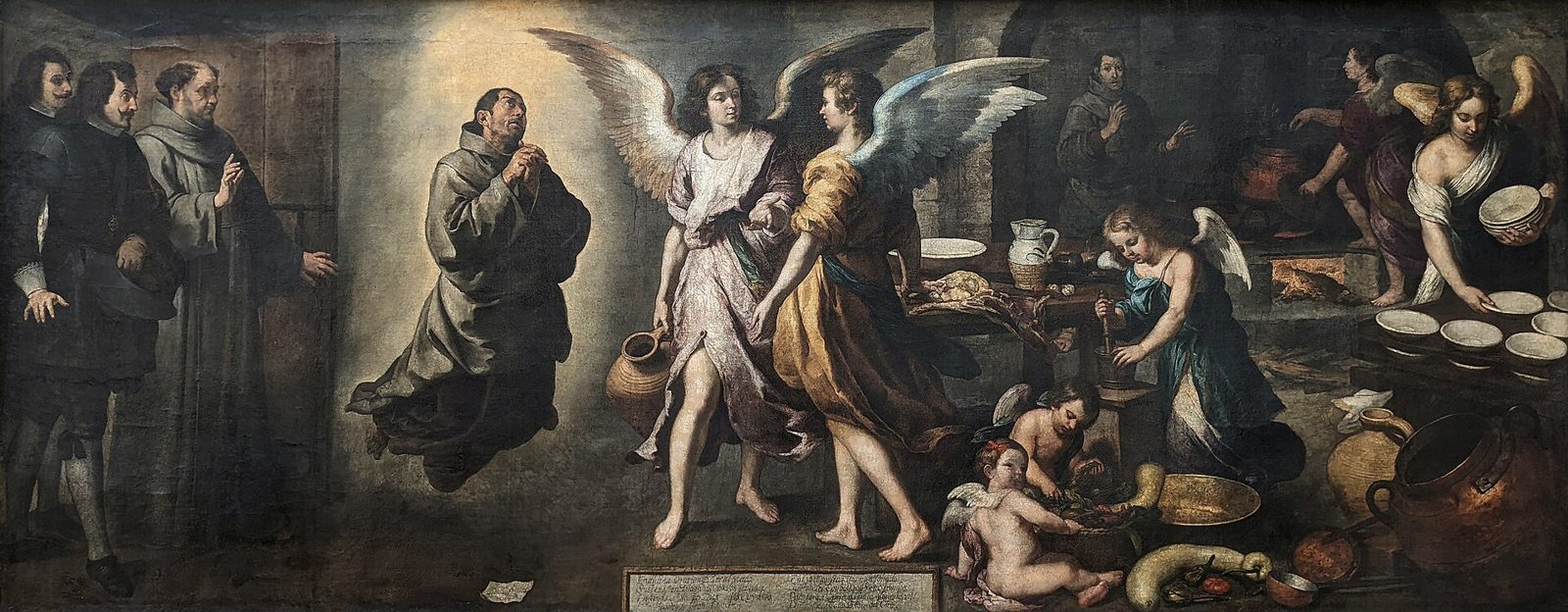
🎧 This work has audio narration — listen in the appA monk hovers in the air, surrounded by angels in a kitchen bustling with activity, as depicted in Murillo's "The Angels' Kitchen." To the left, the central figure, seemingly in ecstasy, is flanked by two angels; one cradles a basket while the other tends to a pot, suggesting divine intervention in mundane tasks. On the right, cherubs play with vegetables, adding a sense of whimsy to the sacred scene.
This depiction of levitation reflects a moment of miraculous grace, emphasizing the theme of divine assistance in the daily lives of the Franciscan monks. The muted palette and soft lighting create an intimate atmosphere, inviting viewers to contemplate the intersection of the earthly and the heavenly. The painting is not just a representation of a kitchen but a narrative of faith and devotion, illustrating how the monk, possibly Brother Francisco, experienced a moment of transcendence while his kitchen duties were performed by angels.
Commissioned for a Franciscan monastery in Seville, this work was part of a series that Murillo created to celebrate the lives of Franciscan saints.
Bartolomé Esteban Murillo was a prominent Spanish Baroque painter, born in Seville in late December 1617. Orphaned at a young age, he was raised by his sister and her husband, which fostered a close-knit family environment. Murillo began his artistic training under his uncle, Juan del Castillo, where he developed a realist style influenced by the tenebrism of Francisco de Zurbarán and the naturalism of Caravaggio. He married Beatriz Cabrera in 1645 and had ten children, though only five survived.
Murillo is celebrated for his religious works, particularly those commissioned by Franciscan convents, but he also gained fame for his genre paintings depicting the lives of the poor, including children and street urchins. His ability to capture the essence of everyday life set him apart from his contemporaries. He established an influential workshop in Seville and founded the Academy of Fine Arts, aiming to elevate the standards of artistic training.
Despite never leaving Seville, Murillo became a leading figure in the Spanish Golden Age, alongside Diego Velázquez and Francisco de Zurbarán. His legacy endures through his extensive body of work, which includes notable pieces in major museums like the Louvre and the Prado. Murillo died in 1682 after a fall while painting, leaving behind a rich artistic heritage that continues to resonate in the art world.
Murillo's 'The Angels' Kitchen' was painted in 1646, commissioned for a Franciscan monastery in Seville. This work was part of a larger series celebrating the lives of Franciscan saints, marking a significant moment in Murillo's career as it was his first major commission. The painting was originally displayed in the Alcázar of Seville, but after being looted by Marshal Soult during the Napoleonic Wars, it found its way to Paris. By 1858, it was acquired by the French state and has been housed in the Louvre ever since. The painting's provenance traces back to the heirs of Marshal Soult, showcasing its tumultuous journey through history.
Murillo employed oil on canvas to create 'The Angels' Kitchen,' skillfully manipulating the medium to evoke a sense of warmth and intimacy. The muted palette, dominated by earthy tones, enhances the painting's serene atmosphere, while the soft lighting draws attention to the central figure's levitation. The brushwork is delicate yet confident, allowing for a smooth transition between the figures and the background. The composition is thoughtfully balanced; the levitating monk captures the viewer's focus, flanked by angels engaged in various kitchen tasks. This horizontal division of the scene—earthly labor on one side and divine intervention on the other—breaks from traditional vertical arrangements, creating a dynamic interplay between the sacred and the mundane. Murillo's technique not only showcases his mastery but also invites contemplation on the intersection of daily life and divine grace.
Murillo's technique highlights his artistic skill while encouraging viewers to reflect on the relationship between everyday life and divine grace.