Saint Matthew and the Angel
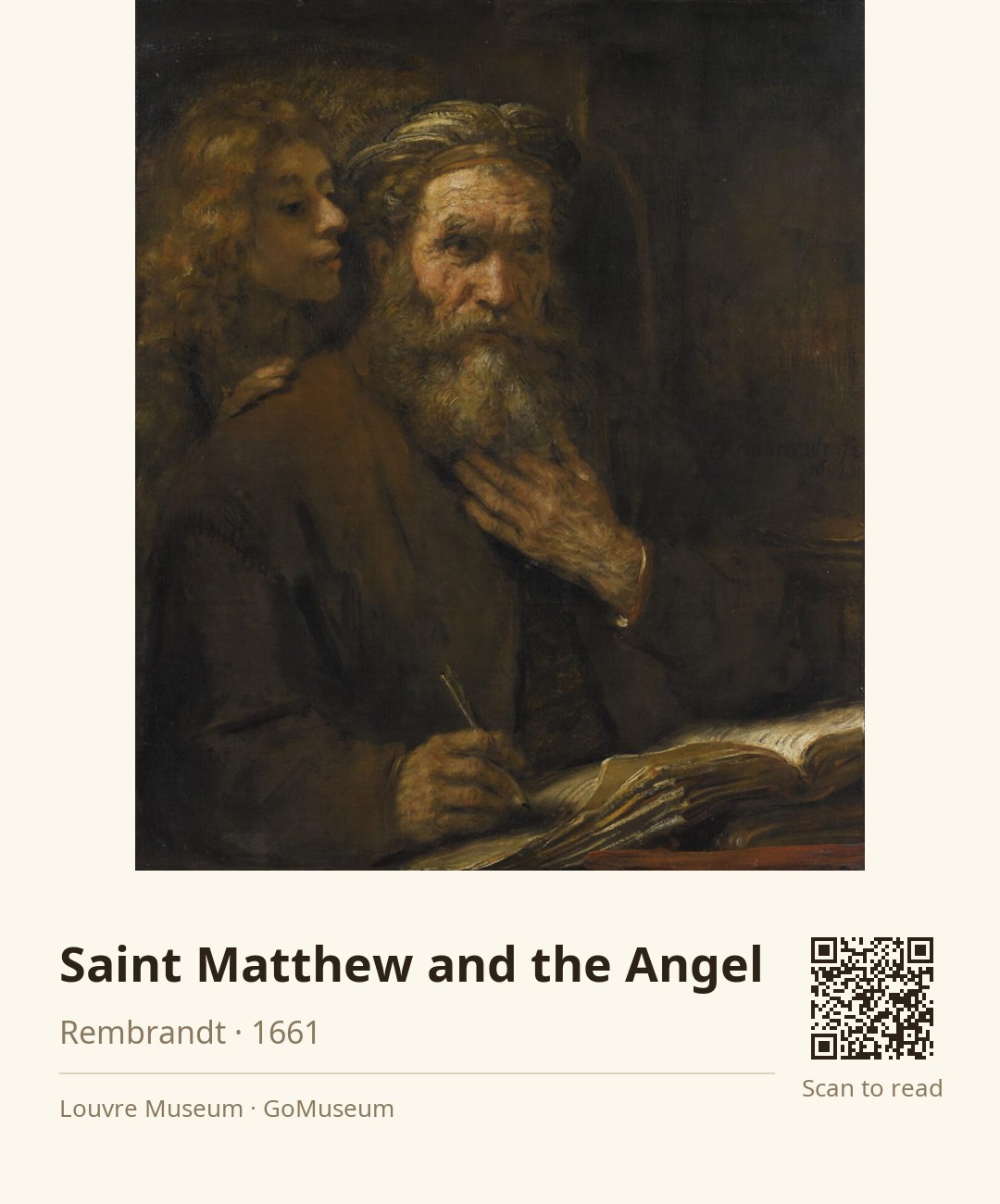
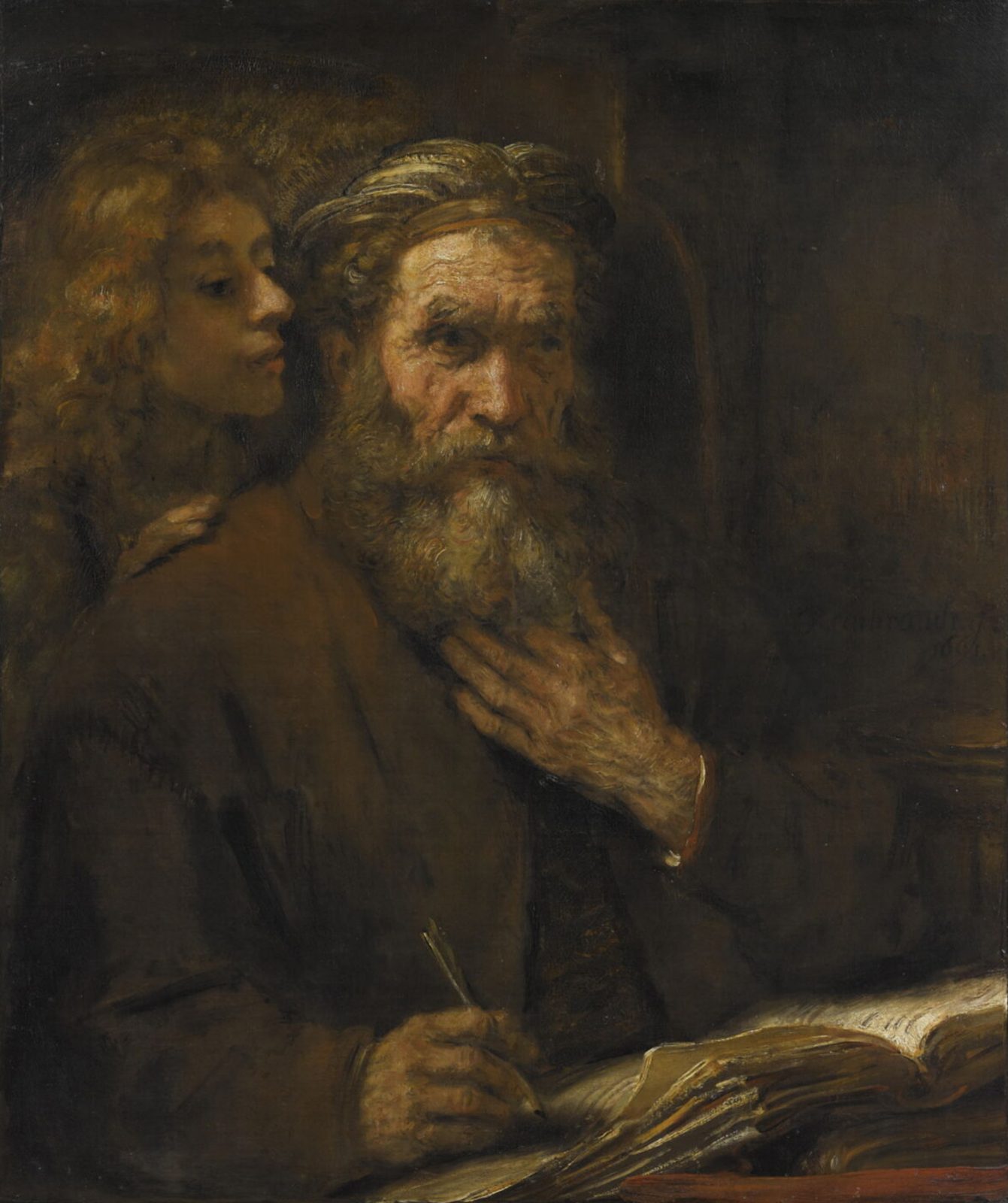
🎧 This work has audio narration — listen in the appTake a moment to really look at Rembrandt's "Saint Matthew and the Angel." Notice how Saint Matthew is captured in a moment of deep contemplation, his gaze drifting off into the distance. His unkempt beard and the loose, chestnut-brown robe give him a sense of authenticity, a man lost in thought rather than an idealized figure.
Now, focus on the angel beside him, with those rich, flowing curls and the gentle touch on Matthew's shoulder. This detail is crucial—it transforms the scene from mere writing to a divine collaboration, suggesting that inspiration comes from a higher power. It’s not just about Matthew’s task of recording the gospel; it’s about the connection between the earthly and the divine.
Created in 1661, during the Dutch Golden Age, this painting reflects Rembrandt’s mastery of light and shadow, a technique known as chiaroscuro. This approach not only adds depth but also emphasizes the emotional weight of the moment. Rembrandt was known for portraying biblical figures with a raw humanity, making them relatable and real.
As you stand here, think about what it means to be inspired. What thoughts or ideas do you feel are worth capturing in your own life?
Rembrandt Harmenszoon van Rijn, born on July 15, 1606, in Leiden, was a pivotal figure of the Dutch Golden Age and is celebrated as one of the greatest artists in Western art history. His oeuvre includes around three hundred paintings, three hundred etchings, and numerous drawings, showcasing a remarkable range of styles and subjects, from intimate portraits to grand historical and biblical scenes.
Rembrandt's artistic journey began in Leiden, where he was influenced by both Dutch and Italian masters. He opened his studio in 1625 and quickly gained recognition for his portrait work. His move to Amsterdam marked a significant turning point, as he became a sought-after portraitist and married Saskia van Uylenburgh, a union that brought both joy and tragedy. The couple faced immense personal losses, including the deaths of their children and Saskia's own passing in 1642, which deeply affected his work.
Despite financial struggles later in life, Rembrandt's innovative techniques, particularly in etching, transformed the medium into a respected art form. His mastery of light and shadow, known as chiaroscuro, and his empathetic portrayal of human experience set him apart from his contemporaries. Rembrandt's legacy endures through his profound ability to capture the complexities of the human condition, making him a cornerstone of art history.
Rembrandt's "Saint Matthew and the Angel" was painted in 1661 and is now housed in the Louvre. This artwork is a striking example of the Dutch Golden Age, showcasing Rembrandt's unique approach to biblical themes. The painting was first documented by Hofstede de Groot in 1914, who noted its composition and the emotional depth captured in Matthew's expression. Interestingly, it was influenced by earlier works, particularly one by Frans Hals, which depicted an angel as a guiding presence. The painting has been part of various collections and was mentioned in several catalogues over the years, highlighting its enduring significance in art history. Its journey to the Louvre reflects the appreciation and demand for Rembrandt's work, even centuries after it was created.
As you gaze at "Saint Matthew and the Angel," take a moment to appreciate Rembrandt's masterful use of chiaroscuro. Notice how the light dramatically illuminates Matthew's face, drawing your eye to his contemplative expression while the shadows envelop the background, creating a sense of depth and intimacy. The brushwork here is both loose and deliberate; you can almost feel the texture of the paint as it captures the folds of Matthew's robe and the delicate curls of the angel's hair. The composition is carefully structured, with Matthew positioned three-quarters to the right, inviting you into his moment of divine inspiration. This arrangement not only emphasizes the connection between the earthly and the celestial but also creates a dynamic tension that makes the scene feel alive. Rembrandt's choice of a life-size scale allows viewers to connect with the figures on a personal level, making the moment feel immediate and relatable.
Rembrandt's 'Saint Matthew and the Angel' is a pivotal work from the Dutch Golden Age, showcasing his mastery in religious art. This painting not only reflects the era's deep spiritual engagement but also highlights Rembrandt's innovative approach to storytelling through light and shadow. His unique use of chiaroscuro influenced countless artists, pushing them to explore emotional depth and human experience in their works. The way he captures the intimate moment between Matthew and the angel invites viewers to ponder the divine inspiration, making it a significant piece that continues to resonate in art history. Remember, this painting is more than just a depiction; it's a dialogue between the earthly and the divine, a theme that echoes through the ages.
One fascinating tidbit about 'Saint Matthew and the Angel' is that Rembrandt was inspired by an earlier work of Frans Hals, which influenced how he depicted the angel as more of an assistant rather than a distant divine figure. This choice adds a layer of intimacy to the scene, making it feel more like a conversation between friends than a mere religious moment. It’s a reminder that even the greatest artists draw from those who came before them, blending styles and ideas to create something uniquely their own.
Rembrandt faced significant personal tragedies, including the loss of his wife and children, which likely deepened his empathy and understanding of human suffering, allowing him to portray biblical figures with a raw, relatable humanity.
Rembrandt's brushwork in 'Saint Matthew and the Angel' is characterized by a combination of loose and deliberate strokes, which create a rich texture that enhances the emotional depth of the scene and invites viewers to engage with the physicality of the figures.