St Augustine in Ecstasy
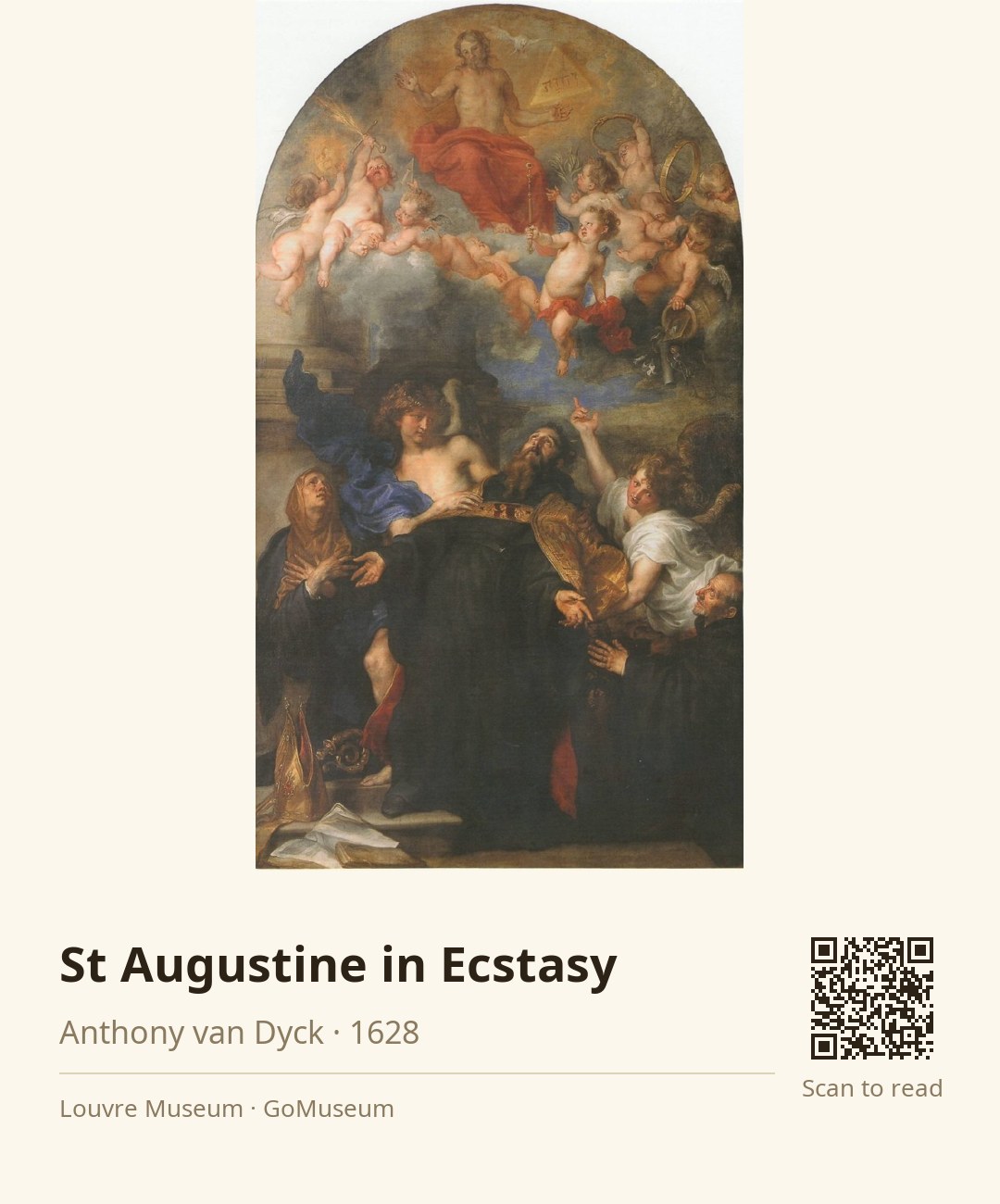
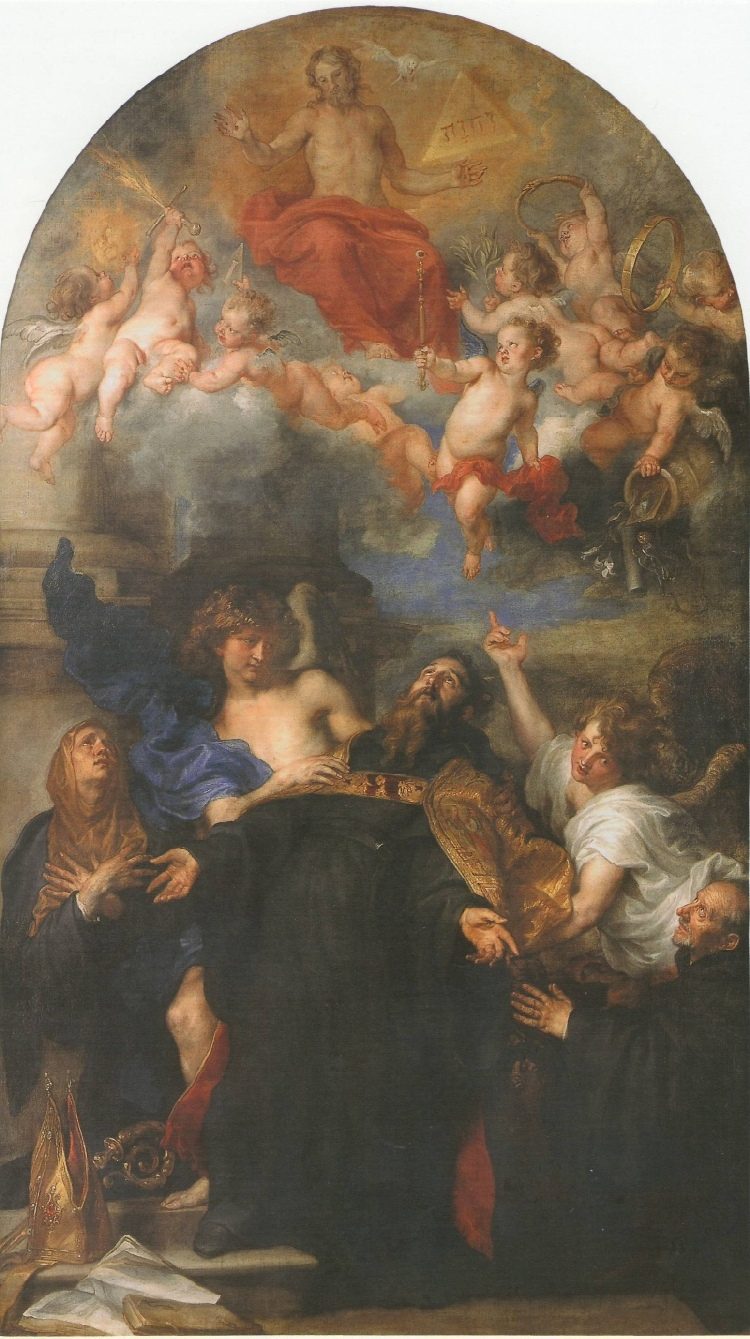
🎧 This work has audio narration — listen in the appSt. Augustine, seated regally on a red-draped throne, commands attention with his scepter in one hand and an open gesture in the other, as cherubs flit around him, holding a wreath and a staff. Above this celestial scene, a triangular symbol with an inscription hints at divine significance, while below, figures in varied poses gaze upward, their expressions a mix of reverence and curiosity.
This dynamic composition, rich in warm tones and swirling clouds, captures a moment of spiritual ecstasy, reflecting the profound influence of Baroque art on the viewer's emotions. The architectural elements in the background add depth, suggesting a heavenly realm that contrasts with the earthly figures below. Van Dyck's ability to blend the sacred with the human experience is evident here, as he invites the audience to witness a moment of divine revelation.
Created in 1628, "St. Augustine in Ecstasy" showcases Van Dyck's mastery of both religious themes and portraiture, a hallmark of his career that would later establish him as the leading court painter in England.
Sir Anthony van Dyck, born on March 22, 1599, in Antwerp, was a pivotal Flemish Baroque artist renowned for his portraits. As the seventh child of a wealthy silk merchant, his artistic talent emerged early, leading him to study under Hendrick van Balen and later become an assistant to the celebrated Peter Paul Rubens. By 1617, he was a master in the Guild of Saint Luke, establishing his independent workshop shortly thereafter.
Van Dyck's career flourished as he traveled to Italy, where he absorbed the styles of Titian and Veronese, and produced his acclaimed Iconography series. His return to England in 1632 as court painter to Charles I marked a significant turning point, as he became the leading portraitist of the English aristocracy, capturing the elegance and stature of his subjects with a relaxed sophistication that would influence portraiture for generations.
His innovative techniques in watercolor and etching, alongside his ability to blend mythological and biblical themes into his work, solidified his legacy. Van Dyck's impact on English art persisted long after his death on December 9, 1641, evident in the enduring popularity of the Van Dyke beard and his burial in St. Paul's Cathedral, a testament to his esteemed position in art history.
Augustine in Ecstasy' showcases his mastery of color and brushwork. The rich, warm palette creates a sense of warmth and spirituality, while the swirling clouds and flowing drapery give the painting a sense of movement and life. His brushwork is both precise and fluid, allowing for intricate details in the cherubs and the central figure. The composition is dynamic, with the figures arranged in a way that draws the viewer's eye towards St. Augustine, creating a focal point that commands attention. The architectural elements in the background not only add depth but also serve to elevate the celestial theme, contrasting the earthly figures below with the divine presence above. This careful orchestration of elements contributes to the painting's emotional impact, inviting viewers to engage with the spiritual narrative.
Van Dyck spent time in London in 1621, returned briefly to Flanders, and then traveled to Italy, primarily residing in Genoa until 1627.
During his time in Italy, Van Dyck created the Iconography series, which featured portrait etchings of various artists and notable contemporaries.
Van Dyck's legacy persists today, notably through the term 'Van Dyke beard,' which is named after him.