 Image: Nathanael Burton
Hunter Killing a Wild Boar
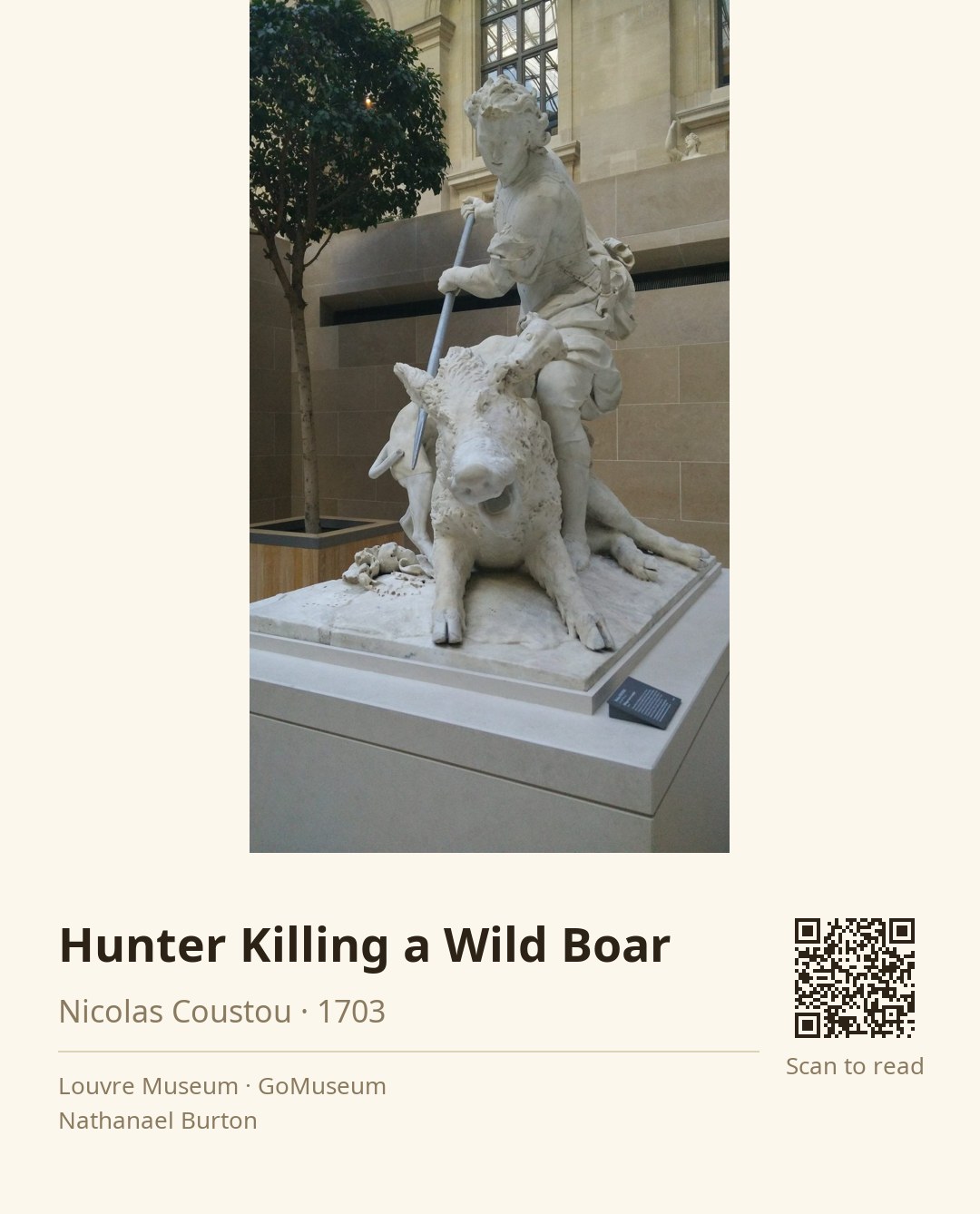
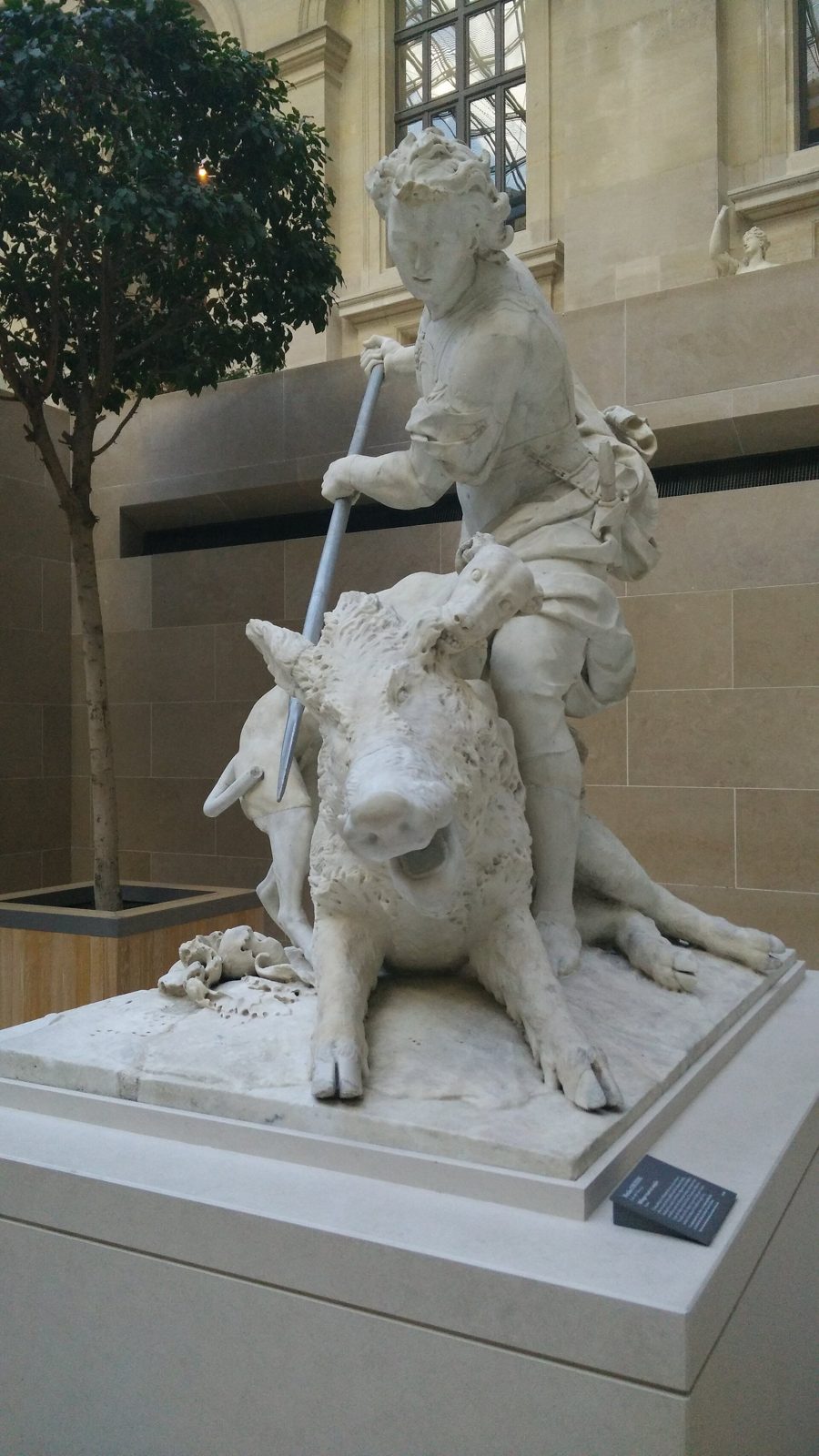
🎧 This work has audio narration — listen in the appThe fierce struggle between a man and a wild boar unfolds in this striking sculpture by Nicolas Coustou, created in 1703. The man, poised above the crouching boar, grips a spear tightly, his determined expression and curly hair bringing life to the moment. The boar snarls, its mouth wide open, while the intricate details of the man's tunic and the texture of the boar's fur showcase Coustou's exceptional skill in carving.
This dynamic scene captures a raw moment of tension and action, reflecting the artist's ability to convey movement and emotion through stone. The scattered elements at the base, resembling rocks or debris, enhance the sense of chaos in the struggle, while the tree in the background adds depth to the scene. Coustou's work is influenced by the dramatic styles of Michelangelo and Algardi, merging their best characteristics to create a vivid narrative in three dimensions.
Nicolas Coustou, born in Lyon in 1658, became a prominent figure in French sculpture, contributing significantly to the artistic landscape of his time. His career flourished as he worked on major projects for Louis XIV, including those at the palaces of Versailles and Marly.
Nicolas Coustou, born in Lyon on January 9, 1658, was a prominent French sculptor whose career flourished in the late 17th and early 18th centuries. Coming from a family of woodcarvers, he was initially trained by his father and later studied under his uncle, Antoine Coysevox, at the Académie royale de peinture et de sculpture in Paris. Coustou's talent was recognized early when he won the prestigious Colbert prize, allowing him to study at the French Academy in Rome.
His works, characterized by a blend of Michelangelo's dynamism and Algardi's elegance, include notable pieces such as "La Seine et la Marne" and "Daphne Pursued by Apollo." Despite the destruction of many of his sculptures during the French Revolution, his legacy endures through his remaining masterpieces in public collections, including the Louvre and Notre-Dame Cathedral. Coustou's collaborative efforts with his brother, Guillaume, often blurred the lines of authorship in their shared works.
As a respected figure in the art community, he served as rector and chancellor of the Academy, influencing the next generation of artists. Coustou passed away in Paris on May 1, 1733, leaving behind a significant mark on French sculpture and baroque art.
The lifelike texture of the boar's fur contrasts with the smoothness of the man's tunic, emphasizing the struggle between the two figures. You can see the meticulous attention to detail in the curls of the man's hair and the folds of his clothing, which add a sense of realism and movement. The base of the sculpture, scattered with elements that mimic rocks or debris, is not just decorative; it enhances the chaotic energy of the scene, grounding the figures in a dynamic environment.
Interestingly, Coustou was not just a solitary artist; he often collaborated with his brother, Guillaume Coustou, who was also a prominent sculptor. This partnership sometimes led to confusion over the attribution of their works, as they frequently shared ideas and techniques, blending their styles in ways that enriched the artistic landscape of their time.
Yes, he collaborated frequently with his brother, Guillaume Coustou, who was also a well-known sculptor.
Many of his works were destroyed during the French Revolution, but some notable pieces that remain include 'La Seine at la Marne' and 'Daphne Pursued by Apollo'.