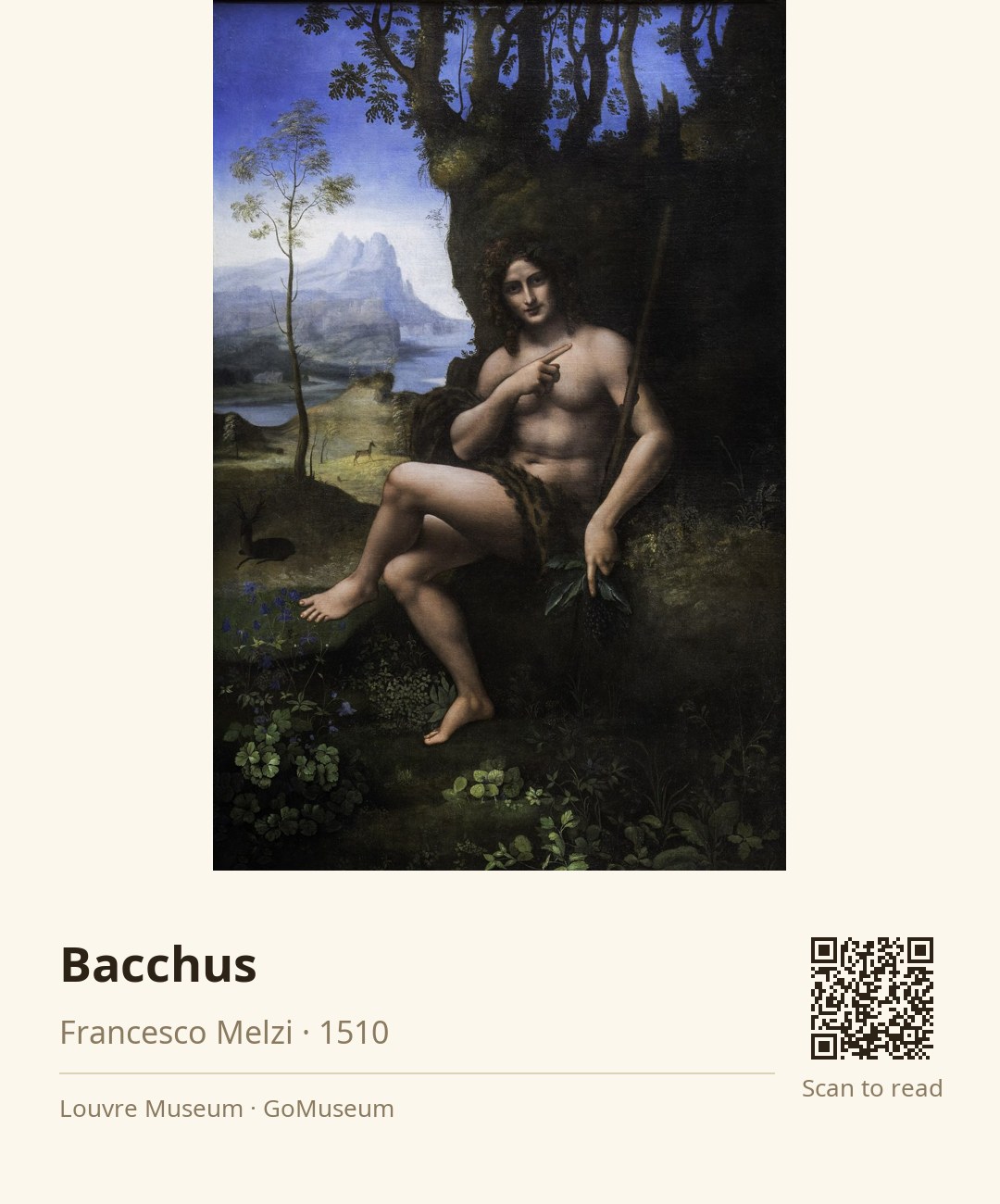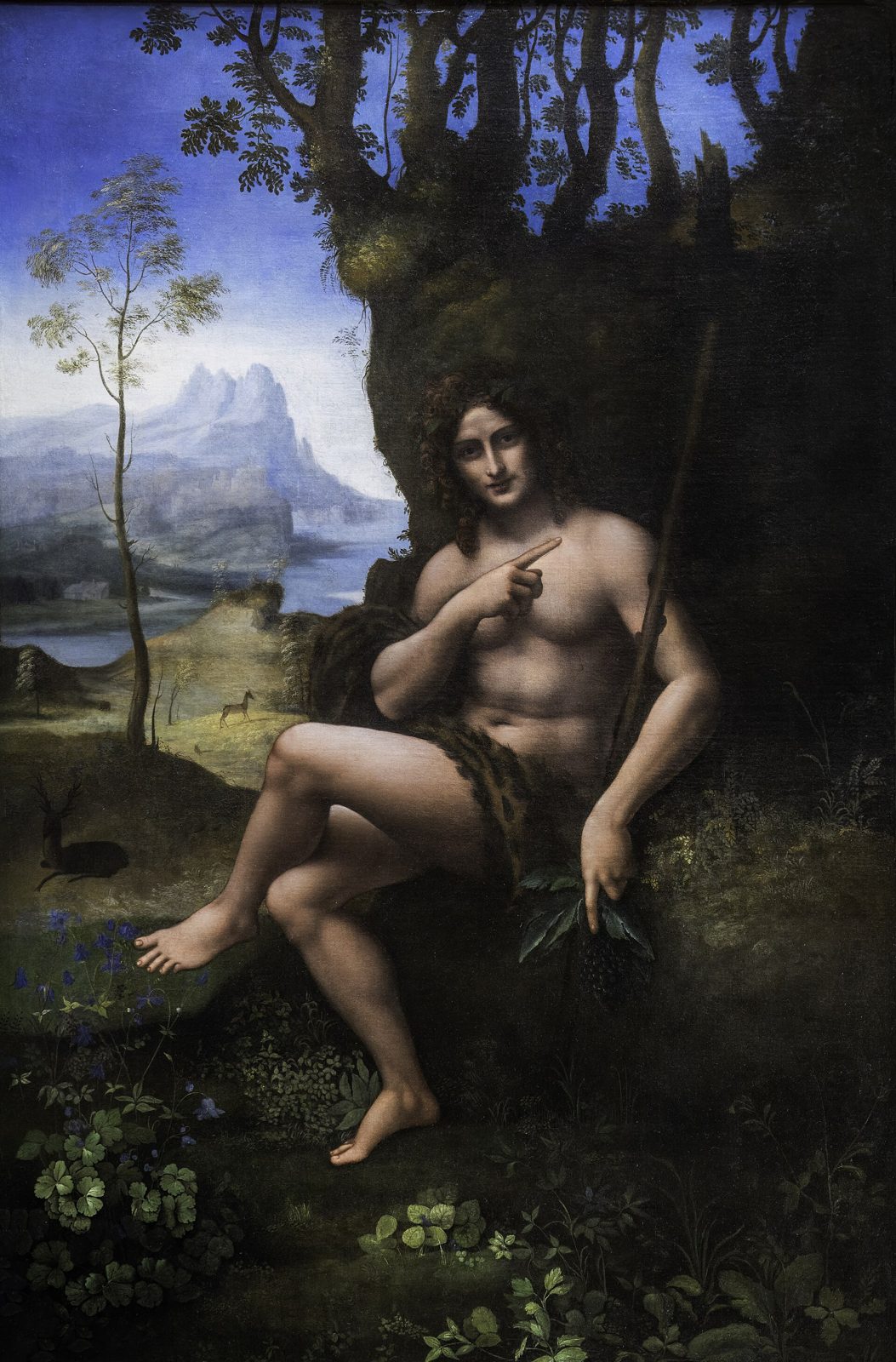
Take a moment to really look at Bacchus. Notice how the figure is adorned with a garland of vines, and the leopard skin draped across his body. These details are not just decorative; they tell a story of transformation. Originally painted as Saint John the Baptist, this artwork underwent a significant change in the late 17th century, morphing into Bacchus, the Roman god of wine.
The lush landscape surrounding him enhances this idea of indulgence and nature's bounty, inviting you to ponder the relationship between humanity and the divine.
Francesco Melzi, a pupil of Leonardo da Vinci, likely painted this piece in 1510, capturing the essence of Renaissance ideals—beauty, sensuality, and the interplay of light and shadow. As you stand here, think about the journey this painting has taken, from a religious icon to a celebration of hedonism. What emotions does Bacchus evoke in you?
Francesco Melzi, born in 1491 in Milan, was an Italian painter of the Renaissance, closely associated with Leonardo da Vinci. Coming from a noble family, he was well-educated and charming, traits that endeared him to Leonardo, who became his mentor around 1505. Melzi was not only Leonardo's favorite pupil but also his devoted assistant, accompanying him throughout Italy and France until Leonardo's death in 1519. Following this loss, Melzi took on the significant role of literary executor, meticulously compiling Leonardo's notes into the Codex Urbinas, which later influenced the posthumous publication of the Treatise on Painting.
Despite his talent, Melzi's career was overshadowed by his master, leading to a lack of recognition. He produced a limited body of work, with only a few paintings attributed to him, including the signed "Young Man with a Parrot." After returning to Italy, he married and had eight children, one of whom inherited Leonardo's manuscripts. Melzi's life reflects the challenges faced by artists in the shadow of greater masters, yet his dedication to preserving Leonardo's legacy secures his place in art history as a crucial link to one of the greatest artists of all time. He died around 1570, leaving behind a legacy intertwined with that of Leonardo.
Originally created as 'Saint John the Baptist', it was likely commissioned during the early 16th century, around 1510, while Francesco Melzi was working in Leonardo da Vinci's workshop. This collaboration with Leonardo, a towering figure in art, set the stage for Melzi's future endeavors. The painting was first documented in 1625 by Cassiano dal Pozzo, who noted its striking departure from traditional depictions of the saint. However, it wasn't until the late 17th century, between 1683 and 1693, that the painting underwent a significant transformation. It was overpainted to reflect Bacchus, the Roman god of wine, complete with a thyrsus and a vine wreath. This alteration marked a shift in the painting's identity, moving from a religious icon to a celebration of hedonism. Today, it resides in the Musée du Louvre, Paris, a testament to its enduring legacy and the evolving tastes of art collectors and patrons over the centuries.
Standing before 'Bacchus', you can't help but notice the vibrant colors and the way the light dances across the figure. Melzi's brushwork is both delicate and bold, creating a sense of movement that feels almost alive. The lush greens and earthy tones of the landscape contrast beautifully with the rich reds and golds of Bacchus's attire, drawing your eye to the figure at the center. Notice how the composition is structured; Bacchus is seated, yet he seems to reach out to the viewer, inviting you into his world of indulgence. The thyrsus in his left hand, with its twisting vines, adds a dynamic element, suggesting both festivity and chaos. The way Melzi handles light—softly illuminating Bacchus's face while casting shadows in the background—creates depth and drama, enhancing the emotional impact of the piece. This interplay of light and shadow is a hallmark of Renaissance painting, reflecting the ideals of beauty and sensuality that were so important during this period.
Originally depicting Saint John the Baptist, this painting underwent a transformation that shifted its identity to that of Bacchus, the Roman god of wine. This change not only reflects the fluidity of artistic interpretation during the Renaissance but also highlights Melzi's connection to Leonardo da Vinci, whose influence looms large over his work. Melzi, as Leonardo's closest pupil, helped preserve and disseminate his master's ideas, ensuring that the innovations of the High Renaissance would echo through the ages. Remember, this piece is more than just a painting; it's a testament to the evolving nature of art and the enduring impact of its creators.
Did you know that this painting, originally depicting Saint John the Baptist, underwent a significant transformation in the late 17th century? Between 1683 and 1693, it was overpainted to become Bacchus, the Roman god of wine. The long-handled cross of the Baptist was cleverly converted into a thyrsus, a staff associated with Bacchus, and a vine wreath was added to complete the metamorphosis. This change not only altered the identity of the figure but also shifted the entire narrative of the artwork, turning a solemn religious icon into a celebration of hedonism and nature's bounty.
Salaì, a pupil of Leonardo da Vinci and a close companion of Melzi, is believed to have been the model for both Saint John the Baptist and Bacchus. His androgynous features and youthful beauty likely influenced the sensual portrayal of Bacchus, which deviated from traditional depictions.
There are a few copies of Bacchus attributed to artists from Leonardo's circle, including one by Bernardino Lanino, which depicts Saint John the Baptist in a different setting. These copies highlight the influence of Melzi's original work and its adaptation by other artists, showcasing the painting's enduring legacy.