Sacred and Profane Love
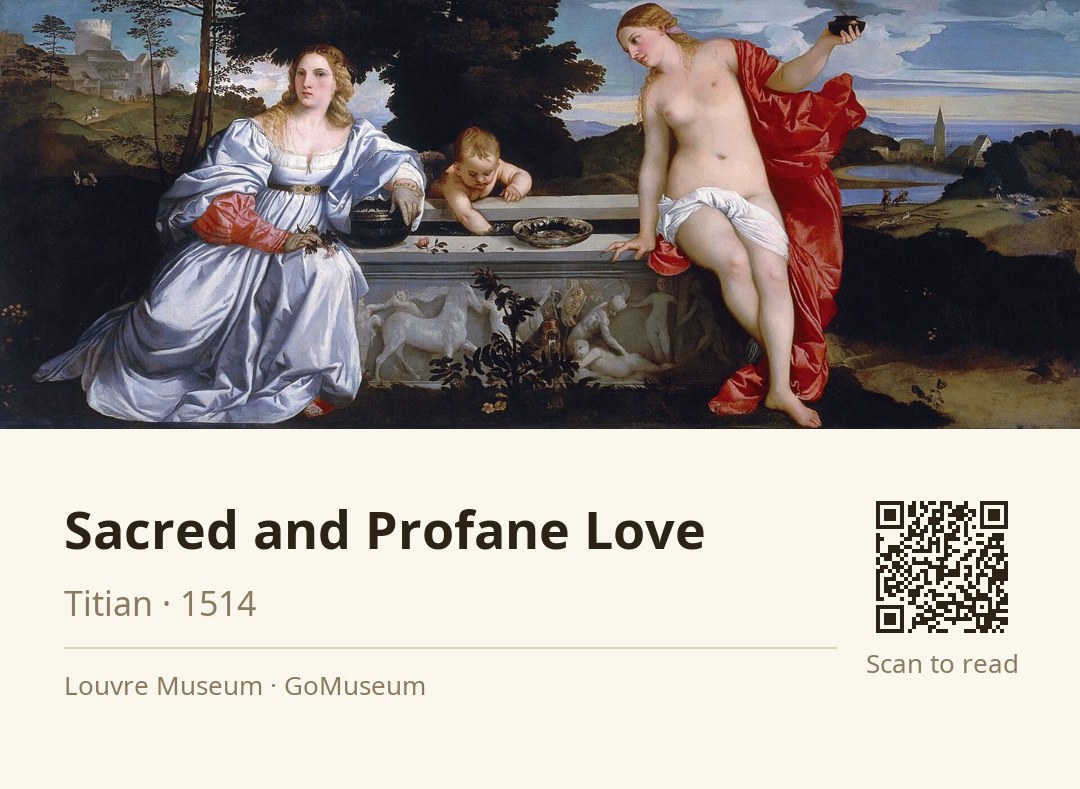
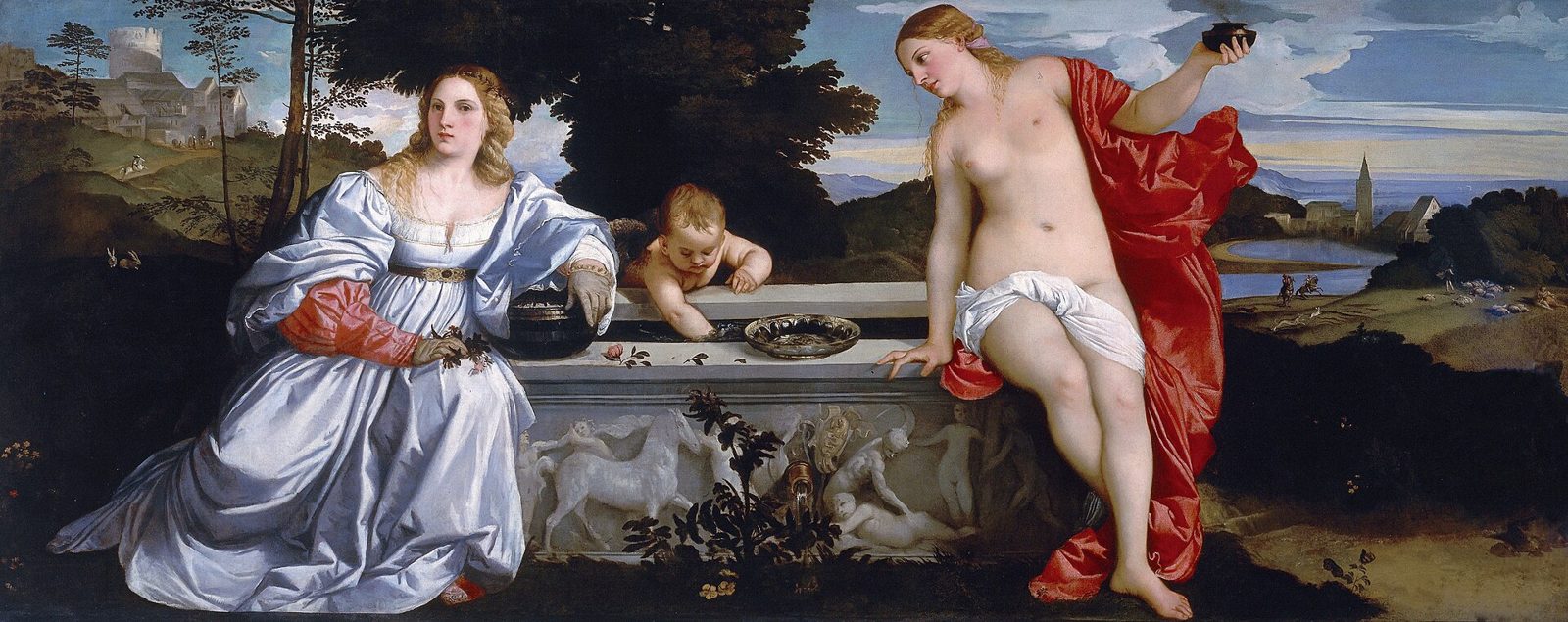
🎧 This work has audio narration — listen in the appTake a moment to really look at Titian's "Sacred and Profane Love." Notice how the two women, seemingly identical, sit on a Roman sarcophagus turned fountain. The woman on the left, dressed in a flowing white gown, is adorned with myrtle, a symbol of love and marriage, while the nude figure to her right drapes herself in a red mantle, holding an incense burner that releases wisps of smoke.
These details matter because they embody the duality of love—sacred versus profane. The clothed woman represents the sanctity of marriage, while the nude figure embodies earthly desire. This contrast invites us to ponder the complexities of love and relationships, especially in the context of the painting's commission for a wedding.
Created around 1514, this piece was likely commissioned by Niccolò Aurelio to celebrate his marriage to Laura Bagarotto. Titian, at this early stage of his career, was already exploring profound themes through rich symbolism and vibrant color, setting the stage for his later masterpieces.
As you stand here, consider: what does love mean to you? Are these two forms of love truly separate, or do they intertwine in our lives?
Titian, born Tiziano Vecellio around 1488 in Pieve di Cadore, was a pivotal figure in the Italian Renaissance, particularly in Venetian painting. Renowned for his versatility, he excelled in portraits, landscapes, and mythological themes, becoming a sought-after artist among patrons, including the Habsburgs and the papacy. His innovative use of color and brushwork transformed the art of painting, liberating it from the rigid constraints of line and form that characterized earlier periods.
Titian's career began in Venice, where he trained under notable masters such as Giovanni Bellini and Giorgione. His early works reflected the influence of these artists, but he quickly developed a distinctive style that emphasized color and emotional depth. His masterpiece, "Assumption of the Virgin," showcased his ability to blend religious themes with dynamic composition, setting a new standard in Christian art.
Throughout his life, Titian's artistic evolution mirrored his personal experiences, including the loss of his wife and the challenges of his time. He became a prominent portraitist, capturing the essence of his subjects with remarkable realism. His legacy endures, influencing countless artists and solidifying his place as one of the greatest painters in Western art history. Titian passed away in 1576, leaving behind a rich body of work that continues to inspire and captivate audiences today.
Titian's 'Sacred and Profane Love' was likely commissioned around 1514 by Niccolò Aurelio, a secretary to the Venetian Council of Ten. This painting was meant to celebrate his marriage to Laura Bagarotto, a young widow. The coat of arms of Aurelio is prominently displayed on the sarcophagus, which adds a personal touch to the work. Initially recorded in an inventory in 1693, the title 'Sacred and Profane Love' may not reflect the original intent of the artist. Over the centuries, it has sparked extensive debate among art historians regarding its iconography and meaning, with many interpretations still contested today.
As you gaze at 'Sacred and Profane Love,' notice the masterful use of color and light that Titian employs. The contrast between the richly dressed woman on the left and the nude figure on the right is striking. Titian's brushwork feels both fluid and dynamic, capturing the softness of fabric and the smoothness of skin with equal finesse. The composition is carefully structured, with the sarcophagus serving as a central element that divides the two figures, yet also connects them through the flowing water. The landscape behind each woman enhances their contrasting themes: the serene, walled castle behind the clothed figure versus the more chaotic, hunting scene behind the nude. This interplay of light and shadow not only highlights the figures but also evokes a sense of depth and emotion, drawing you into the narrative of love's duality.
One curious aspect of 'Sacred and Profane Love' is the ambiguity surrounding the identity of the central figures. While many art historians agree that the clothed woman represents sacred love and the nude figure embodies profane love, the exact identities of these women remain a topic of debate. Some suggest that the clothed figure may represent the bride, while others propose she could symbolize a more abstract concept of virtue. This uncertainty adds a layer of intrigue to the painting, inviting viewers to interpret the figures in their own way.
The sarcophagus in 'Sacred and Profane Love' is actually a water trough, which is an anachronistic element, as the broad ledges seen here are not typical of real Roman sarcophagi. This creative adaptation adds a layer of intrigue to the work, blurring the lines between life and death, and between the sacred and the profane.
Critics have pointed out that the clothed woman's pose appears strange, as her lower body seems lost in her drapery and does not conform to her upper half. This anatomical inconsistency raises questions about Titian's early technique and his evolving mastery of the human form.