Venus Blindfolding Cupid
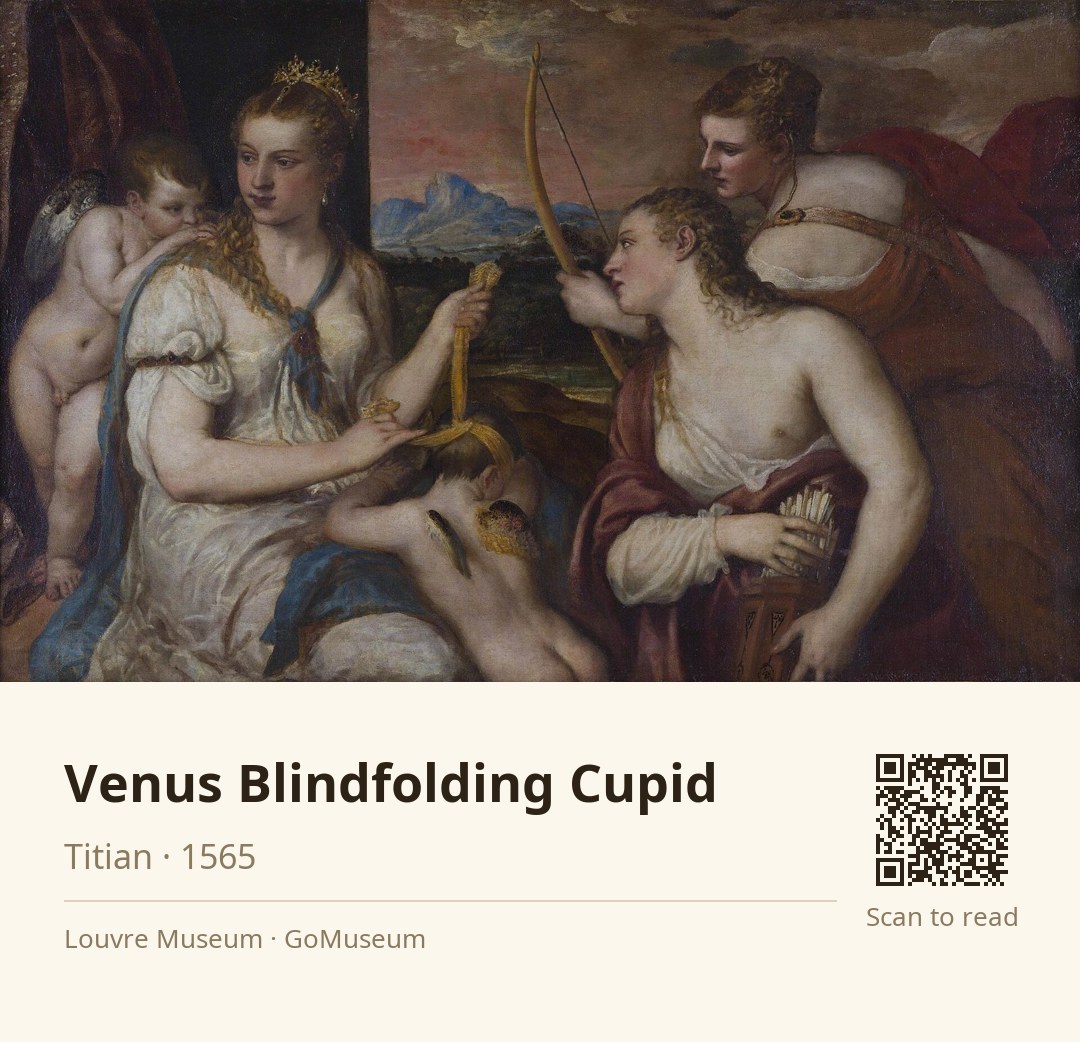
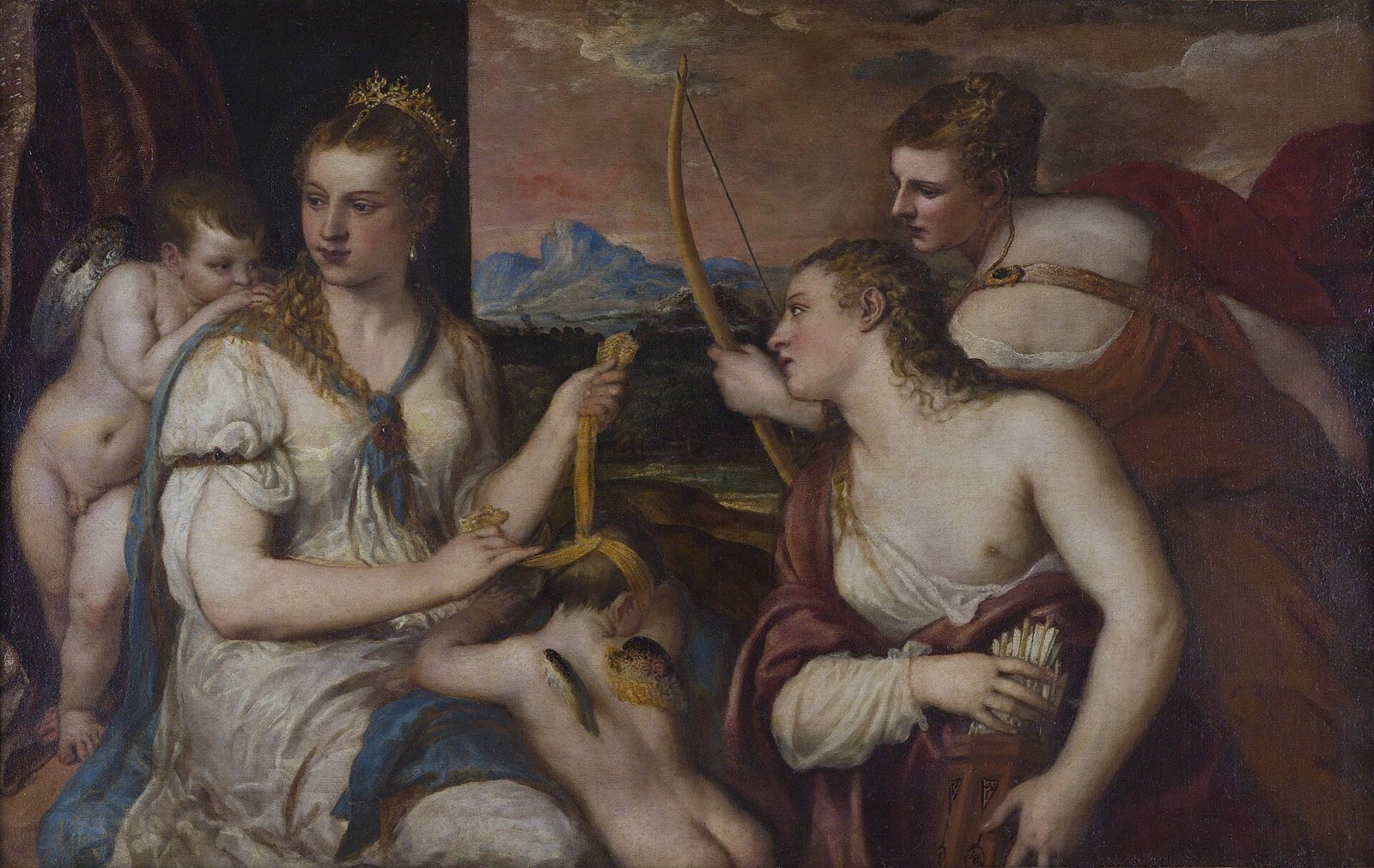
🎧 This work has audio narration — listen in the appTake a moment to really look at Titian's "Venus Blindfolding Cupid." Notice how Venus, the goddess of love, gently ties a blindfold around Cupid’s eyes. Her expression is both tender and playful, as if she’s teasing him about the unpredictability of love.
Now, focus on the delicate drapery of her gown. The light fabric contrasts beautifully with the rich, dark background, drawing your eye to her figure. This interplay of light and shadow is a hallmark of Titian’s style, showcasing his mastery of color and texture.
These details matter because they reveal Titian's deep understanding of human emotion and the complexities of love. By blindfolding Cupid, Venus suggests that love is often blind, a theme that resonates through art and literature even today.
Created around 1565, this painting reflects the height of the Venetian Renaissance, a time when artists like Titian were celebrated for their innovative techniques and emotional depth.
As you stand here, think about the last time you felt love's unpredictability. How does this painting capture that feeling for you?
Titian, born Tiziano Vecellio around 1488 in Pieve di Cadore, was a pivotal figure in the Italian Renaissance, particularly in Venetian painting. Renowned for his versatility, he excelled in portraits, landscapes, and mythological themes, becoming a sought-after artist among patrons, including the Habsburgs and the papacy. His innovative use of color and brushwork transformed the art of painting, liberating it from the rigid constraints of line and form that characterized earlier periods.
Titian's career began in Venice, where he trained under notable masters such as Giovanni Bellini and Giorgione. His early works reflected the influence of these artists, but he quickly developed a distinctive style that emphasized color and emotional depth. His masterpiece, "Assumption of the Virgin," showcased his ability to blend religious themes with dynamic composition, setting a new standard in Christian art.
Throughout his life, Titian's artistic evolution mirrored his personal experiences, including the loss of his wife and the challenges of his time. He became a prominent portraitist, capturing the essence of his subjects with remarkable realism. His legacy endures, influencing countless artists and solidifying his place as one of the greatest painters in Western art history. Titian passed away in 1576, leaving behind a rich body of work that continues to inspire and captivate audiences today.
Titian's "Venus Blindfolding Cupid" was created around 1565, a time when the Venetian Renaissance was in full bloom. While the exact details of its commission remain shrouded in mystery, some speculate that it was commissioned by Antonio Pérez, a secretary to King Philip II of Spain. The painting eventually found its way into the collection of Cardinal Paolo Emilio Sfondrati, who sold it to Cardinal Scipione Caffarelli-Borghese in 1608. This work has been part of the Galleria Borghese in Rome since then. Interestingly, it was once owned by Cornelis van der Geest, a notable collector, and can be seen in two paintings by Willem van Haecht that depict his art gallery in the 1630s. Over the years, the painting has undergone significant restoration, particularly between 1992 and 1993, to restore its chromatic value without altering its original canvas or frame.
As you gaze at "Venus Blindfolding Cupid," take a moment to appreciate Titian's masterful brushwork. The way he layers paint creates a sense of depth and texture, especially in Venus's delicate gown, which seems to flow and shimmer with life. Notice how the light plays across her figure, contrasting with the dark background that envelops the scene. This interplay of light and shadow not only highlights her form but also enhances the emotional undertone of the painting. The composition is carefully structured, with a horizontal layout that draws your eye across the canvas, from Venus on the left to the nymphs on the right. The almost symmetrical arrangement of figures creates a harmonious balance, while the slight asymmetry in their poses adds a dynamic quality. Titian's choice of colors, particularly the soft whites and rich reds, evokes a sense of warmth and intimacy, inviting you to linger in this moment of playful affection.
One intriguing aspect of "Venus Blindfolding Cupid" is that it has been copied many times throughout history, reflecting its popularity and the admiration it garnered. This speaks to the painting's impact and the way it captured the imagination of both artists and art lovers alike, ensuring that its themes of love and playfulness would echo through the ages.
The almost symmetrical arrangement of figures creates a harmonious balance, while the slight asymmetry in their poses adds a dynamic quality, drawing the viewer into the playful interaction between Venus and Cupid.
Significant restoration occurred between 1992 and 1993, focusing on removing layers of paint and oily substances that had diminished its chromatic value, while ensuring the original canvas and frame remained intact.