Saint John the Baptist
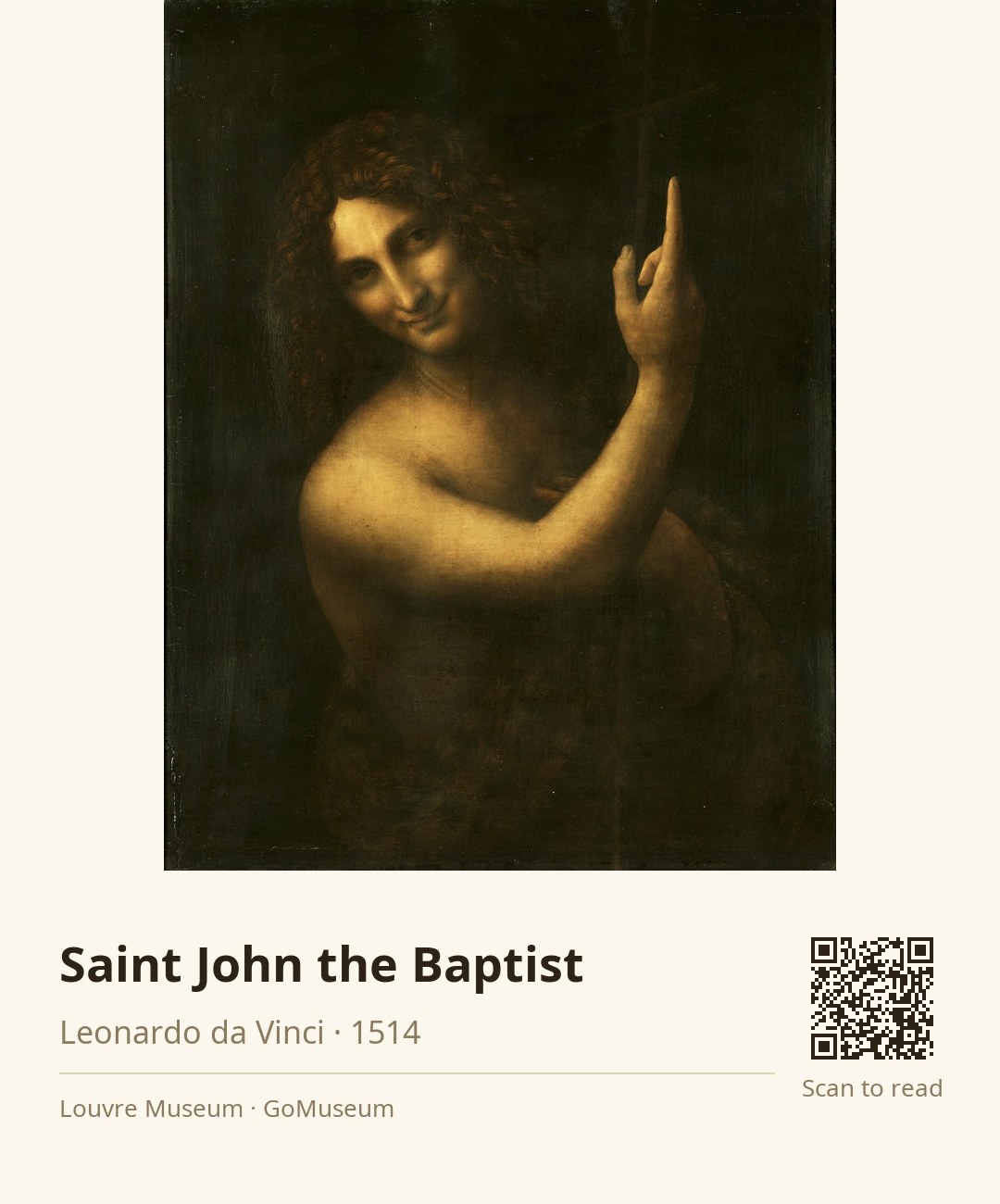
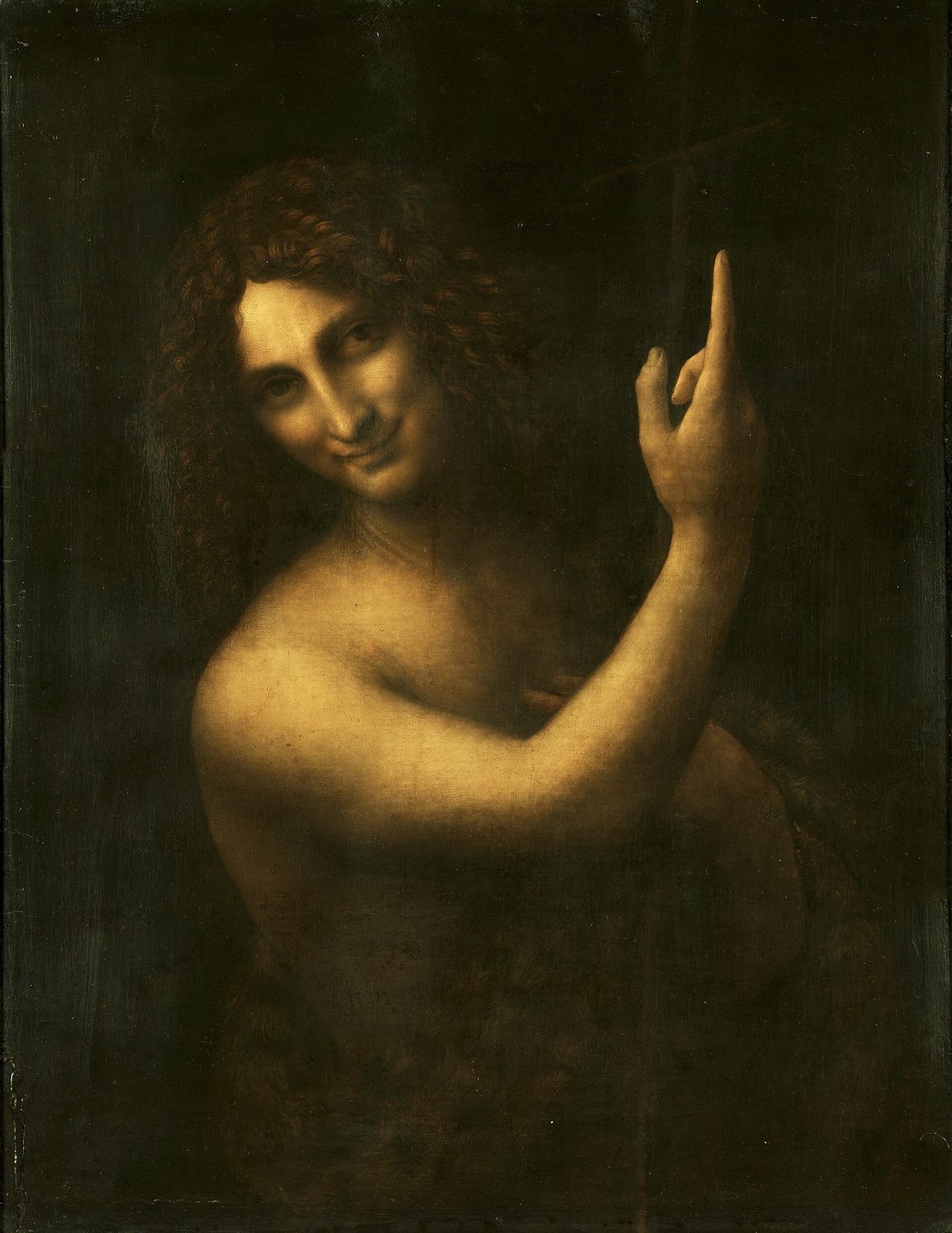
🎧 This work has audio narration — listen in the appAs you stand before Leonardo da Vinci's "Saint John the Baptist," take a moment to really absorb the figure emerging from the shadows. Notice how the soft, almost ethereal light caresses his face and torso, creating a striking contrast against the dark background. This technique, known as chiaroscuro, is a hallmark of Leonardo's mastery, allowing the saint to almost float in space, inviting you into his enigmatic world.
Now, look closely at his expression—there’s a subtle smile that echoes the famous Mona Lisa. This ambiguity is intentional; it draws you in, making you ponder the deeper meanings behind his gaze. Leonardo's use of sfumato here gives Saint John an almost androgynous quality, blurring the lines between the physical and the spiritual. This isn’t just a portrait; it’s a meditation on the nature of existence, the interplay of light and shadow representing the eternal questions of life and faith.
Created around 1514, this painting is believed to be one of Leonardo's last works, a culmination of his artistic journey. It reflects not only his technical prowess but also his philosophical inquiries into humanity and divinity. The figure of Saint John, with his reed cross pointing heavenward, embodies the quest for enlightenment and grace.
As you take in this remarkable piece, consider: what mysteries does Saint John hold for you? What questions about life and spirituality does his enigmatic smile provoke? Let this moment linger, and allow the painting to speak to you in its own unique way.
Leonardo da Vinci, born on April 15, 1452, in Vinci, Italy, was a quintessential figure of the High Renaissance, renowned for his multifaceted genius as a painter, scientist, and inventor. Raised by his grandparents after being born out of wedlock, he received artistic training under Andrea del Verrocchio in Florence. His career flourished in Milan under Ludovico Sforza, where he produced iconic works like "The Last Supper" and began his extensive studies in anatomy and engineering.
Leonardo's notebooks reveal a relentless curiosity, encompassing subjects from botany to mechanics, showcasing his innovative spirit. Despite creating fewer than 25 major works, his influence on Western art is profound, with the "Mona Lisa" standing as a cultural icon. His visionary designs for flying machines and other inventions, though largely unfeasible in his time, reflect a forward-thinking approach that laid groundwork for future scientific exploration.
In his later years, he moved to France, where he continued to work until his death in 1519. Leonardo's legacy endures as a symbol of the Renaissance ideal, blending art and science, and inspiring generations with his empirical observations and artistic mastery. His life and work remain a testament to the boundless potential of human creativity.
Believed to have been completed between 1513 and 1516, this work is often regarded as one of Leonardo's final masterpieces. Initially, it was likely part of the collection of King Francis I of France by 1542, showcasing its royal pedigree. The painting later passed to King Charles I of England in 1625, who received it as a gift from Louis XIII of France, trading it for other notable works. After the tumultuous events surrounding Charles's execution in 1649, the painting changed hands several times before finding its way back to France, where it was acquired by Louis XIV. Following the French Revolution, it became part of the Louvre's collection, where it remains today. This rich provenance reflects not just the painting's artistic value but also its cultural significance across centuries and borders.
As you gaze at 'Saint John the Baptist,' take a moment to appreciate the extraordinary techniques Leonardo employed. The painting is a masterclass in chiaroscuro, where light and shadow dance across the figure, creating a three-dimensional effect that draws you in. Notice how the soft, delicate brushwork gives the saint an almost ethereal quality, as if he is emerging from the darkness of the background. Leonardo's use of sfumato—blurring the edges and softening the transitions between colors—adds to the ambiguity of Saint John's expression, making it both inviting and elusive. The composition is carefully structured, with the figure's pose echoing classical ideals while still feeling fresh and innovative. The scale, at 69 by 57 centimeters, allows for an intimate viewing experience, inviting you to engage with the saint on a personal level. Each stroke of paint seems deliberate, as if Leonardo was not just painting a figure, but capturing a moment of divine revelation.
Prior to this work, depictions of Saint John often leaned towards the ascetic and gaunt. However, Leonardo's portrayal introduced a more humanized and youthful saint, influencing artists like Raphael and Giulio Romano, who adopted similar approaches in their own works. This painting also exemplifies the High Renaissance's exploration of the human condition, blending spirituality with a tangible sense of humanity.
One surprising aspect of 'Saint John the Baptist' is its journey through royal collections. Originally part of King Francis I of France's collection, it was traded to King Charles I of England in exchange for a Titian painting. After Charles's execution, the painting changed hands multiple times, eventually ending up with a banker before returning to France under Louis XIV.
Leonardo's portrayal of a youthful and humanized Saint John influenced contemporaries like Raphael and Giulio Romano, who adopted similar representations in their works. This shift marked a significant change in how religious figures were depicted, moving towards a more relatable and less ascetic portrayal.