Study (Young Male Nude Seated Beside the Sea)
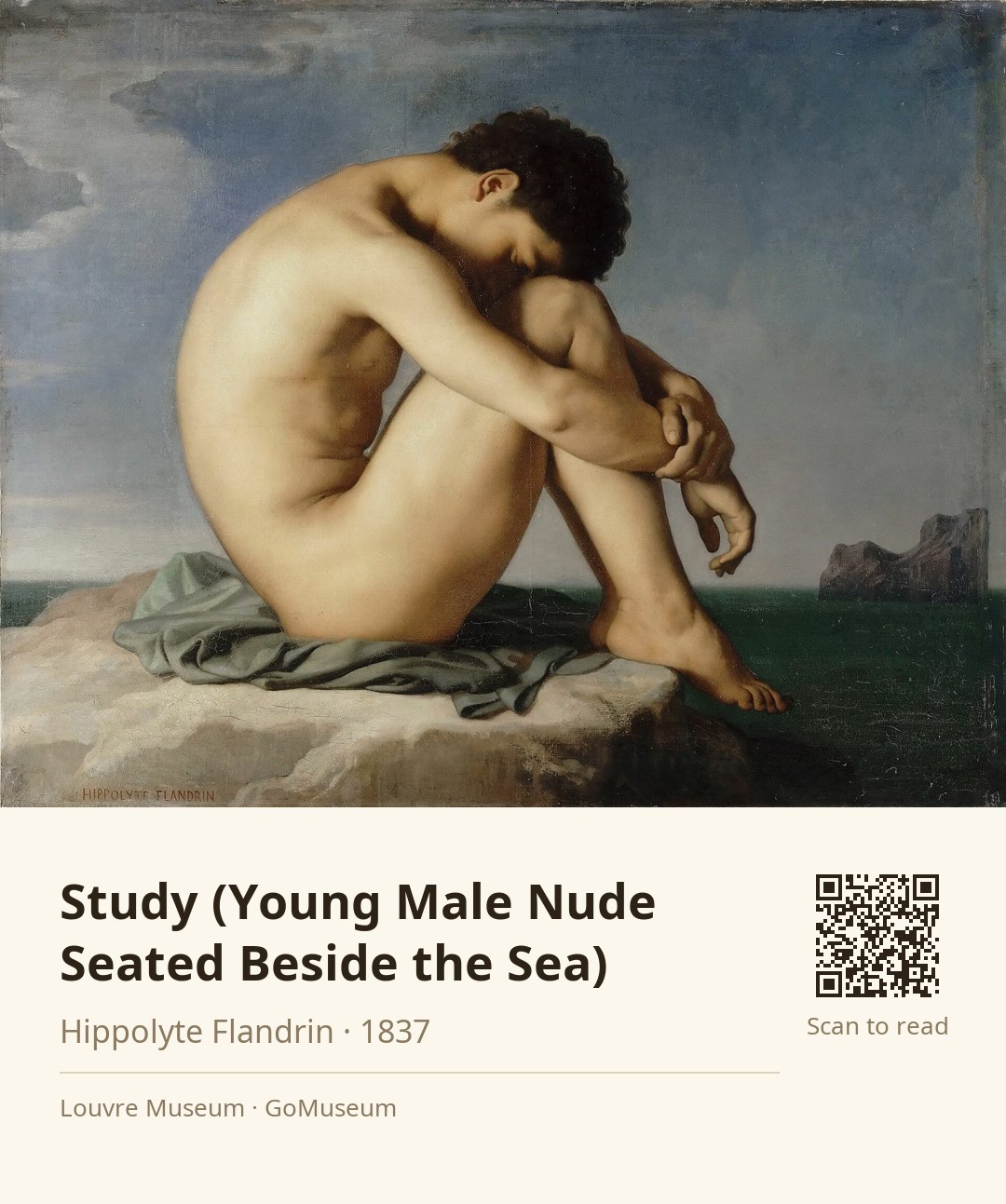
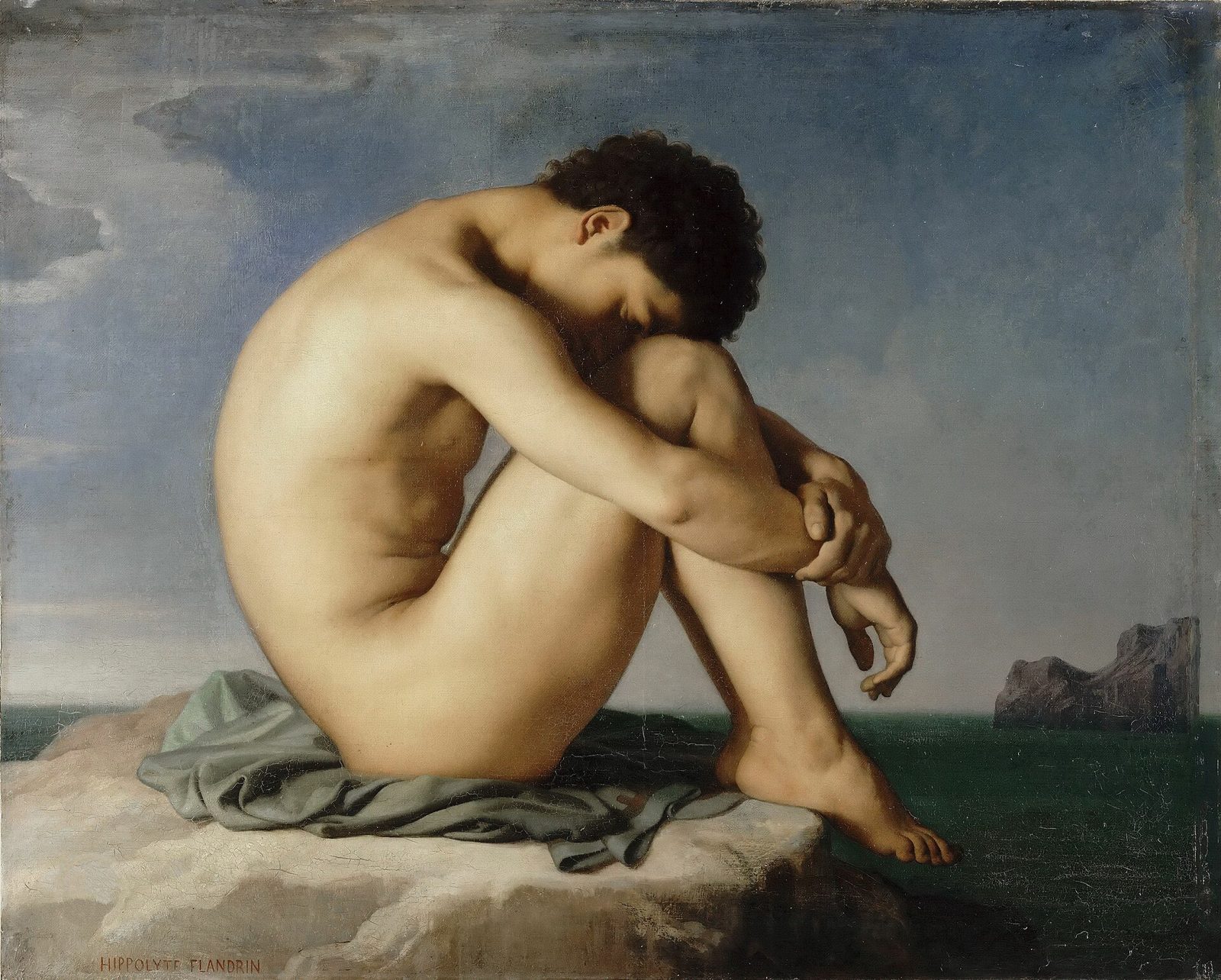
🎧 This work has audio narration — listen in the appTake a moment to gaze at the serene figure before you—Hippolyte Flandrin's "Study (Young Male Nude Seated Beside the Sea)." Notice how the young man sits, his body curled protectively, almost fetal, against the backdrop of an endless sea. His eyes are closed, as if lost in thought or perhaps in a dream.
Now, focus on the way the light dances across his skin, highlighting the soft curves and contours of his form. This flawless modeling not only showcases Flandrin's technical skill but also evokes a sense of vulnerability and introspection. The absence of any identifiable landmarks in the background adds to the mystery—who is this young man? What thoughts occupy his mind?
Created in 1836 during Flandrin's time in Rome, this work reflects the ideals of beauty and form that were celebrated in Neoclassical art. Critics noted its resemblance to the classical notion of the "ephebe," a youthful male figure symbolizing beauty and potential. Yet, the ambiguity of the scene invites various interpretations, from a shipwrecked soul to a shepherd in solitude, leaving it open to your imagination.
As you stand here, consider the impact this painting has had over the years. It became an unexpected icon of homosexual culture in the 20th century, inspiring photographers and artists alike. What feelings does this enigmatic figure stir in you? What stories might he hold?
Jean-Hippolyte Flandrin was a notable French Neoclassical painter born on March 23, 1809, in Lyon. The second of three brothers, all of whom pursued art, Flandrin's early passion for painting led him to Paris in 1829, where he studied under Louis Hersent and later became a protégé of Jean-Auguste-Dominique Ingres. His career flourished after winning the prestigious Prix de Rome in 1832, allowing him to study in Italy for five years, where he created celebrated works like "Jeune Homme Nu Assis au Bord de la Mer" and "St. Clair Healing the Blind."
Flandrin's artistic focus shifted from historical to religious themes, and he became renowned for his monumental decorative paintings in various churches, including St. Germain des Prés and St. Vincent de Paul in Paris. His work was characterized by a blend of idealism and spirituality, reflecting deeper psychological and emotional themes. In 1853, he was elected to the Académie des Beaux-Arts, marking his significant standing in the art community.
Despite his success, Flandrin's health declined due to the demands of his work, and he tragically died of smallpox in Rome on March 21, 1864. His legacy endures through his influential contributions to Neoclassical art, and he is remembered for his ability to transform classical ideals into expressions of Christian thought.
Hippolyte Flandrin's 'Study (Young Male Nude Seated Beside the Sea)' was created during his time in Rome, following his prestigious win of the Prix de Rome in 1832. This award allowed him to immerse himself in the artistic culture of Italy, and it was here, between 1835 and 1836, that he crafted this evocative piece. Flandrin sent the work back to Paris in 1837, fulfilling the requirements of his bursary. The painting caught the eye of Napoleon III, who purchased it in 1857, ensuring its place in the Louvre, where it remains today. The reception of the piece was mixed; while some critics praised its beauty and technical skill, others were puzzled by its ambiguous narrative. Over the years, its provenance has shifted from a personal study to a celebrated icon of art history, reflecting the evolving interpretations of its subject matter.
In 'Study (Young Male Nude Seated Beside the Sea)', Flandrin's brushwork is both delicate and deliberate, capturing the soft contours of the figure's body with a remarkable sense of realism. Notice how the light plays across the skin, creating a luminous quality that enhances the figure's vulnerability. The composition is strikingly simple yet profound; the young man’s curled posture evokes a sense of introspection, while the vast, empty sea behind him amplifies his solitude. The lack of identifiable landmarks in the background invites you to ponder the figure's story—who is he, and what thoughts occupy his mind? Flandrin’s choice to use a muted color palette allows the viewer to focus on the form and emotion of the subject, making the work feel almost timeless. This technique not only showcases his technical prowess but also engages you on an emotional level, drawing you into the narrative of the piece.
Flandrin's work has left a lasting legacy, particularly in its unexpected embrace by 20th-century homosexual culture. Initially intended as a study of beauty and form, it transformed into an icon that resonated with artists and photographers exploring themes of identity and desire. Its influence can be seen in the works of notable figures like Marcel Moore and Claude Cahun, who adopted similar poses in their photography, as well as in the art of Robert Mapplethorpe. The painting's journey from a classical study to a symbol of modern identity reflects broader shifts in societal attitudes towards sexuality and representation in art, marking it as a significant touchstone in the evolution of artistic expression.
Critics noted that the painting's enigmatic quality and the ambiguity of the figure's pose prefigured Surrealist themes, inviting interpretations that extend beyond its Neoclassical roots. This unexpected link highlights how Flandrin's work transcended its time, influencing artists long after its creation.
The 1887 engraving helped popularize Flandrin's painting, making it more widely recognized and appreciated, which contributed to its later status as an icon of homosexual culture.
Coming from a family of painters, Flandrin was immersed in the arts from a young age, studying under prominent artists like Ingres, which shaped his Neoclassical style and technical skills.
Critics noted that the ambiguous quality of Flandrin's painting prefigured themes found in Surrealism, showing how his work transcended its Neoclassical roots and influenced later artists.