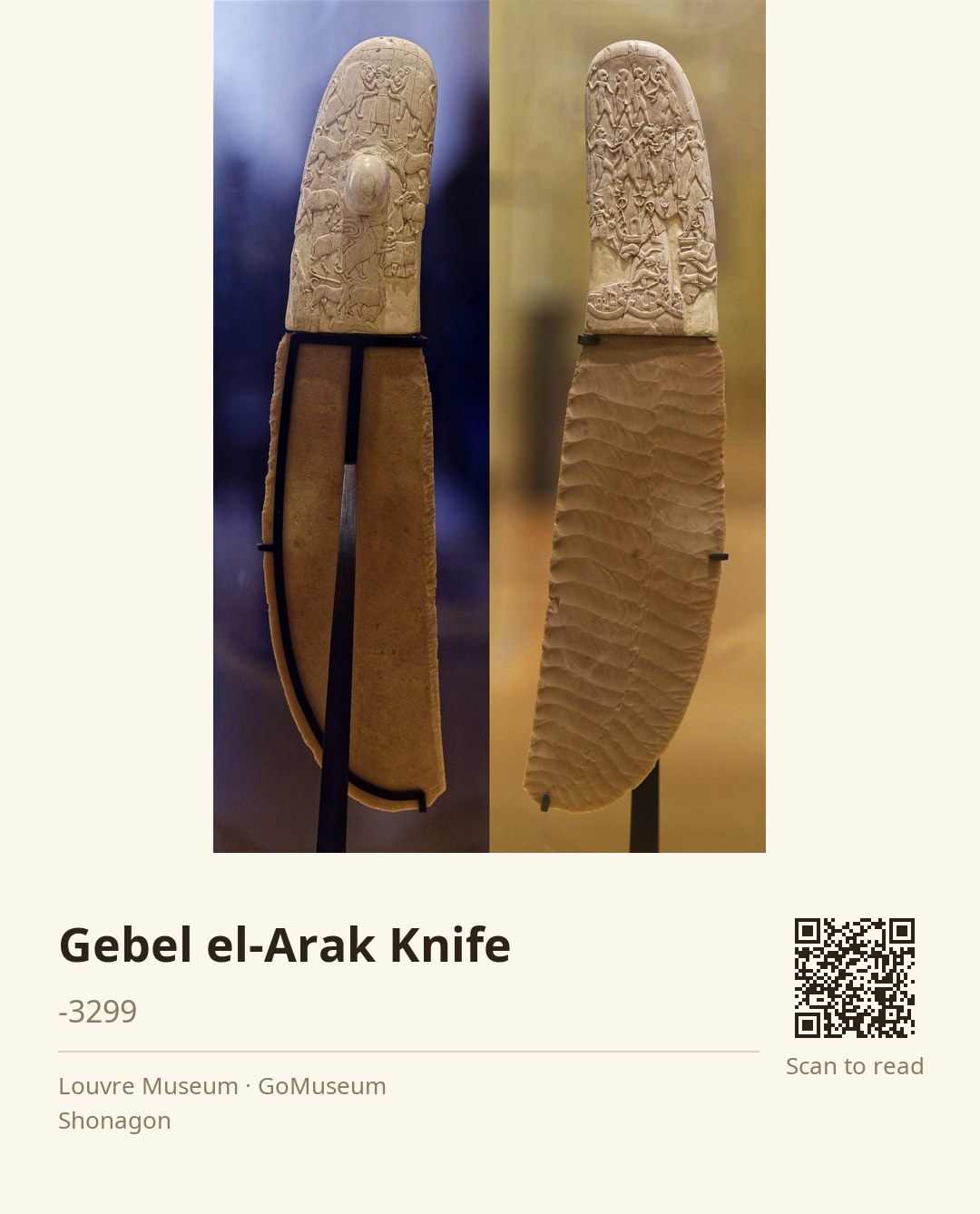
 Image: Shonagon · Gary Todd from Xinzheng, China · Calimeronte
Gebel el-Arak Knife
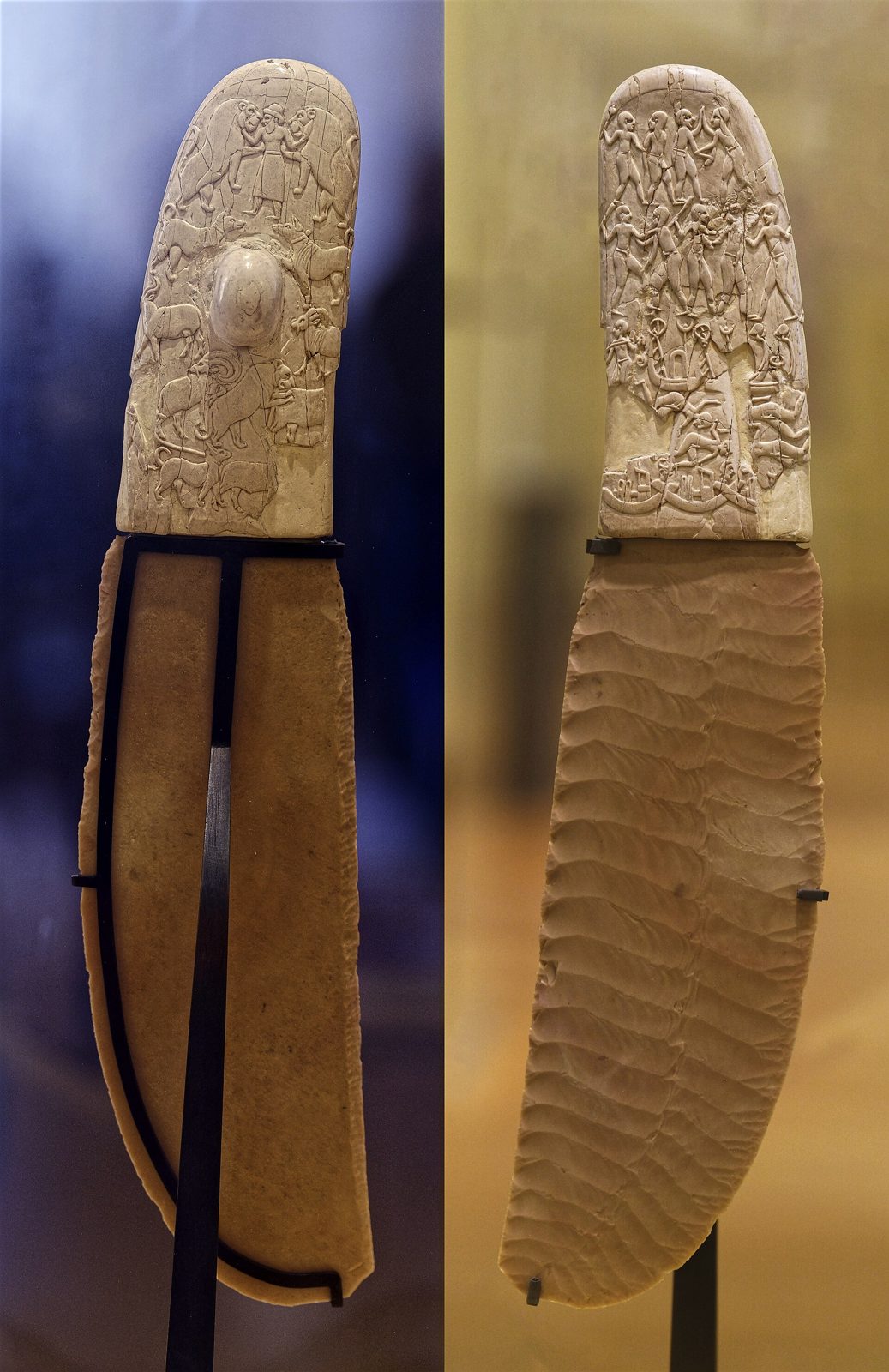
🎧 This work has audio narration — listen in the appTake a moment to really look at the Gebel el-Arak Knife in front of you. Notice the intricate carvings on the ivory handle—particularly the fierce battle scene. Can you see the figures, their hair styles distinguishing them as they clash with weapons in hand?
Well, this knife, dating back to around 3299 BC, is more than a beautifully crafted artifact; it’s a testament to the cultural exchanges happening at the time, influenced by Mesopotamian styles. The craftsmanship showcases the advanced skills of early Egyptian artisans, hinting at a society that valued both artistry and storytelling.
Acquired by the Louvre in 1914, it was recognized immediately for its exceptional preservation and significance. The knife was believed to have originated from Abydos, a key archaeological site, rather than Gebel el-Arak as initially thought.
As you stand here, consider this: what stories do you think this knife could tell if it could speak? What battles, victories, or rituals might it have witnessed? Let your imagination roam through the sands of time.
The Gebel el-Arak Knife was acquired in February 1914 by Georges Aaron Bénédite, a philologist and Egyptologist, from a Cairo antique dealer named Maurice Nahman. Bénédite recognized the knife's exceptional preservation and its archaic significance. In a letter to Charles Boreux, head of the Louvre's Egyptian Antiquities department, he described it as a masterpiece of predynastic sculpture, highlighting its intricate carvings and the importance of its scenes. Interestingly, when Bénédite purchased it, the blade and handle were separated, as the dealer didn’t realize they belonged together. Restoration efforts began in 1933, reuniting the two parts, and further conservation work was done in 1997. Initially thought to be from Gebel el-Arak, its true origin is now believed to be Abydos, a significant archaeological site, supported by the lack of finds at Gebel el-Arak during extensive excavations there.
One surprising detail about the Gebel el-Arak Knife is that when it was purchased in 1914, the dealer had no idea that the ivory handle and flint blade belonged together. They were presented as separate pieces, with the seller claiming the handle was found at Gebel el-Arak, while the blade was said to be from recent excavations at Abydos. It was only later that the true connection was recognized, leading to its restoration in 1933. This mix-up highlights how even experts can overlook the obvious, and it adds a layer of intrigue to this already fascinating artifact.
During the restoration process, it was found that the blade had been polished on one side to imitate a metal blade, indicating that it may have served an artistic purpose rather than a purely functional one.
The knife shows no signs of wear, suggesting it was likely a ceremonial object or a display piece rather than a tool used for practical purposes.