 Image: Shonagon
The Mocking of Christ
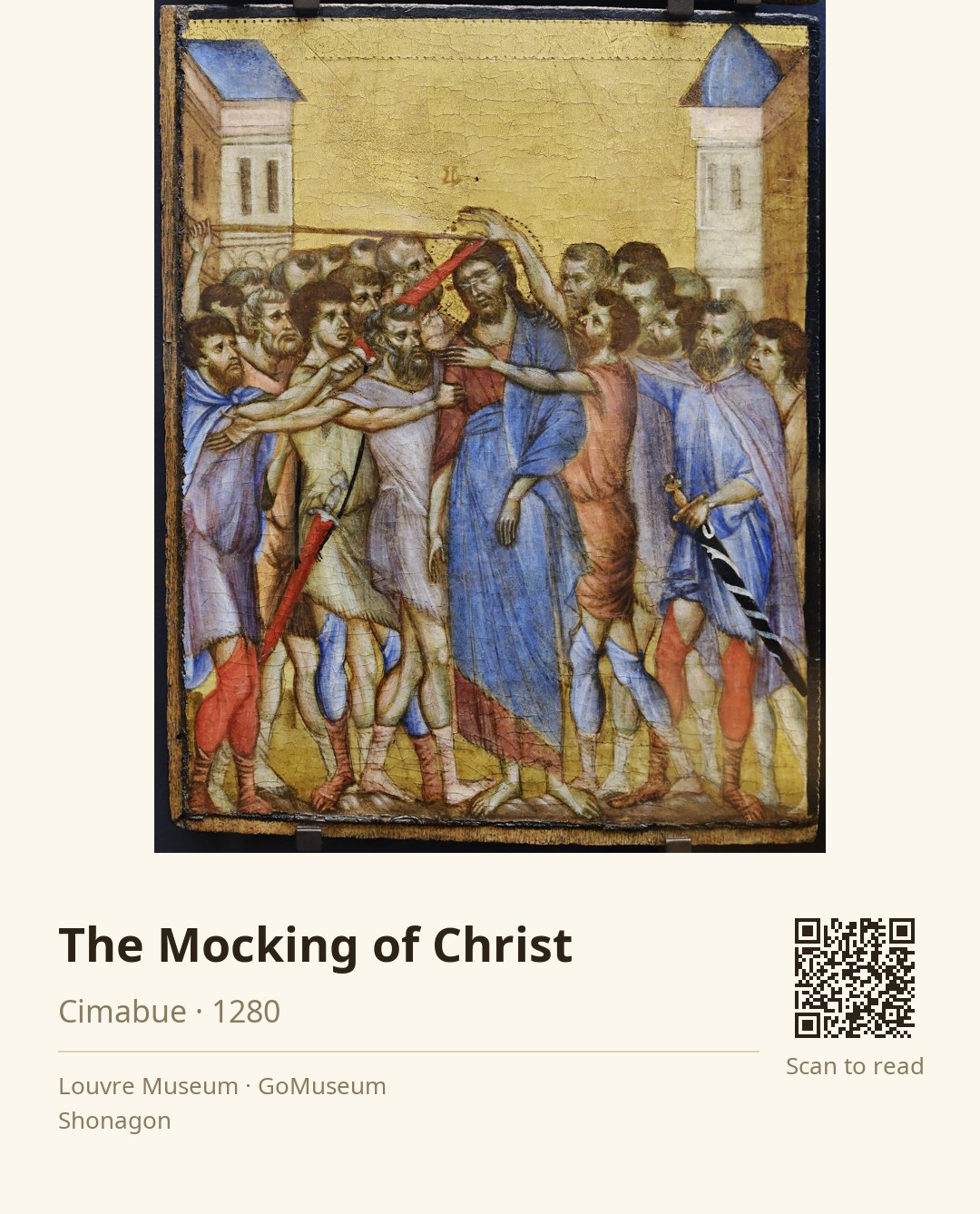
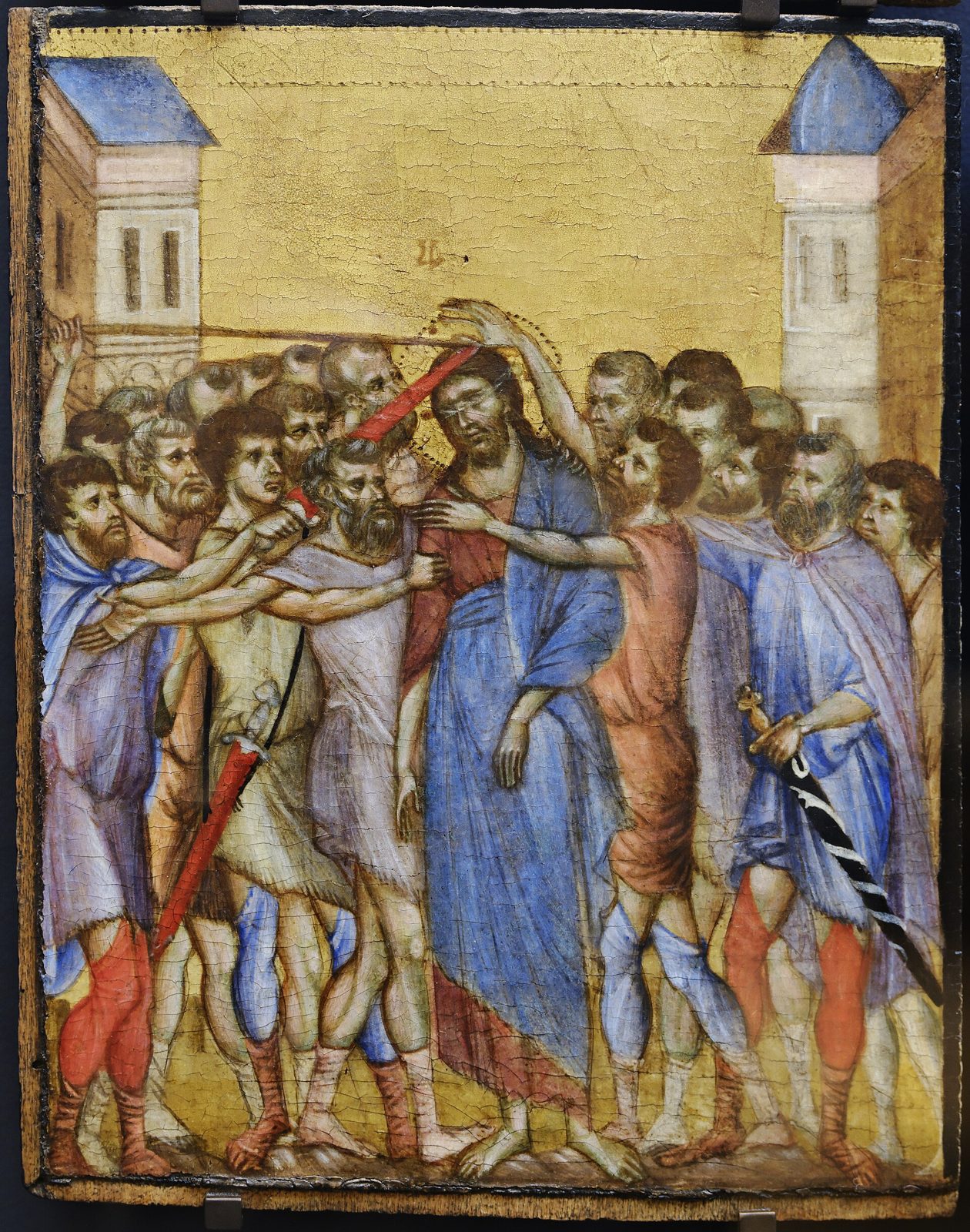
🎧 This work has audio narration — listen in the appTake a moment to really look at "The Mocking of Christ" by Cimabue. Notice how Christ stands at the center, draped in a vibrant red robe and a deep blue cloak, his expression almost serene amidst the chaos around him. Look closely at the figures surrounding him—some are striking him with rods, while one seems to be reaching for his halo. This contrast of violence against his calmness is striking, isn’t it?
Cimabue, painting in 1280, was moving away from the rigid, flat representations of Byzantine art towards a more naturalistic style. This painting is one of the few that captures a crowd scene with such emotional depth, hinting at the human experience behind the biblical narrative.
Cimabue is often seen as a bridge between the medieval and the Renaissance, and this piece is a prime example of that transition. It’s part of a diptych, a devotional work meant to inspire reflection, and it’s fascinating to think about how it was rediscovered in a kitchen in France, valued only as an old icon before its true worth was realized.
As you stand here, consider how this small panel—just about the size of a book—holds such a significant place in art history. What emotions does it stir in you?
Giovanni Cimabue, born around 1240 in Florence and passing in 1302 in Pisa, is a pivotal figure in the transition from Byzantine to early Renaissance art. Known as Cenni di Pepo, he is celebrated for his innovative approach to painting, which introduced more naturalistic proportions and emotional depth to figures, marking a departure from the rigid Italo-Byzantine style. His seminal works, such as the Crucifixion in Arezzo and the Maestà, reflect a blend of Byzantine influence and emerging Gothic elements, setting the stage for future artists like Giotto, whom he is often credited with mentoring, though this claim is debated among scholars.
Cimabue's career flourished through commissions from religious orders, particularly the Franciscans, which shaped his artistic vision. His frescoes in Assisi and the Maestà of Santa Trinita exemplify his ability to evoke human emotion and spirituality. Despite limited documentation of his life, his legacy is profound; he is recognized as a precursor to the naturalism that would dominate the Renaissance. His influence extended beyond Italy, impacting the trajectory of Western art. Cimabue's work remains a testament to the evolving nature of artistic expression in the late medieval period, bridging the gap between the sacred traditions of the past and the burgeoning humanism of the future.
Cimabue's "The Mocking of Christ" was painted around 1280 as part of a diptych, a two-panel work meant for devotion. This particular panel was rediscovered in a kitchen in northern France in 2019, where it had been hanging above a hotplate, mistaken for a mere religious icon. The elderly owner, preparing to move, had no idea of its true value. Initially estimated at €300,000 to €400,000, it shocked the art world when it sold for €24 million at auction in October 2019, setting a record for a pre-16th-century artwork. Following its classification as a national treasure, it was acquired by the Louvre in 2023, ensuring its preservation and public display. This journey from obscurity to the heights of art history is a testament to the painting's significance and the mysteries that often surround great works of art.
As you gaze at "The Mocking of Christ," pay attention to Cimabue's masterful use of tempera on a poplar panel, which gives the work a unique texture and depth. The vibrant red and blue of Christ's robes contrast sharply with the gold leaf background, creating a luminous effect that draws your eye. Notice how Cimabue employs a slightly bowed panel, enhancing the sense of three-dimensionality. The crowd surrounding Christ is depicted with a dynamic brushwork that feels almost restless, capturing the chaotic energy of the moment. The figures are slightly shorter than Christ, emphasizing his centrality and the weight of their actions against him.
It represents a shift from the flat, stylized forms of Byzantine art to a more naturalistic approach that would influence generations of artists, including his student Giotto. This painting encapsulates the emotional depth and human experience that would become central to Renaissance art. By portraying Christ with an impassive expression amidst the violence, Cimabue invites viewers to engage with the narrative on a personal level, setting a precedent for emotional storytelling in visual art.
One intriguing detail about "The Mocking of Christ" is that it is one of only a dozen works attributed to Cimabue, none of which bear his signature. The painting's rediscovery in a kitchen highlights how art can be hidden in plain sight, waiting for the right moment to emerge and reclaim its place in history.
Its rediscovery in a kitchen, mistaken for a mere icon, highlights how valuable artworks can be hidden in plain sight, and it sparked discussions about the importance of provenance and the potential for lost masterpieces to resurface.
Initially, the elderly owner and her family viewed it as just an old religious icon with little value, unaware of its true artistic significance and potential worth, which dramatically changed after its auction.