Apollo and Marsyas
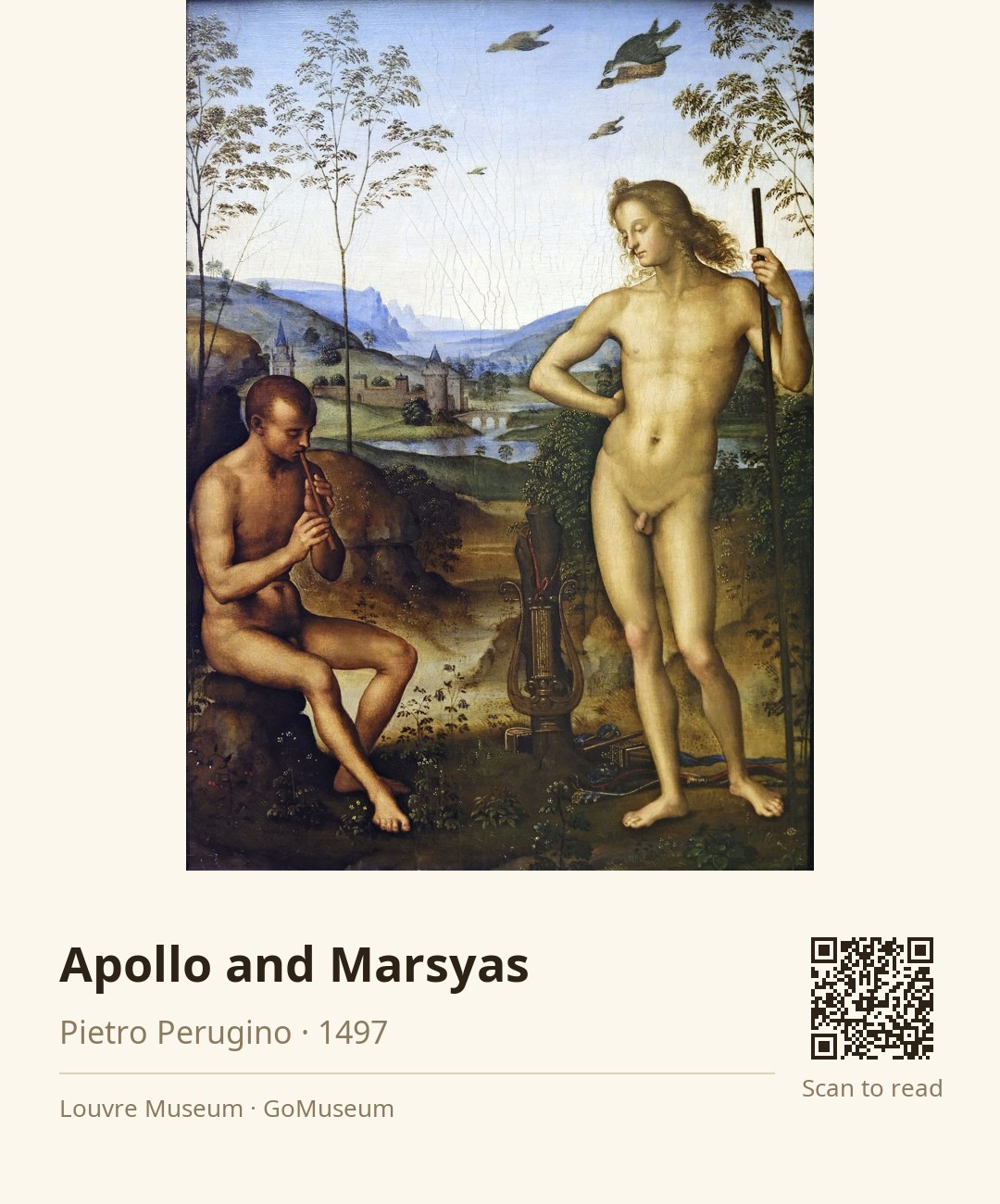
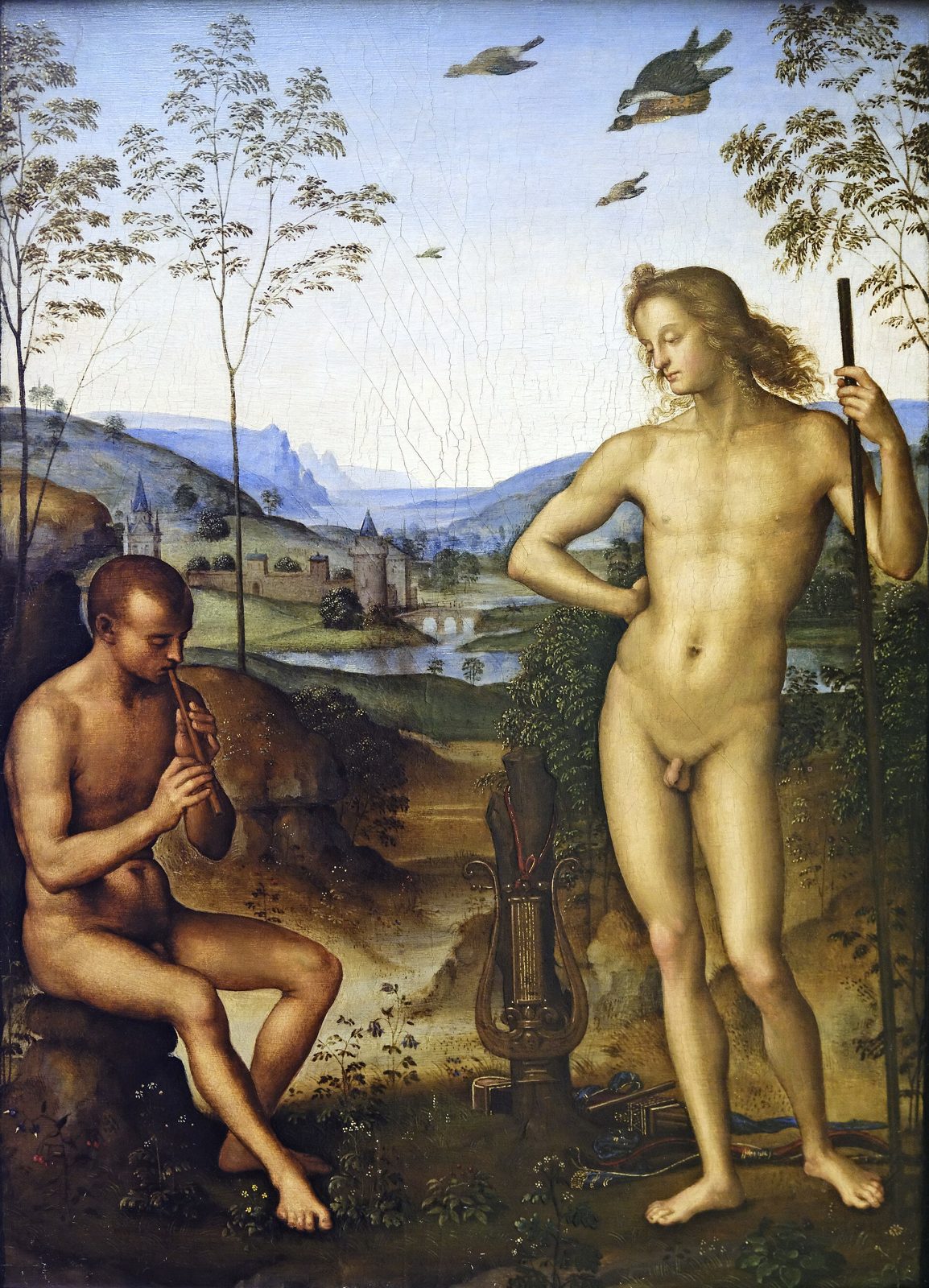
🎧 This work has audio narration — listen in the appAs you stand before "Apollo and Marsyas," let your eyes drift to the figures in the foreground. Notice how Apollo stands tall, his body poised in a graceful contrapposto, while the seated figure, possibly Marsyas, plays his flute with a sense of vulnerability. This contrast between their stances is more than just a visual delight; it symbolizes the tension between divine order and human passion.
The way Apollo's light skin glows against the darker, earthy tones of the landscape emphasizes his godly status, while Marsyas, with his shorter hair and humble pose, represents the mortal struggle against the divine.
Perugino was known for his ability to blend figures harmoniously with serene landscapes, a technique that elevates the narrative of this mythological contest. The background, with its tranquil hills and a distant city, invites you into a world where nature and art coexist, echoing the Renaissance belief in the beauty of the natural world.
As you take in this scene, consider the deeper story of Apollo's victory over Marsyas, a tale of hubris and humility. What does this struggle say about the balance of power in your own life?
Pietro Perugino, born Pietro Vannucci around 1446-1452 in Città della Pieve, was a pivotal figure in the Italian Renaissance, particularly within the Umbrian school. His early training in Perugia and Florence, where he likely apprenticed under Verrocchio alongside Leonardo da Vinci, laid the foundation for his mastery in fresco and oil painting. Perugino's style is characterized by serene compositions, elegant figures, and harmonious landscapes, reflecting a balance between realism and idealism.
His career flourished after he was commissioned to create frescoes for the Sistine Chapel, including the Baptism of Christ and Delivery of the Keys, showcasing his significant role in the High Renaissance. Notably, he became Raphael's mentor, influencing the next generation of artists. Despite facing criticism later in life, including a public rebuke from Michelangelo, Perugino continued to produce notable works, such as the extensive decoration of the Sala delle Udienze del Collegio del Cambio in Perugia.
Perugino's legacy endures through his innovative techniques and the serene beauty of his religious subjects, marking him as one of the foremost painters of his time. His contributions helped shape the trajectory of Renaissance art, bridging the gap between earlier and later masters. He passed away in 1523, leaving behind a rich body of work that continues to inspire.
However, by the late 19th century, the painting found its way to the Louvre in Paris, where it was misattributed to Raphael in the museum's catalogue. This misattribution reflects the painting's significant impact and the confusion surrounding its authorship, as Perugino's style was often overshadowed by his more famous pupil. The work's journey through time showcases its importance in the dialogue of Renaissance art, as it was created during a period when the revival of classical themes was at its peak, appealing to the elite who sought to decode its mythological references.
As you gaze at 'Apollo and Marsyas,' notice the masterful brushwork that Perugino employs to create a sense of harmony between the figures and their surroundings. The composition is structured with Apollo standing in a graceful contrapposto, which not only emphasizes his divine nature but also draws your eye naturally across the canvas. The use of light is particularly striking; Apollo is bathed in a warm, golden glow, contrasting with the softer, cooler tones of Marsyas. This not only highlights their differing statuses but also enhances the emotional weight of the scene. The background is meticulously crafted, with a serene landscape that invites contemplation, featuring a three-arch bridge and gentle hills that evoke a sense of tranquility. The careful placement of flowers at the figures' feet adds a touch of life, grounding the mythological narrative in the beauty of the natural world.
A curious tidbit about 'Apollo and Marsyas' is that the identity of the seated figure has sparked debate among art historians for centuries. While many initially believed it to be Marsyas, the character is typically depicted as a satyr. Some scholars suggest it may actually represent Daphnis, a shepherd known for his tragic love for Apollo. This ambiguity adds an intriguing layer to the painting, inviting viewers to ponder the deeper connections between the figures and the themes of love and rivalry.
The small yellow and white flowers scattered at the feet of Apollo and Marsyas add a touch of life to the scene, symbolizing the beauty of nature and grounding the mythological narrative in a realistic setting.