Saint Bonaventure's Body Lying in State
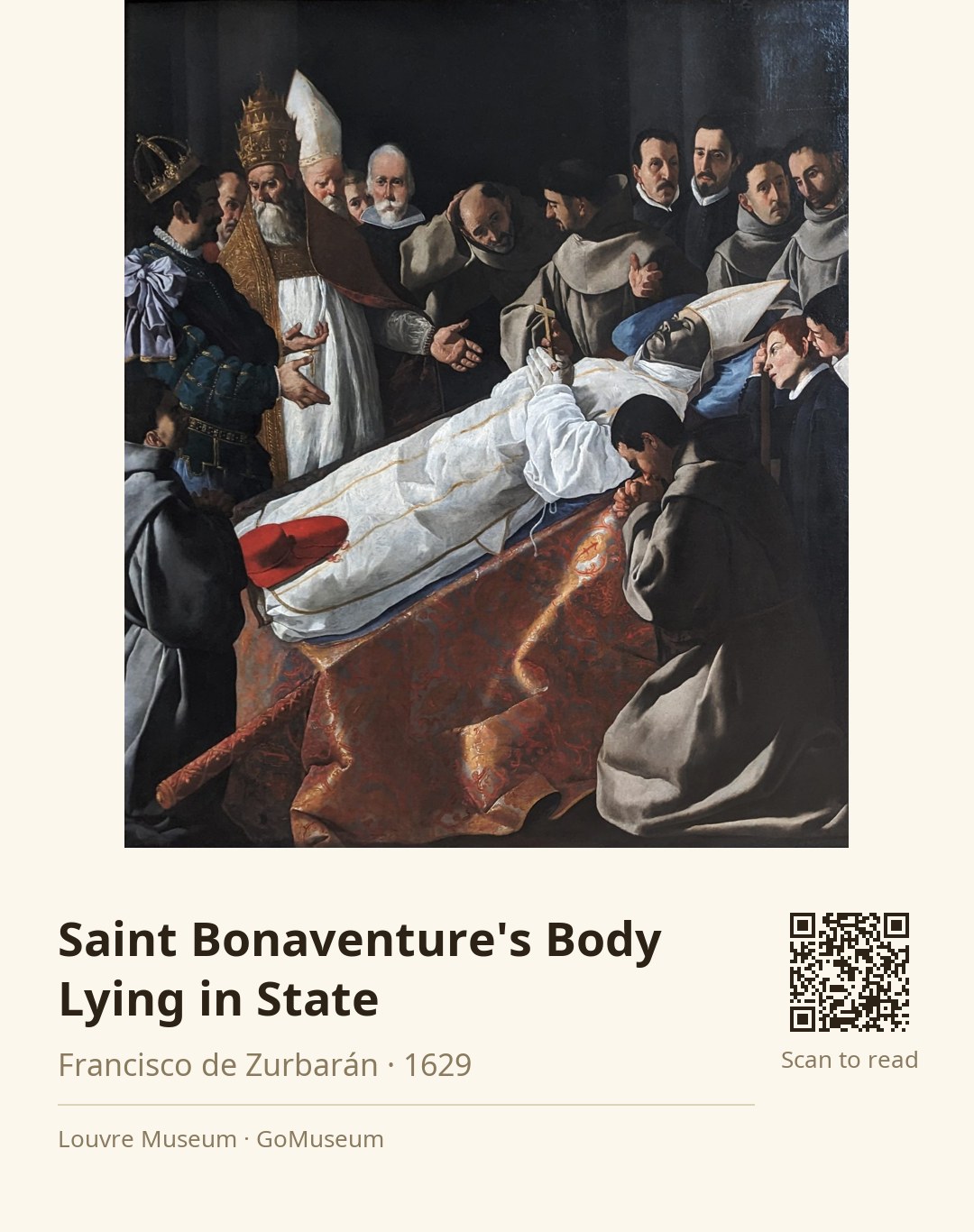
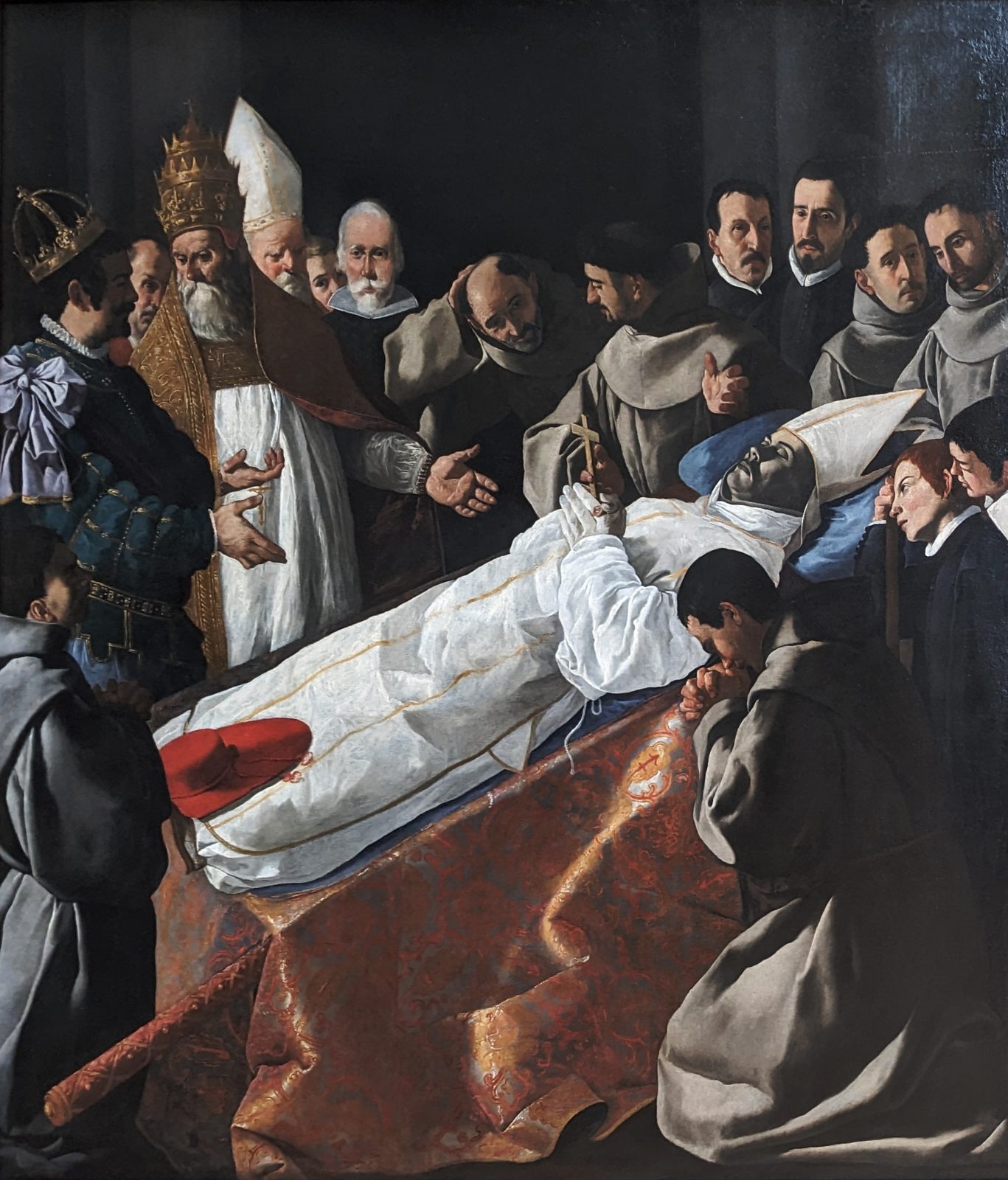
🎧 This work has audio narration — listen in the appTake a moment to really absorb the scene before you in Francisco de Zurbarán's "Saint Bonaventure's Body Lying in State." Notice how the figures surrounding the saint are arranged in a semi-circle, their expressions a mix of reverence and conversation. Look closely at the vibrant red of the cardinal's hat, stark against the saint's pale, lifeless form dressed in white liturgical garments.
These details matter because they draw you into a moment of profound stillness and reflection, capturing the tension between life and death. The way the figures engage with one another, particularly Pope Gregory X and King James I of Aragon, suggests a dialogue about faith and legacy, making this not just a depiction of mourning, but a celebration of Bonaventure's impact on the Church.
Zurbarán painted this in 1629, as part of a series exploring the life of Saint Bonaventure, a key figure in Franciscan theology. His mastery of chiaroscuro, the dramatic play of light and shadow, enhances the solemnity of the scene, inviting you to contemplate the spiritual significance of death and the afterlife.
As you stand here, think about what legacy means to you. How do we honor those who have passed? What stories do we carry forward?
Francisco de Zurbarán, born in 1598 in Fuente de Cantos, was a prominent Spanish Baroque painter known for his religious works and still-lifes. His early talent for imitating objects led him to apprentice in Seville, where he developed a distinctive style characterized by dramatic chiaroscuro, earning him the nickname "Spanish Caravaggio." Zurbarán's compositions often depicted solitary figures in contemplative poses, reflecting a deep mysticism that resonated with the Counter-Reformation's spiritual themes.
His career flourished after securing significant commissions, including a contract for 21 paintings for a Dominican monastery, which established his reputation. He moved to Seville in 1629, where he became a leading artist, creating works for influential patrons and religious institutions. Despite a decline in popularity later in life, his art remained notable for its austere beauty and meticulous detail, particularly in the rendering of white draperies.
Zurbarán's legacy is marked by his unique ability to convey profound emotion through simplicity, distinguishing him from contemporaries like Velázquez. His influence extended beyond Spain, with many works exported to South America. He died in 1664, leaving behind a legacy that continues to be celebrated in art history for its spiritual depth and technical mastery.
Zurbarán's 'Saint Bonaventure's Body Lying in State' was painted in 1629, commissioned as part of a series dedicated to the life of Saint Bonaventure, a significant figure in Franciscan theology. This series also includes works like 'Saint Bonaventure at the Council of Lyon' and 'Saint Bonaventure and the Angel.' The painting is now housed in the Louvre, where it has been since its completion. His works often reflected the spiritual and religious fervor of the time, and this particular piece was no exception, capturing a moment of solemnity and reflection surrounding the saint's death.
In 'Saint Bonaventure's Body Lying in State,' Zurbarán employs a striking chiaroscuro technique, creating a dramatic interplay of light and shadow that enhances the painting's emotional weight. The figures are arranged in a semi-circle, drawing your eye towards the saint's pale, lifeless form, which is dressed in white liturgical garments. Notice how the vibrant red of the cardinal's hat contrasts sharply with the saint's attire, a choice that not only highlights the cardinal's presence but also symbolizes the tension between life and death. The brushwork is meticulous, with each figure rendered in a way that conveys their unique personalities and emotions. The composition is carefully structured, with the diagonal arrangement of the figures creating a dynamic yet harmonious balance. This simplicity in layout allows the viewer to focus on the expressions and interactions among the characters, inviting contemplation of their dialogue about faith and legacy.
Painted in 1629, it not only showcases the artist's mastery of chiaroscuro but also reflects the Counter-Reformation's emphasis on spirituality and the veneration of saints. This work, part of a series on Saint Bonaventure, influenced later artists by demonstrating how to convey deep emotion and reverence through composition and light. The way Zurbarán captures the solemnity of the moment, with figures like Pope Gregory X engaged in quiet conversation, invites viewers to contemplate the sacredness of the scene.
One intriguing anecdote about Zurbarán is that he was once referred to as the 'Spanish Caravaggio' due to his exceptional use of chiaroscuro. However, unlike Caravaggio, who often depicted dramatic narratives, Zurbarán's compositions tend to focus on singular figures, emphasizing their spiritual journeys rather than the stories surrounding them. This distinction highlights his unique approach to religious painting, where the emphasis is placed on the internal experience of faith rather than external action.
Zurbarán's meticulous brushwork not only showcases his skill in chiaroscuro but also emphasizes the distinct personalities and emotions of each figure, allowing viewers to engage with their individual stories.