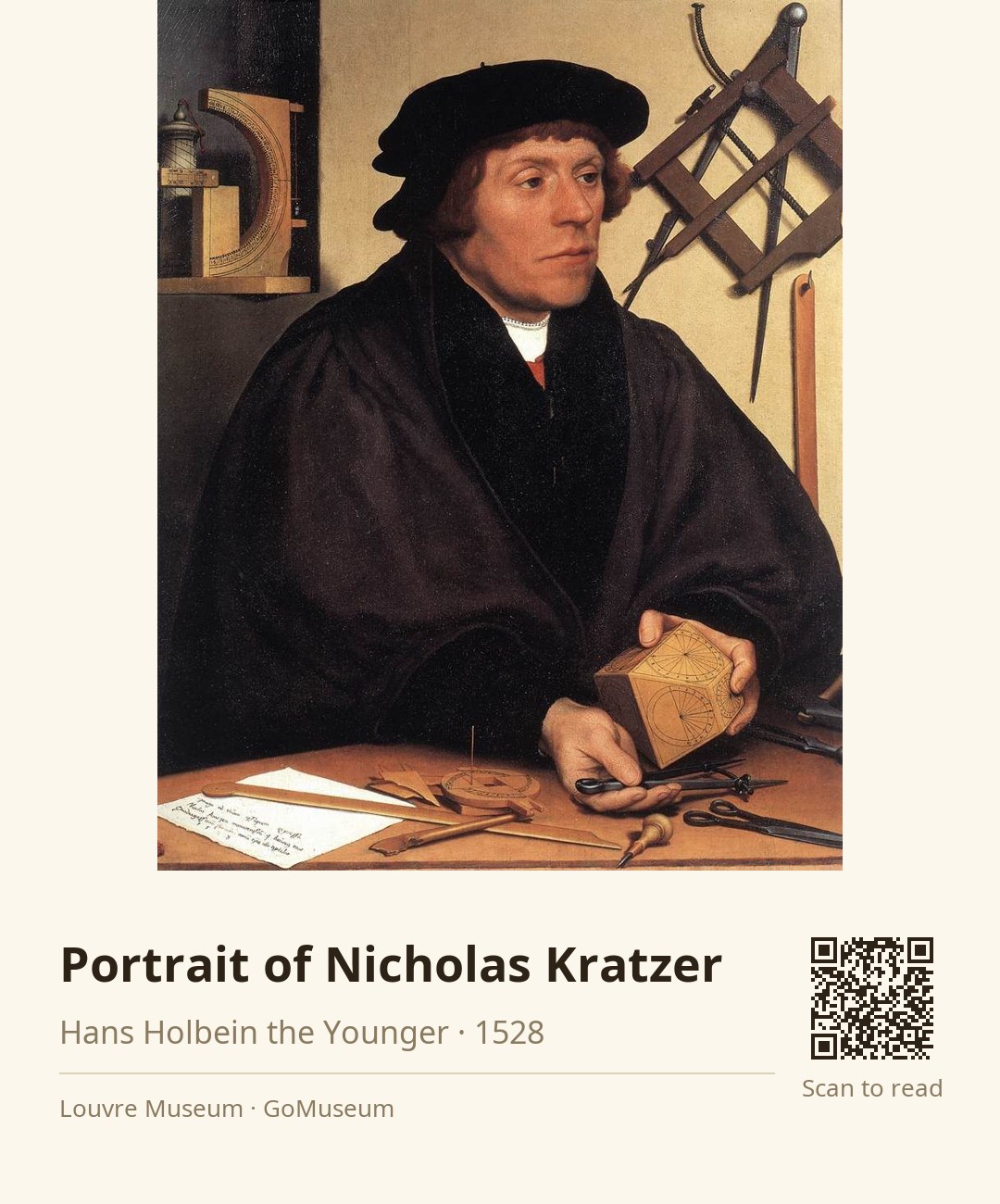
Portrait of Nicholas Kratzer
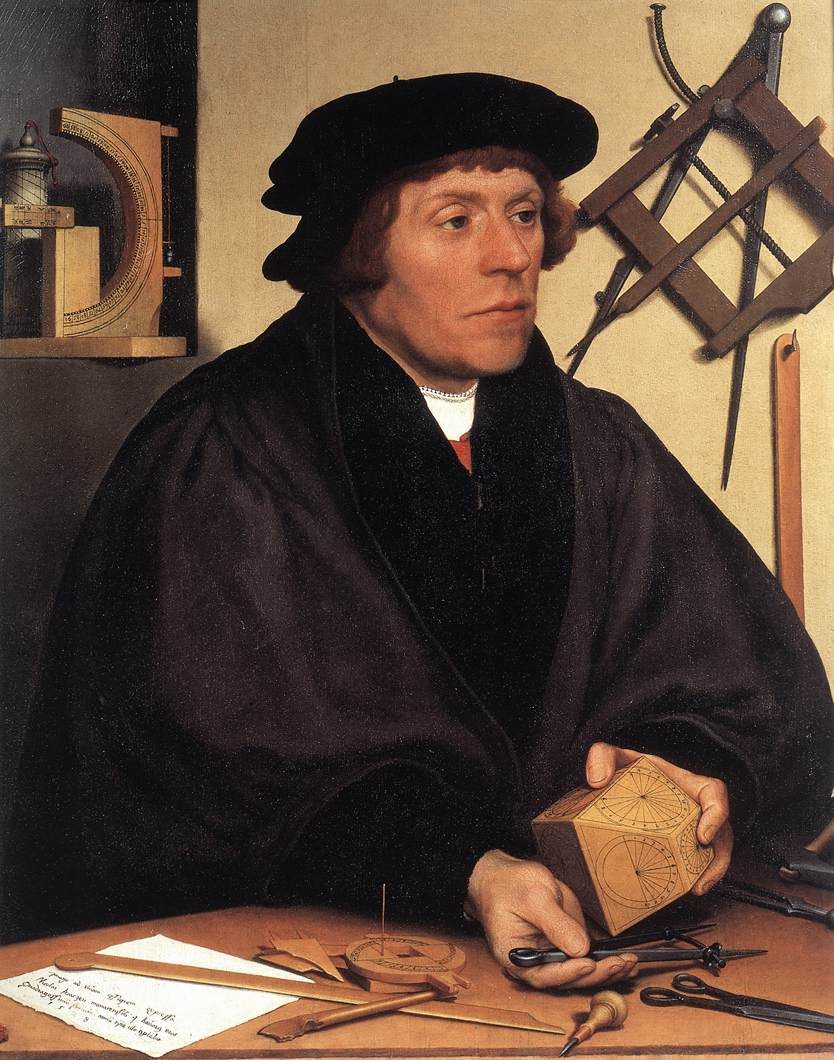
🎧 This work has audio narration — listen in the appTake a moment to really look at this striking portrait of Nicholas Kratzer by Hans Holbein the Younger. Notice how Kratzer’s gaze seems to pull you in, his expression a mix of intelligence and contemplation. Now, focus on the half-finished polyhedral sundial he holds. This isn’t just a prop; it’s a symbol of his work as an astronomer, a nod to the scientific curiosity of the early 16th century.
This detail matters because it reflects the Renaissance spirit, where art and science intertwined. Holbein captures not only Kratzer’s likeness but also the essence of a man deeply engaged in the pursuit of knowledge. The instruments behind him—a star quadrant and a shepherd's dial—further emphasize this connection, showcasing the tools of his trade and the era’s fascination with the cosmos.
Holbein painted this in 1528, during a time when he was gaining recognition in England, thanks to his connections with influential figures like Thomas More. This portrait is more than just a depiction; it’s a celebration of human intellect and the artistic mastery of Holbein, who was known for his precise and lifelike portrayals.
As you stand here, think about the world Kratzer inhabited—what do you think it was like to be an astronomer in the 1500s, balancing the wonders of the universe with the realities of life?
Hans Holbein the Younger, born around 1497 in Augsburg, was a pivotal figure in Northern Renaissance art, renowned for his extraordinary portraiture. Initially trained in his father's workshop, he moved to Basel, where he honed his skills in religious art and humanist themes. His early works, including portraits of notable figures like Erasmus, showcased his keen observational prowess and wit.
In 1526, Holbein relocated to England, quickly gaining favor among the humanist elite, including Thomas More. His return to England in 1532 marked the height of his career, as he became the official court painter for Henry VIII. Holbein's portraits, such as "The Ambassadors," are celebrated for their realism and intricate symbolism, often embedding deeper meanings within the likenesses of his subjects.
Despite his acclaim, Holbein did not establish a school, making him a unique figure in art history. His work influenced subsequent generations, and he is remembered for his precision and the emotional depth of his portraits. Holbein's legacy endures, as his art continues to captivate scholars and enthusiasts alike, reflecting the complexities of human character and the era's cultural shifts. He passed away in 1543, leaving behind a rich body of work that remains influential today.
The 'Portrait of Nicholas Kratzer' was painted by Hans Holbein the Younger in 1528, a time when Holbein was establishing himself as one of the leading portraitists of the Northern Renaissance. This piece was created for Kratzer, an astronomer and a friend of both Holbein and the renowned humanist Thomas More. The painting captures Kratzer holding a half-finished polyhedral sundial, surrounded by various astronomical instruments, showcasing his scholarly pursuits. Today, this work resides in the Louvre, while a copy can be found in the National Portrait Gallery in London.
As you gaze at this portrait, pay attention to Holbein's meticulous brushwork. The way he layers paint creates a texture that feels almost tangible, inviting you to reach out and touch it. Notice how the light falls on Kratzer’s face, illuminating his features with a soft glow that enhances his contemplative expression. The composition is cleverly structured; Kratzer is positioned slightly off-center, which draws your eye to the sundial in his hand. This half-finished object isn’t just a prop; it symbolizes the ongoing pursuit of knowledge. The background instruments, rendered with precision, create a sense of depth and context, immersing you in the world of 16th-century astronomy. Holbein's choice of color, particularly the rich tones of Kratzer's attire, contrasts beautifully with the more muted background, emphasizing the subject's importance.
Painted in 1528, this work captures the essence of the Northern Renaissance, blending realism with intellectual depth. Holbein's meticulous attention to detail and his ability to convey character set a new standard for portrait artists. Influencing generations, his work inspired not only fellow painters but also the way society viewed individual identity. This portrait, showcasing Kratzer with his scientific instruments, reflects the growing importance of humanism and the intellectual pursuits of the time.