 Image: Jean-Pierre Dalbéra from Paris, France · Jean-Pierre Dalbéra from Paris, France · Yann Caradec from Paris, France · Yann Caradec from Paris, France · Yann Caradec from Paris, France
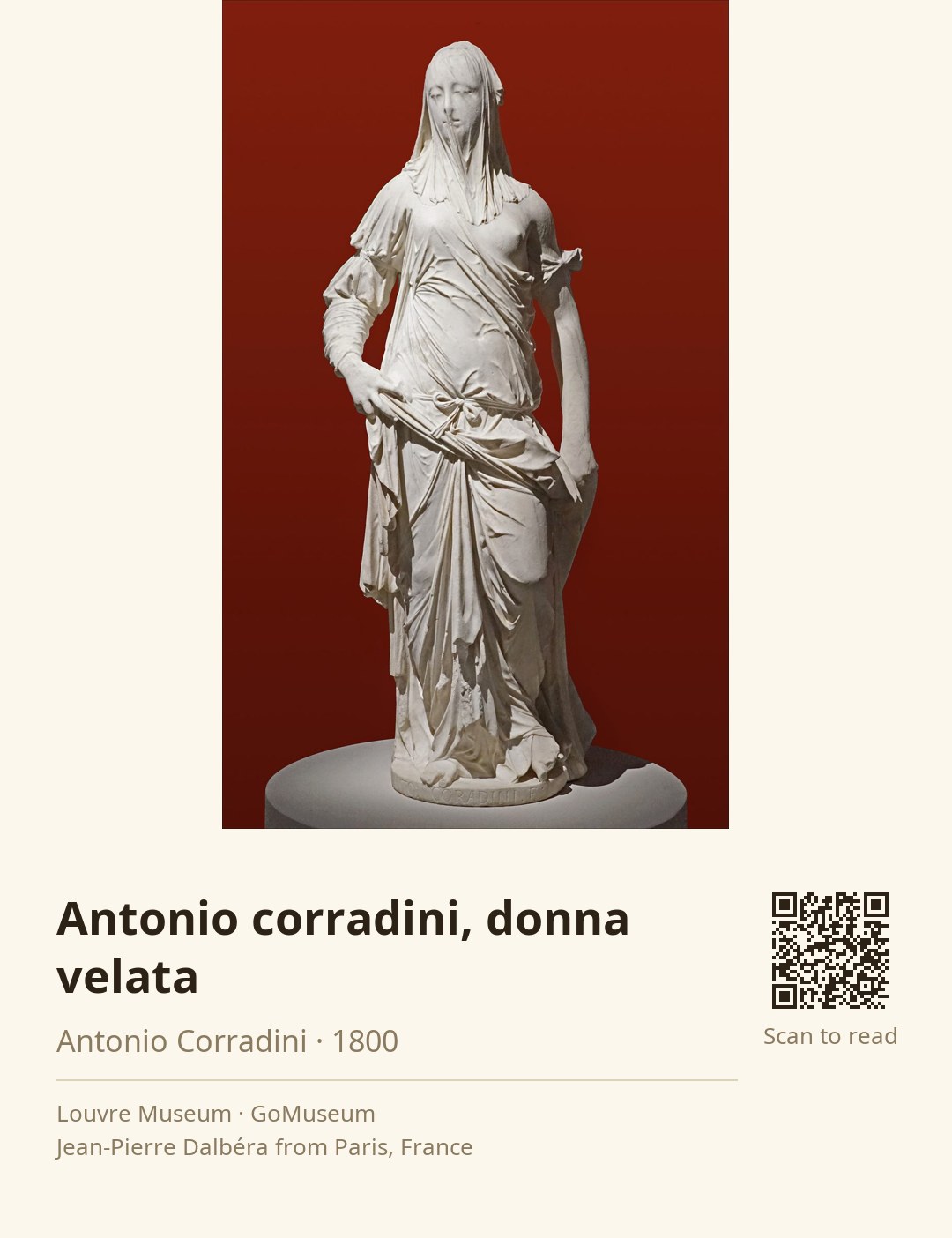
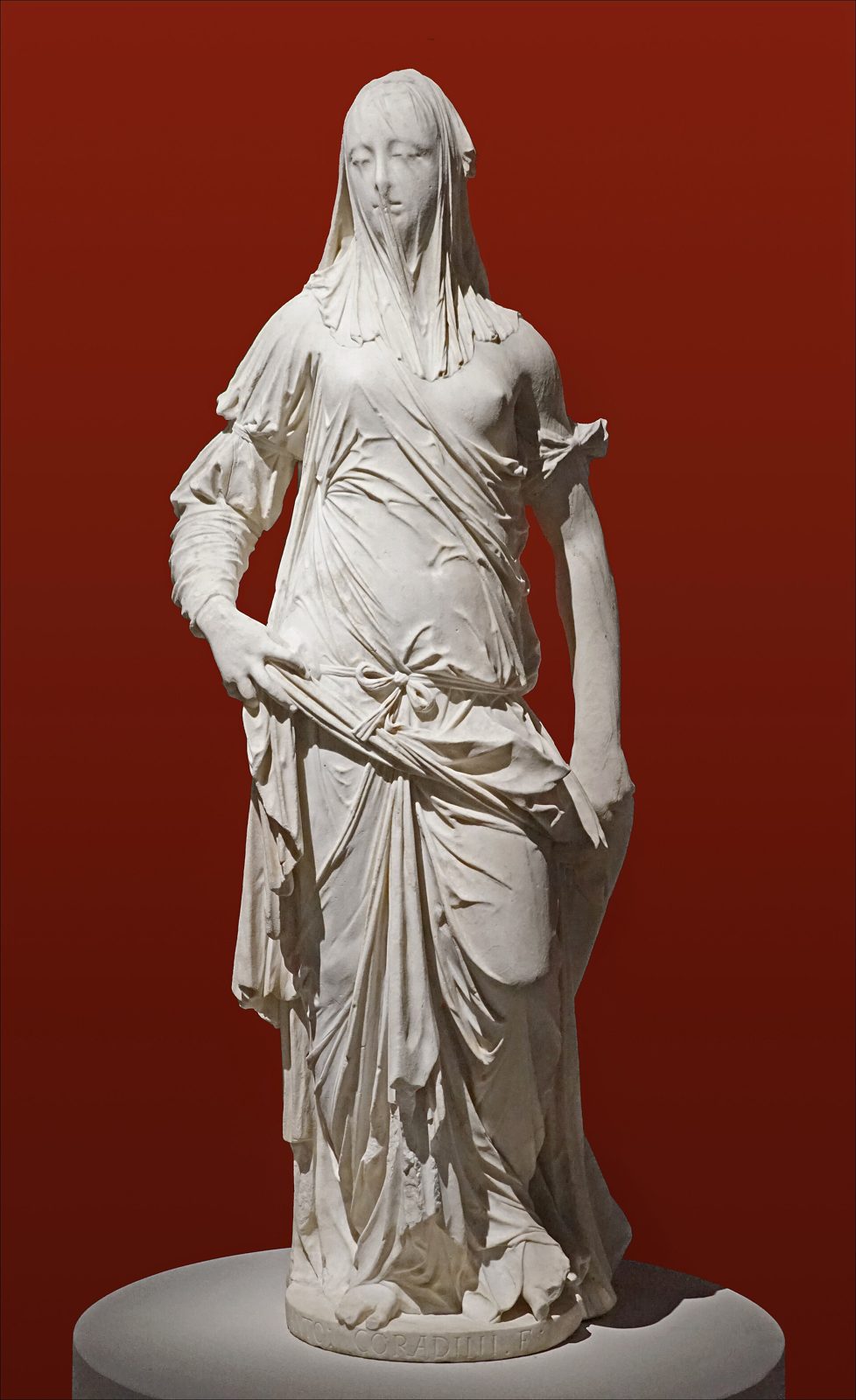
Antonio corradini, donna velata
🎧 This work has audio narration — listen in the appThe flowing garment of the female figure in Antonio Corradini's *Donna Velata* captures the essence of movement, as intricate folds cascade down her body, revealing the skill of the sculptor. The veil drapes delicately over her head, allowing glimpses of her serene facial features, which seem to emerge from the marble itself. This interplay of concealment and revelation highlights Corradini's mastery in portraying the human form, inviting viewers to ponder the mystery of the figure beneath the veil.
Crafted in 1800, this sculpture exemplifies Corradini's renowned technique of creating lifelike representations through the manipulation of marble. The smooth surface enhances the realism of the drapery and veil, while the solid red background contrasts sharply with the white marble, drawing attention to the figure's detailed textures. Corradini, an Italian Rococo sculptor from Venice, was celebrated for his veiled figures, which often suggest a deeper narrative of modesty and allure. His work was influenced by his extensive travels and commissions across Europe, including significant projects in Vienna and Naples.
Antonio Corradini was an Italian Rococo sculptor born in Venice on October 19, 1688. Renowned for his exquisite veiled sculptures, he captured the human form beneath delicate layers of material, creating an illusion of both presence and absence. His artistic journey began in his hometown, where he trained under Antonio Tarsia, eventually marrying his mentor's daughter. By 1713, he established his own workshop, gaining recognition for commissions across Europe, including notable works for Peter the Great in St. Petersburg.
In the 1730s, Corradini became the court sculptor for Emperor Charles VI in Vienna, where he created significant pieces, such as the monument of the Ark of the Covenant. His influence extended to Prague and Naples, where he worked with the enigmatic Raimondo di Sangro. Corradini's legacy is marked by his innovative approach to sculpture, particularly his mastery of veiling techniques, which set him apart in art history. He passed away in Naples on August 12, 1752, leaving behind a body of work that continues to inspire admiration and study.
Corradini's *Donna Velata* showcases his extraordinary skill in marble sculpting. The choice of marble is significant; its smooth surface allows for a lifelike representation that almost seems to breathe. Each fold of the garment is meticulously carved, capturing the essence of movement and drapery. The veil, a hallmark of Corradini's work, is crafted with such precision that it appears to float over the figure's head, revealing just enough of her serene features. This illusion is achieved through a delicate balance of light and shadow, enhancing the sculpture's three-dimensionality and inviting viewers to explore the textures and contours up close.
Antonio Corradini came from a modest family; his father was a packer of sails for ships.
Early in his career, Corradini completed a significant commission for Peter the Great, creating eighteen busts and two statues for his summer garden in St. Petersburg.