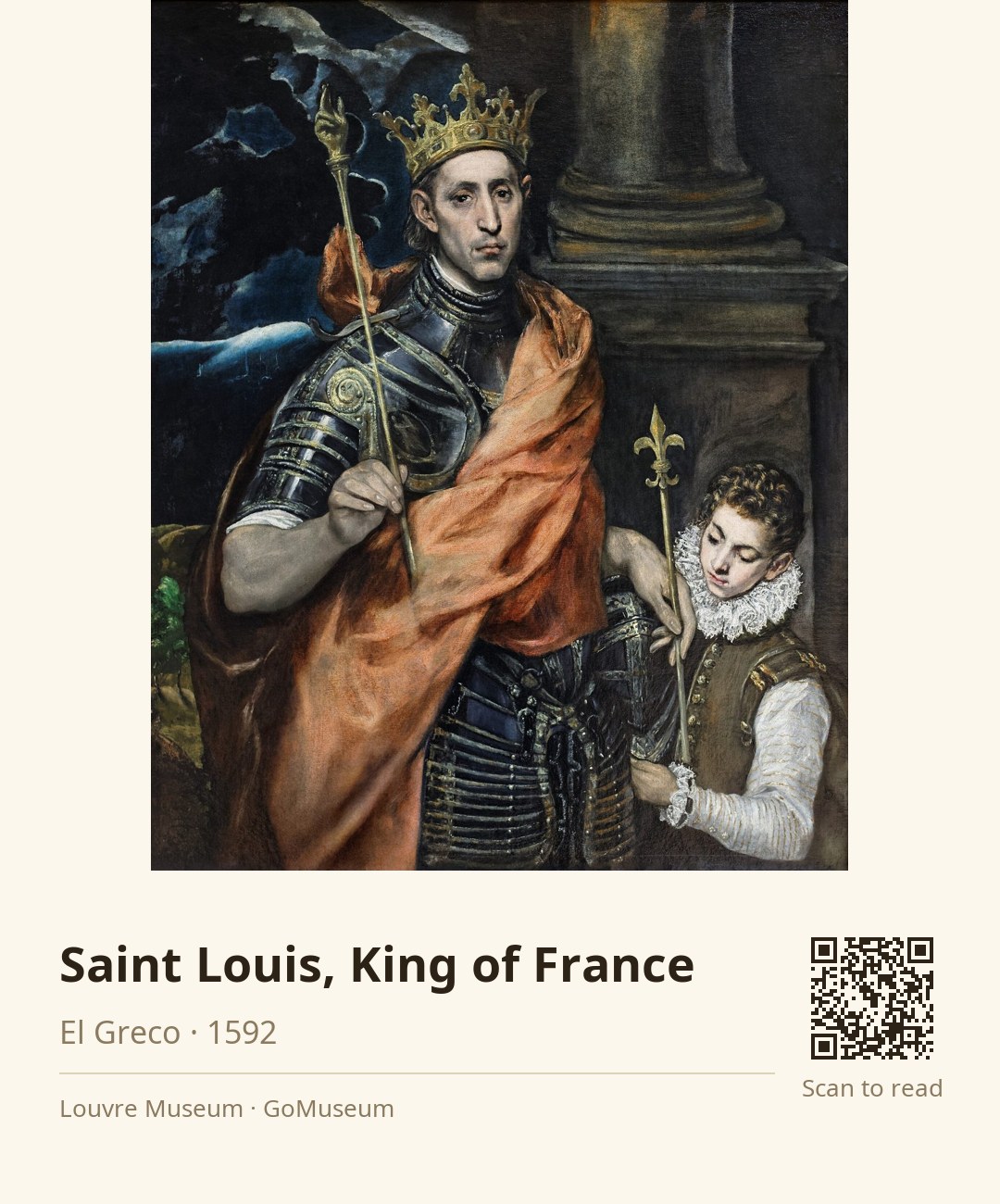
Saint Louis, King of France
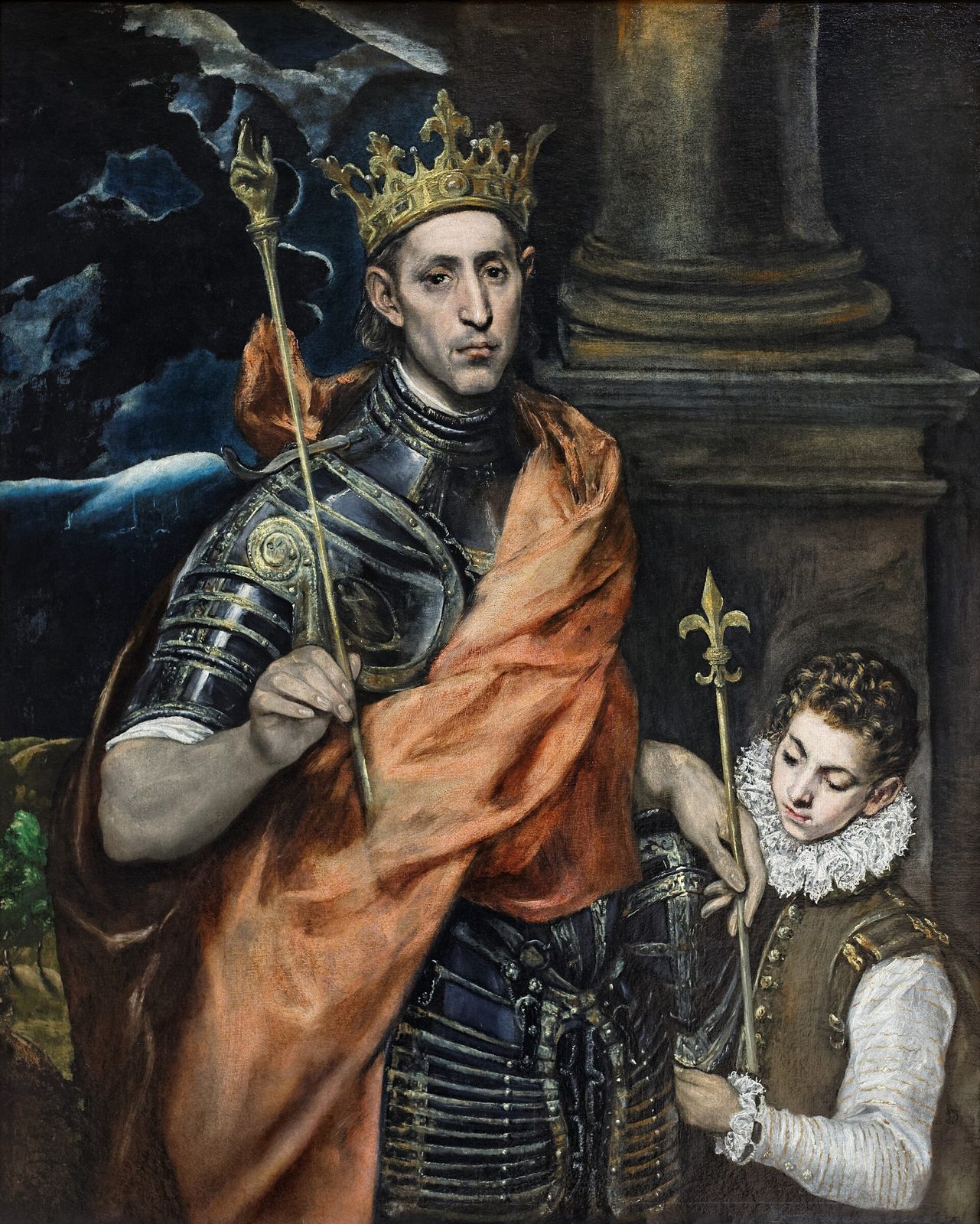
🎧 This work has audio narration — listen in the appTake a moment to really look at El Greco's "Saint Louis, King of France." Notice how the king stands tall in his 16th-century armor, the intricate details of the fleur-de-lis he holds, symbolizing his royal lineage. The way the light catches the armor creates a striking contrast against the deep colors of the background, hinting at the cityscape of Toledo that was revealed in a recent restoration.
These details matter because they tell us more than just a story of a king; they connect us to a moment in history when Louis IX was revered not just in France but also in Spain, where El Greco lived and worked. The armor reflects Louis's participation in the Crusades, a testament to his role as a defender of Christendom, while the fleur-de-lis links him to the French monarchy's identity.
El Greco painted this piece in 1592, during a time when he was deeply engaged with the spiritual and political currents of his era. Commissioned by a friend who shared the same name as the saint, this painting was more than just a portrait; it was a celebration of faith and heritage.
As you stand here, consider this: what does it mean for a king to be immortalized in such a dramatic fashion? How does this blend of history and artistry resonate with your own understanding of legacy?
Doménikos Theotokópoulos, known as El Greco, was born on October 1, 1541, in Crete, then part of the Venetian Republic. He trained as an icon painter in the Cretan school, mastering Byzantine traditions before moving to Venice at 26, where he absorbed Mannerist influences. By 1577, he settled in Toledo, Spain, where he created some of his most renowned works, including "View of Toledo" and "The Opening of the Fifth Seal." His unique style, characterized by elongated figures and vivid colors, initially puzzled contemporaries but later garnered acclaim, positioning him as a precursor to Expressionism and Cubism. Despite being overlooked for centuries, El Greco's innovative approach profoundly influenced artists like Picasso and Goya. His legacy endures, marking him as a pivotal figure in art history, celebrated for his originality and emotional depth. El Greco's life reflected a blend of cultures, embodying the spirit of the Spanish Renaissance while remaining distinctively Greek.
El Greco's 'Saint Louis, King of France' was painted between 1592 and 1595 during his time in Toledo, a city that profoundly influenced his work. The piece was commissioned by Luis de Castilla, a close friend of El Greco and a man who shared the same name as the saint. This connection made the painting not just a portrait but a personal homage. Initially, the work found its way into the collection of the château de Chenonceau before being acquired by the Louvre in 1903. The painting was well-received, particularly in Spain, where Louis IX was revered, especially since no Spanish king had been canonized until Ferdinand III in 1671. The recent restoration revealed a cityscape in the background, likely depicting Toledo, adding a layer of context to the king's portrayal.
As you gaze at 'Saint Louis, King of France,' take note of El Greco's masterful use of color and light. The deep, rich hues of the background contrast dramatically with the gleaming armor of the king, creating a sense of depth and reverence. The brushwork is both meticulous and expressive, lending a sense of movement to the static figure of Louis IX. Notice how the armor, rendered with a striking luminosity, seems to glow against the darker tones surrounding it. This technique not only highlights the king's regal stature but also evokes a spiritual aura, as if he is a divine protector. The composition is carefully structured; the verticality of the king's figure draws your eye upward, suggesting a connection to the heavens. El Greco's elongated forms and dramatic poses give the painting an almost ethereal quality, making it feel alive and dynamic, a hallmark of his unique style.
One intriguing detail about 'Saint Louis, King of France' is that it was once part of the collection at the château de Chenonceau, a historic estate in France. The painting's journey from this royal residence to the Louvre illustrates how art can traverse time and space, connecting different eras and cultures.
Luis de Castilla, who commissioned 'Saint Louis, King of France,' was not only a close friend of El Greco but also shared the same name as the saint, adding a personal and spiritual layer to the painting's creation.
The recent restoration uncovered a cityscape in the background, likely depicting Toledo, which adds a contextual layer to the portrayal of Louis IX and connects the painting more deeply to El Greco's life and environment.