The Two Sisters
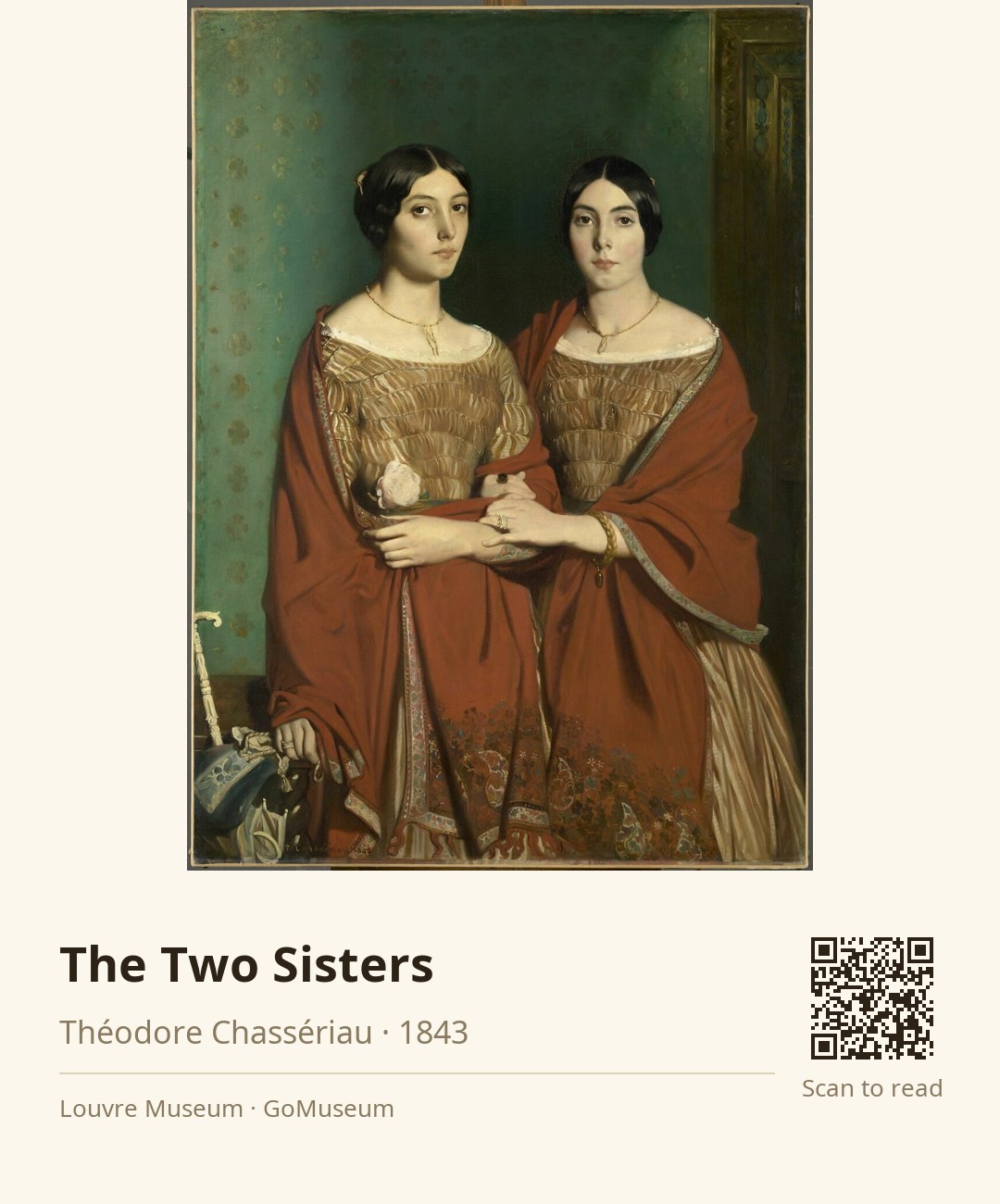
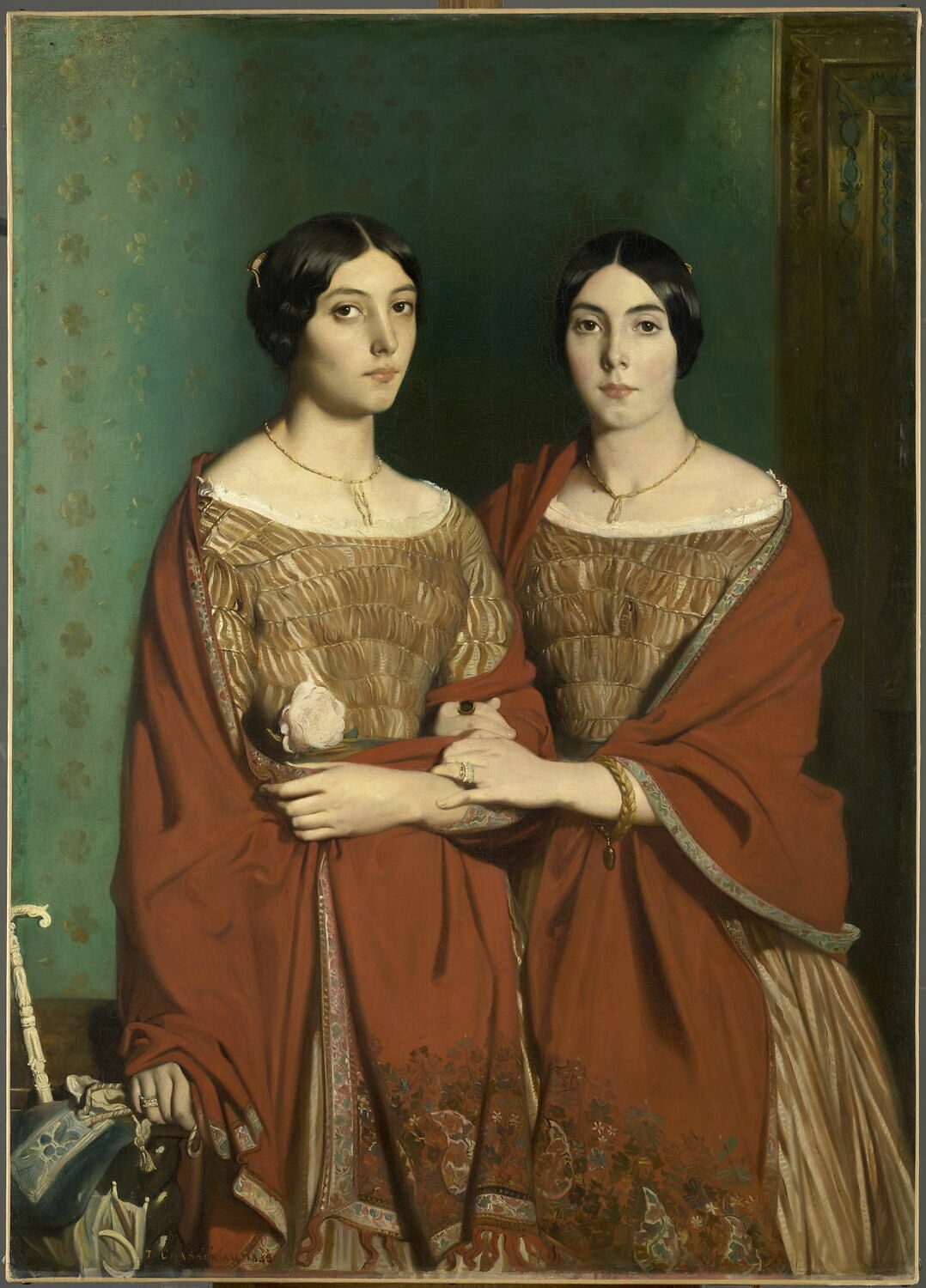
🎧 This work has audio narration — listen in the appAdèle and Aline Chassériau stand side by side in their striking gold dresses, each adorned with rich red shawls that cascade elegantly over their shoulders. The delicate pink rose held by Adèle on the left adds a touch of softness, contrasting with the boldness of their attire, while both sisters share an almost identical hairstyle and jewelry, emphasizing their close bond.
This portrayal captures not just their likeness but the essence of their relationship, suggesting a unity that transcends their age difference—Adèle is thirty-three and Aline just twenty-one. Chassériau's choice to dress them identically, with their figures firmly outlined against a muted green background, creates a sense of symmetry and harmony. The vibrant colors, particularly in the shawls, reflect his departure from the classical style of his mentor, Ingres, and reveal the influence of Romanticism, particularly the vivid palette championed by Delacroix.
Created in 1843, this painting marks a pivotal moment in Chassériau's career, showcasing his desire to assert his artistic independence.
Théodore Chassériau, born on September 20, 1819, in the Dominican Republic, was a prominent French Romantic painter known for his portraits, historical scenes, and Orientalist works. His early talent was nurtured under the guidance of Jean-Auguste-Dominique Ingres, who recognized his potential at a young age. Chassériau's style evolved from Neoclassicism to embrace the vibrant Romanticism of Eugène Delacroix, reflecting a unique blend of both influences.
Chassériau's artistic journey began in Paris, where he quickly gained recognition, exhibiting at the Salon and earning accolades for his innovative approach to the female form. His notable works include "Susanna and the Elders" and "The Toilette of Esther," showcasing his mastery of color and composition. He was also a skilled draftsman, producing a series of prints illustrating Shakespeare's "Othello."
His travels to Algeria inspired a series of dynamic works depicting Arab life, further establishing his reputation. Despite his success, Chassériau struggled with health issues and the pressures of his commissions, leading to his untimely death at 37 in 1856. He left behind a legacy that bridged classical and romantic styles, influencing future generations of artists. His contributions were celebrated by contemporaries like Théophile Gautier, who recognized him as a master in his own right, akin to Raphael.
The Two Sisters, painted in 1843 by Théodore Chassériau, is a vivid portrayal of his sisters, Adèle and Aline, who were already familiar figures in his artistic life. Commissioned during a period of personal and professional upheaval, Chassériau sought to assert his independence from his former mentor, Ingres. The painting debuted at the Salon des artistes français in Paris that same year, where it garnered mixed reviews. Critics like Louis Peisse acknowledged the challenge of depicting two women in identical attire, questioning whether Chassériau succeeded in his ambitious endeavor. Despite the initial skepticism, by the time of his death in 1856, the painting had gained recognition as one of his most significant works. It later entered the Louvre's collection in 1918, solidifying its place in art history.
Chassériau's technique in The Two Sisters is a fascinating blend of classical precision and Romantic vibrancy. The oil paint is applied with a deft hand, allowing for rich textures in the ornate dresses and the delicate shawls that envelop the sisters. The bold use of color, particularly the striking red of the shawls, reflects Chassériau's break from Ingres' restrained palette, embracing the more expressive style of Delacroix. The symmetrical composition, with both figures standing firmly outlined against a muted green background, creates a sense of harmony and balance. The artist's brushwork is confident, capturing the sheen of the fabric and the softness of the rose held by Adèle, while the overall scale of the painting enhances the intimate yet grand portrayal of familial bonds.
Interestingly, Chassériau was only twenty-three when he completed The Two Sisters, yet he had already established a reputation as a promising artist. This early achievement foreshadowed his later prominence in the art world, despite the challenges he faced in asserting his unique style.
The initial reception at the Salon was mixed, with critics acknowledging the challenges of depicting two women in identical attire.