Portrait of Isabella d'Este
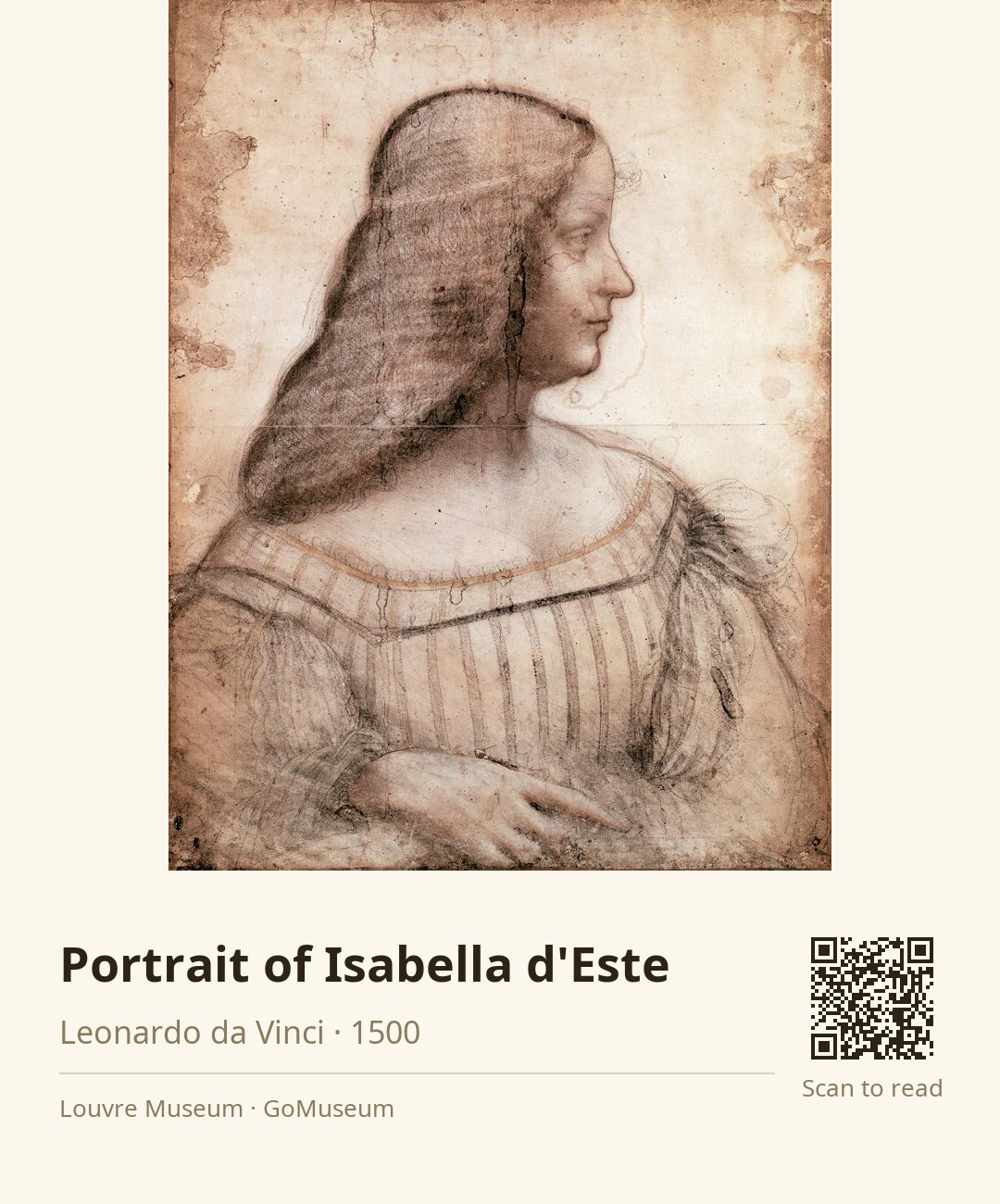
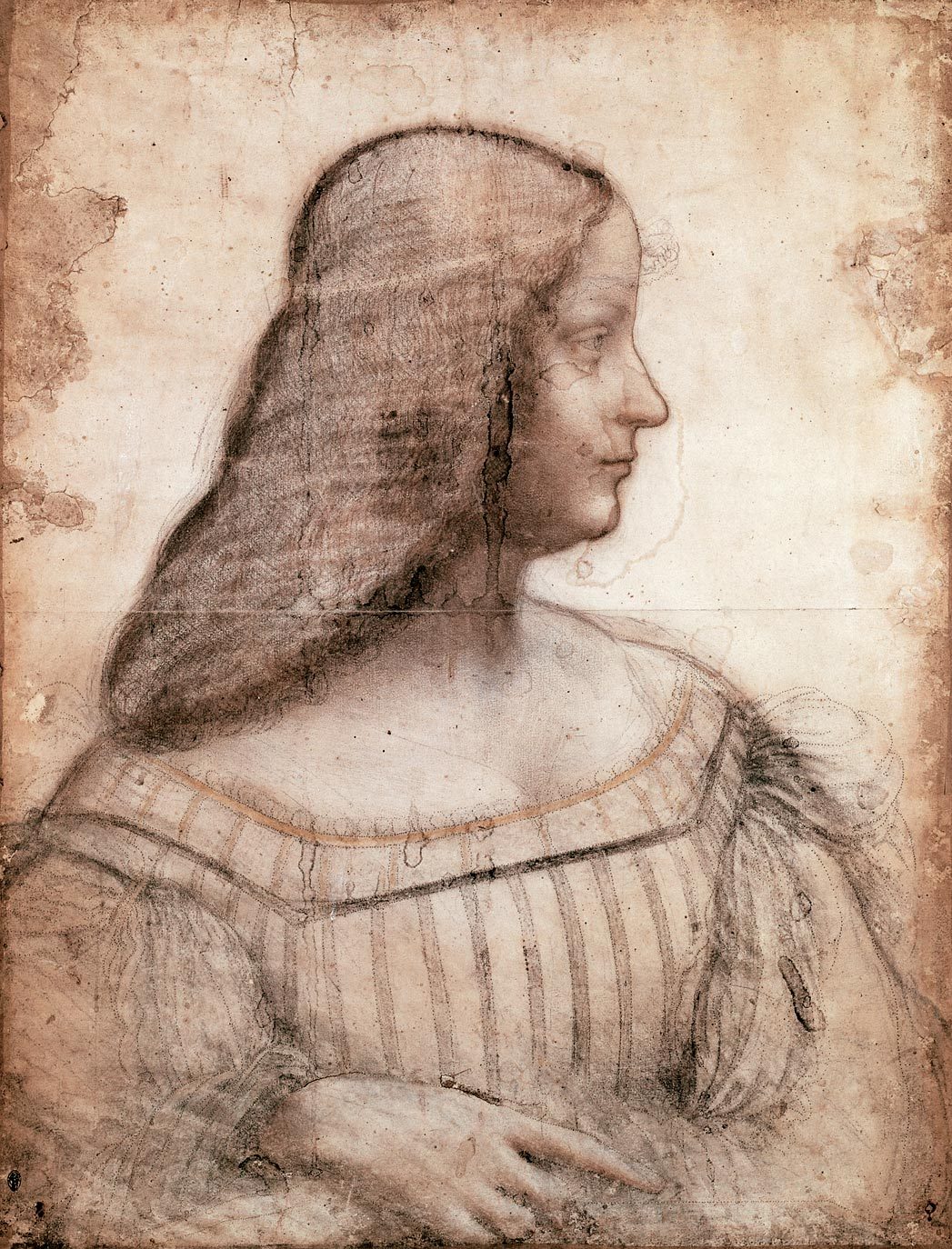
🎧 This work has audio narration — listen in the appTake a moment to really look at Isabella d'Este’s portrait. Notice how her expression is both intelligent and determined, almost as if she’s about to share a secret with you. The way her shoulders turn slightly, while her head is in profile, creates a sense of movement, as if she’s alive and ready to engage with the world around her.
These details matter because they reflect Leonardo da Vinci's mastery of capturing not just likeness, but personality. This was no ordinary commission; Isabella was a powerful figure of the Renaissance, a patron of the arts, and a woman who demanded to be represented by the best. Leonardo’s ability to convey her strength and presence speaks volumes about her status and the artist’s skill.
Created around 1500, this drawing was made during a tumultuous time in Italy, when Leonardo fled to Mantua to escape the French invasion. It was here he met Isabella, who commissioned this portrait, hoping to immortalize her image through the genius of da Vinci. Though it’s unclear if he ever completed the painting, this sketch reveals his innovative techniques and foreshadows elements that would later appear in masterpieces like the Mona Lisa.
As you stand here, think about Isabella’s legacy. What do you think she wanted future generations to remember about her?
Leonardo da Vinci, born on April 15, 1452, in Vinci, Italy, was a quintessential figure of the High Renaissance, renowned for his multifaceted genius as a painter, scientist, and inventor. Raised by his grandparents after being born out of wedlock, he received artistic training under Andrea del Verrocchio in Florence. His career flourished in Milan under Ludovico Sforza, where he produced iconic works like "The Last Supper" and began his extensive studies in anatomy and engineering.
Leonardo's notebooks reveal a relentless curiosity, encompassing subjects from botany to mechanics, showcasing his innovative spirit. Despite creating fewer than 25 major works, his influence on Western art is profound, with the "Mona Lisa" standing as a cultural icon. His visionary designs for flying machines and other inventions, though largely unfeasible in his time, reflect a forward-thinking approach that laid groundwork for future scientific exploration.
In his later years, he moved to France, where he continued to work until his death in 1519. Leonardo's legacy endures as a symbol of the Renaissance ideal, blending art and science, and inspiring generations with his empirical observations and artistic mastery. His life and work remain a testament to the boundless potential of human creativity.
The Portrait of Isabella d'Este, created around 1500, emerged during a tumultuous period in Italy, marked by the Italian Wars. Leonardo da Vinci fled Milan due to the French invasion and found refuge in Mantua, where he met Isabella d'Este, a powerful patron of the arts. She commissioned this portrait, eager to capture her image through the genius of da Vinci. While it's uncertain if he ever completed the painting, letters from the time suggest he had a finished version, though it may have been lost or never fully realized. The drawing itself is preserved in the Louvre, showcasing Leonardo's innovative techniques. Interestingly, a version of the portrait was discovered in Switzerland in 2015, raising questions about its authenticity and connection to Leonardo's original work.
Leonardo's technique in this portrait is a fascinating blend of meticulous detail and expressive brushwork. He began with a metal point on a prepared white surface, layering charcoal and colored pigments like sanguine and ochre to create depth. Notice how the fine hatching around Isabella's face captures light and shadow, giving her an almost lifelike presence. The composition is striking; her shoulders are slightly turned, while her head is in profile, creating a dynamic tension that draws your eye. This approach not only highlights her features but also suggests movement, as if she might speak at any moment.
One intriguing aspect of the Portrait of Isabella d'Este is the method of its creation. This technique was not only practical but also reflects Leonardo's innovative approach to art-making, blending traditional methods with his own unique style. The marks left on the paper from this process can still be seen today, offering a glimpse into the artist's meticulous working methods.
The drawing's relatively poor condition and the unusual coloring techniques used led to earlier misattributions to other artists, including Leonardo's pupil Giovanni Antonio Boltraffio, before a consensus emerged recognizing it as a work by Leonardo.
In 2015, a version of the portrait was discovered in Switzerland, raising questions about its authenticity and whether it could be linked to Leonardo's original work, thus reigniting interest in Isabella's representation and Leonardo's legacy.