Oedipus and the Sphinx
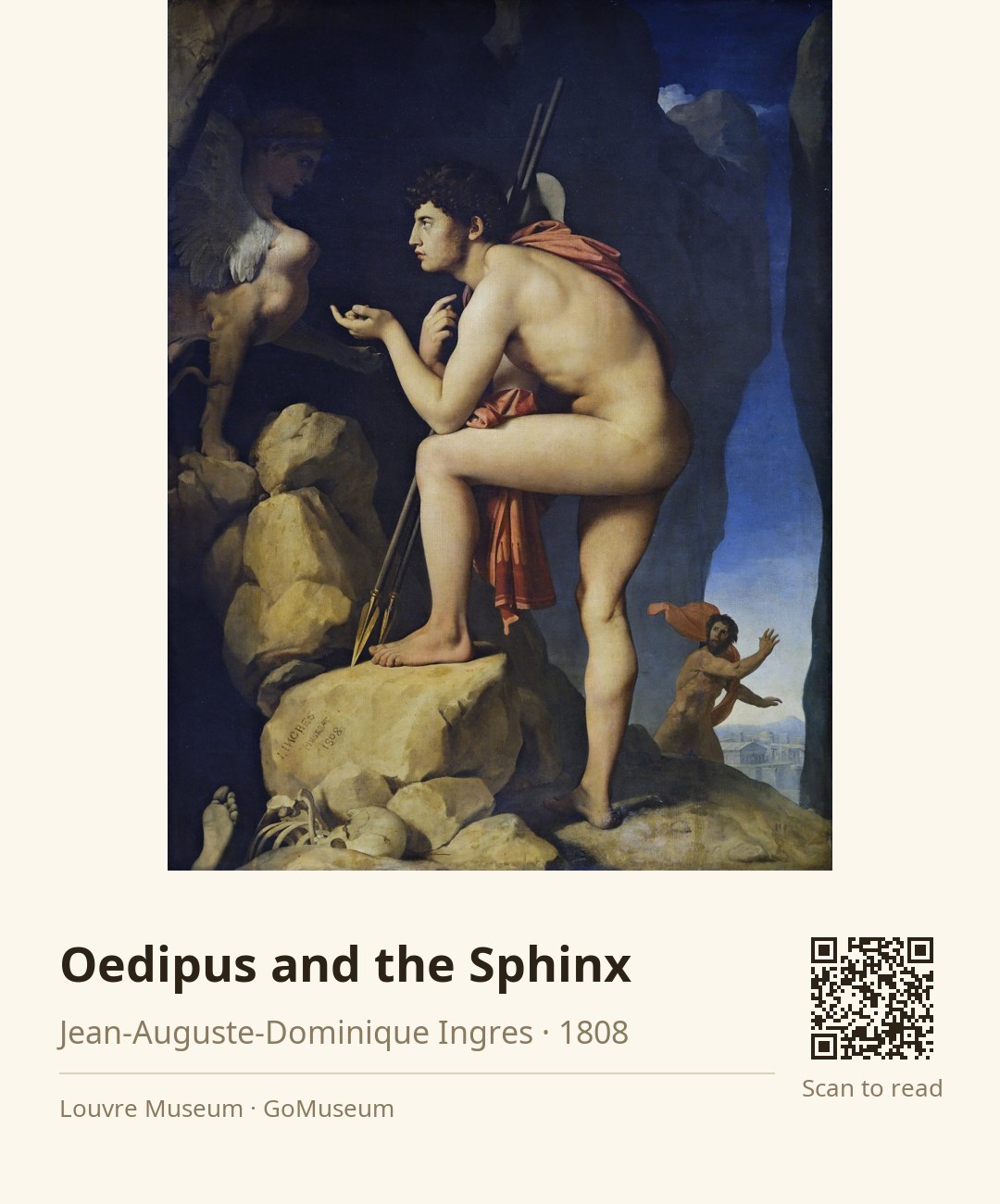
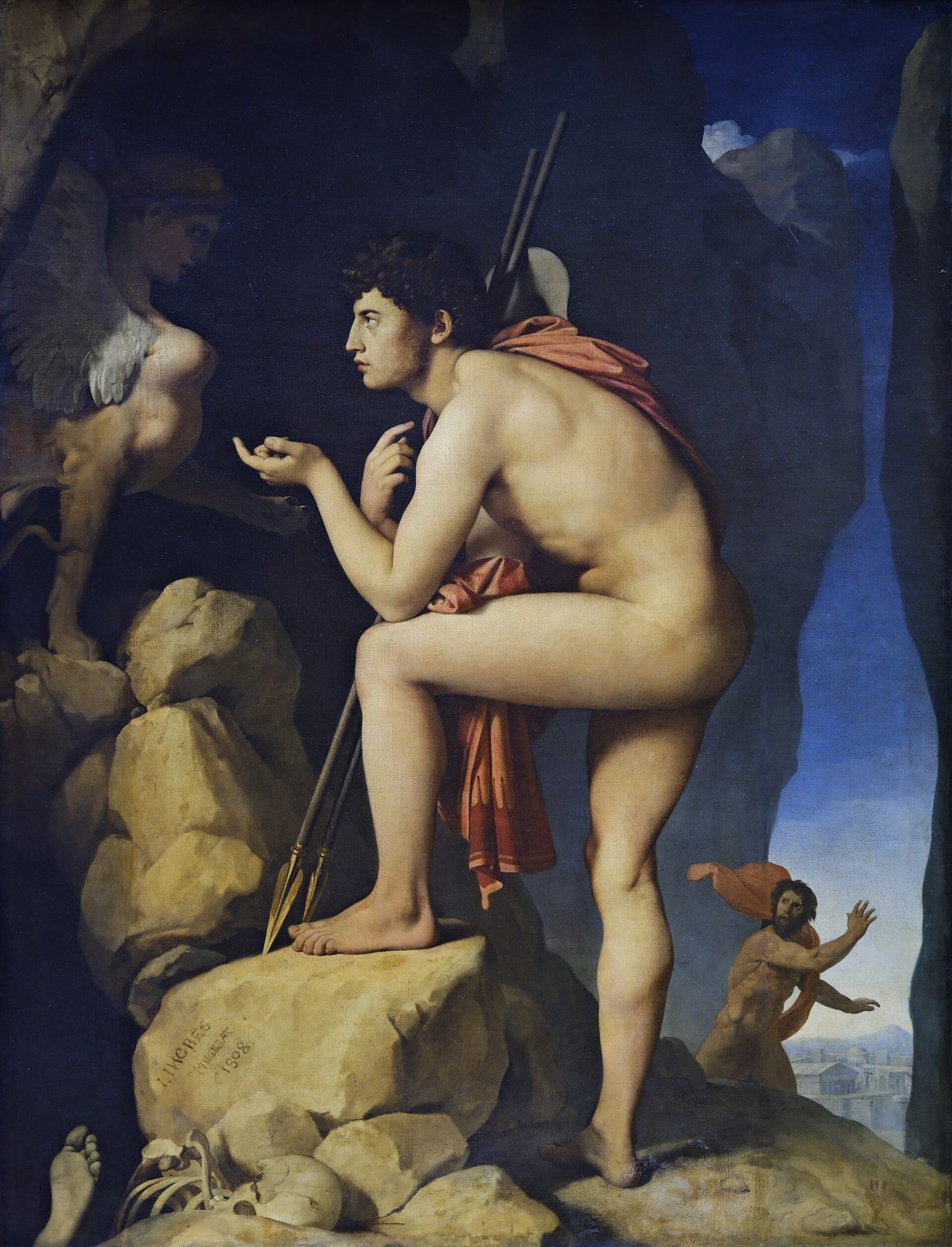
🎧 This work has audio narration — listen in the appTake a moment to really look at "Oedipus and the Sphinx" by Ingres. Notice how Oedipus stands confidently, his body illuminated by light, while the Sphinx looms ominously in shadow. The contrast between light and dark here isn’t just for drama; it symbolizes the struggle between knowledge and ignorance.
Oedipus, naked except for a striking red drape, holds two spears, ready to confront the riddle that has claimed so many lives. The Sphinx, with her fierce gaze and lion's body, represents the danger of the unknown. This tension is palpable, and it invites you to ponder the weight of Oedipus's choice—solving the riddle means salvation for Thebes, but it also leads him down a tragic path.
Painted in 1808, this piece was Ingres's first major work, showcasing his mastery of form and narrative.
As you stand here, think about the riddle itself: “What walks on four legs in the morning, two legs at noon, and three legs in the evening?” What does this riddle say about the human experience? How does it resonate with your own life?
Jean-Auguste-Dominique Ingres was a pivotal figure in French Neoclassicism, born on August 29, 1780, in Montauban. He was the son of a versatile artist, which nurtured his early artistic inclinations. Ingres studied under Jacques-Louis David in Paris, where he developed a commitment to academic traditions, aspiring to elevate history painting above all genres. His early career was marked by struggles, as critics dismissed his style as archaic, yet he persevered, achieving recognition with works like "The Vow of Louis XIII" in 1824.
His portraits, characterized by expressive distortions, became his most celebrated contributions, influencing modern artists such as Matisse and Picasso. Ingres's time in Italy, from 1806 to 1824, was crucial; he immersed himself in the study of Renaissance masters, which shaped his distinctive style. Despite facing criticism for his meticulous approach, he remained steadfast in his vision of beauty, emphasizing drawing over color.
Later in life, he returned to Paris, where he continued to create significant works, including "The Turkish Bath." Ingres's legacy endures as a bridge between classical traditions and modern art, embodying the tension between adherence to established norms and the evolving landscape of artistic expression. He passed away on January 14, 1867, leaving behind a profound impact on the art world.
Jean-Auguste-Dominique Ingres began painting 'Oedipus and the Sphinx' in Rome after winning the Grand Prix de Rome in 1801. This was a pivotal moment in his career, as he was required to send works back to Paris for evaluation. His original submission in 1808 included a life-size figure of Oedipus, which was met with mixed reviews, particularly criticizing the treatment of light and the idealization of figures. Ingres kept the painting in his studio for years, and around 1825, he decided to expand it into a more dynamic narrative scene. By adding to the canvas and enhancing the drama with contrasting light and shadow, he transformed it into the striking piece we see today. The finished work debuted at the Salon in November 1827, where it was well-received. Ingres sold it in 1829, and it eventually made its way to the Louvre in 1878, following a bequest from the Comtesse Duchâtel.
As you gaze at 'Oedipus and the Sphinx,' pay attention to Ingres's meticulous brushwork and his bold use of color. The figures are rendered with a precision that highlights their muscular forms, while the background fades into softer hues, creating a sense of depth. Notice how the light bathes Oedipus, emphasizing his heroic stance, while the Sphinx remains shrouded in shadow, enhancing her menacing presence. The composition is carefully structured, with Oedipus positioned centrally, drawing your eye immediately to him. The addition of human remains in the lower left corner adds a layer of narrative tension, suggesting the stakes of the riddle he faces. Ingres's choice to enlarge the canvas allowed him to create this dramatic interplay of light and shadow, effectively heightening the emotional impact of the scene.
Interestingly, Ingres created a smaller third version of 'Oedipus and the Sphinx' in 1864, which reverses the composition and alters many details. This later work reflects his continued fascination with the subject and his desire to reinterpret his earlier ideas, showing how even established artists like Ingres were always evolving in their craft.
In the enlarged version of 'Oedipus and the Sphinx,' Ingres included human remains in the lower left corner, which heightens the narrative tension and underscores the stakes of the riddle Oedipus faces.
Ingres's experience as a student at the Villa Medici, where he was required to send works back to Paris for evaluation, played a crucial role in shaping 'Oedipus and the Sphinx,' as it was initially created as part of his studies but later evolved into a more complex narrative scene.
The original submission of 'Oedipus and the Sphinx' was met with mixed reviews, with critics particularly noting the treatment of light and the idealization of figures, which prompted Ingres to keep the painting in his studio for years before reworking it.