Echo and Narcissus
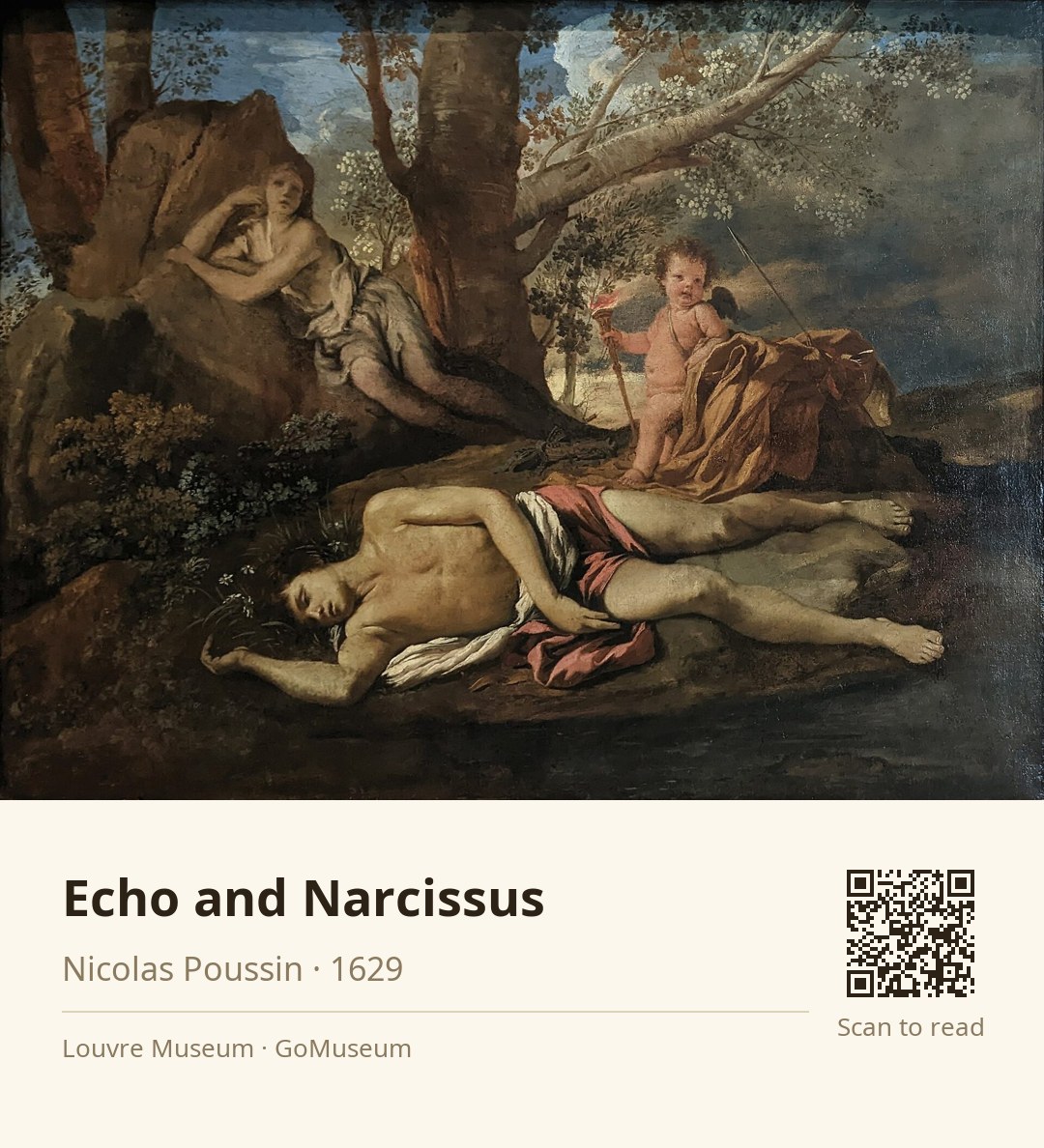
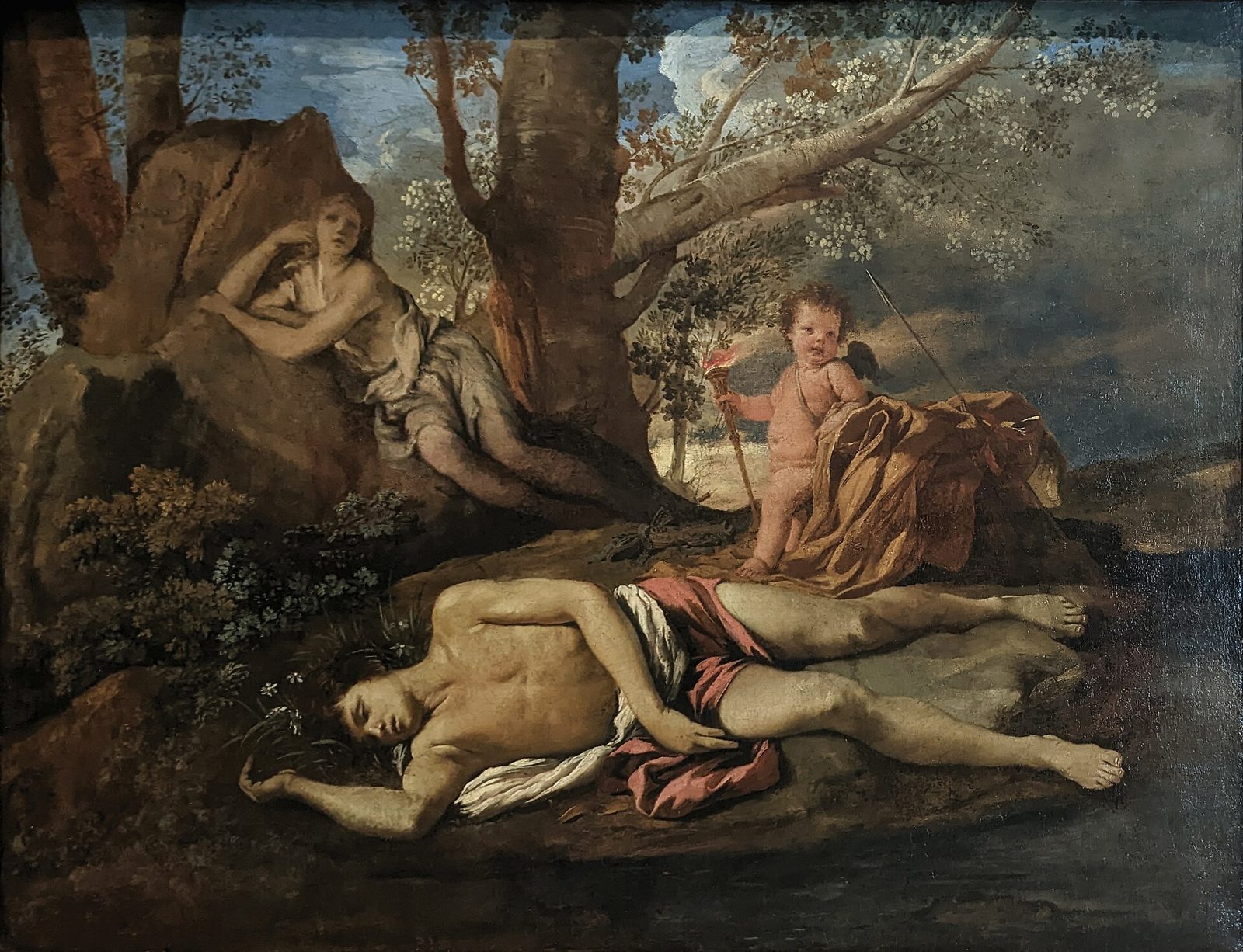
🎧 This work has audio narration — listen in the appTake a moment to really soak in Poussin's "Echo and Narcissus." Notice how Narcissus lies there, almost ethereal, surrounded by blooming flowers that seem to cradle his head. Just behind him, Eros, the god of love, watches over the scene, while Echo, the heartbroken nymph, leans against a rock, her form almost fading into the landscape.
These details matter because they encapsulate the tragic beauty of the myth: Narcissus, entranced by his own reflection, is doomed to love what he can never truly possess, while Echo, forever silenced, embodies unrequited love. Poussin captures this poignant moment with a serene yet melancholic landscape, inviting you to reflect on the nature of love and loss.
As you stand before this artwork, consider: what does it mean to love something you can never have? How does that resonate with your own experiences? Let that question linger as you take in the beauty of this moment frozen in time.
Nicolas Poussin, born in June 1594 near Les Andelys, was a pivotal figure in the classical French Baroque movement, spending most of his career in Rome. His early life was marked by a passion for art that led him to Paris at eighteen, despite his parents' opposition. In Paris, he struggled initially, but his exposure to royal collections ignited his admiration for Italian masters, particularly Raphael. This influence shaped his distinctive style, characterized by clarity, order, and a preference for line over color.
Poussin's artistic journey took him to Rome in 1624, where he developed a reputation for his religious and mythological works, often commissioned by a select group of collectors. His notable pieces include "The Death of Germanicus" and "The Massacre of the Innocents." Although he briefly returned to France as First Painter to Louis XIII, he found the court's demands stifling and returned to Rome, where he continued to evolve, integrating landscapes into his compositions.
His legacy is profound; Poussin's emphasis on classical themes and structure influenced generations of artists, including Jacques-Louis David and Paul Cézanne. He remains a cornerstone of classical painting, with around 260 attributed works and nearly 400 drawings, solidifying his place in art history until his death in 1665.
Commissioned for a select group of collectors, this oil on canvas piece measures 74 by 100 cm and is now housed in the Louvre, Paris. The painting illustrates the tragic tale of Narcissus, who falls in love with his own reflection, a theme rooted in Ovid's 'Metamorphoses.' Poussin's work was part of a broader trend in the early 17th century where artists began to explore mythological subjects, and it was received with intrigue and admiration. Over time, it has become a significant example of Poussin's classical style, reflecting his deep engagement with both the landscape and the emotional weight of the story.
As you gaze at "Echo and Narcissus," take a moment to appreciate Poussin's meticulous brushwork. Notice how the delicate strokes create a soft, almost ethereal quality around Narcissus, enhancing his otherworldly presence. The color palette is carefully chosen—muted earth tones contrast with the vibrant blooms encircling Narcissus's head, drawing your eye to the tragic beauty of his fate. The composition is structured yet fluid, with Echo’s form leaning against the rock, creating a visual balance that invites contemplation. Poussin's use of light adds depth, casting gentle shadows that evoke a sense of intimacy in this mythical moment.
Living in Rome allowed Poussin to immerse himself in classical art and architecture, which deeply influenced his approach to composition and clarity, evident in the serene yet dramatic depiction of the myth.