 Image: Coyau
Christ on the Cross Adored by Donors
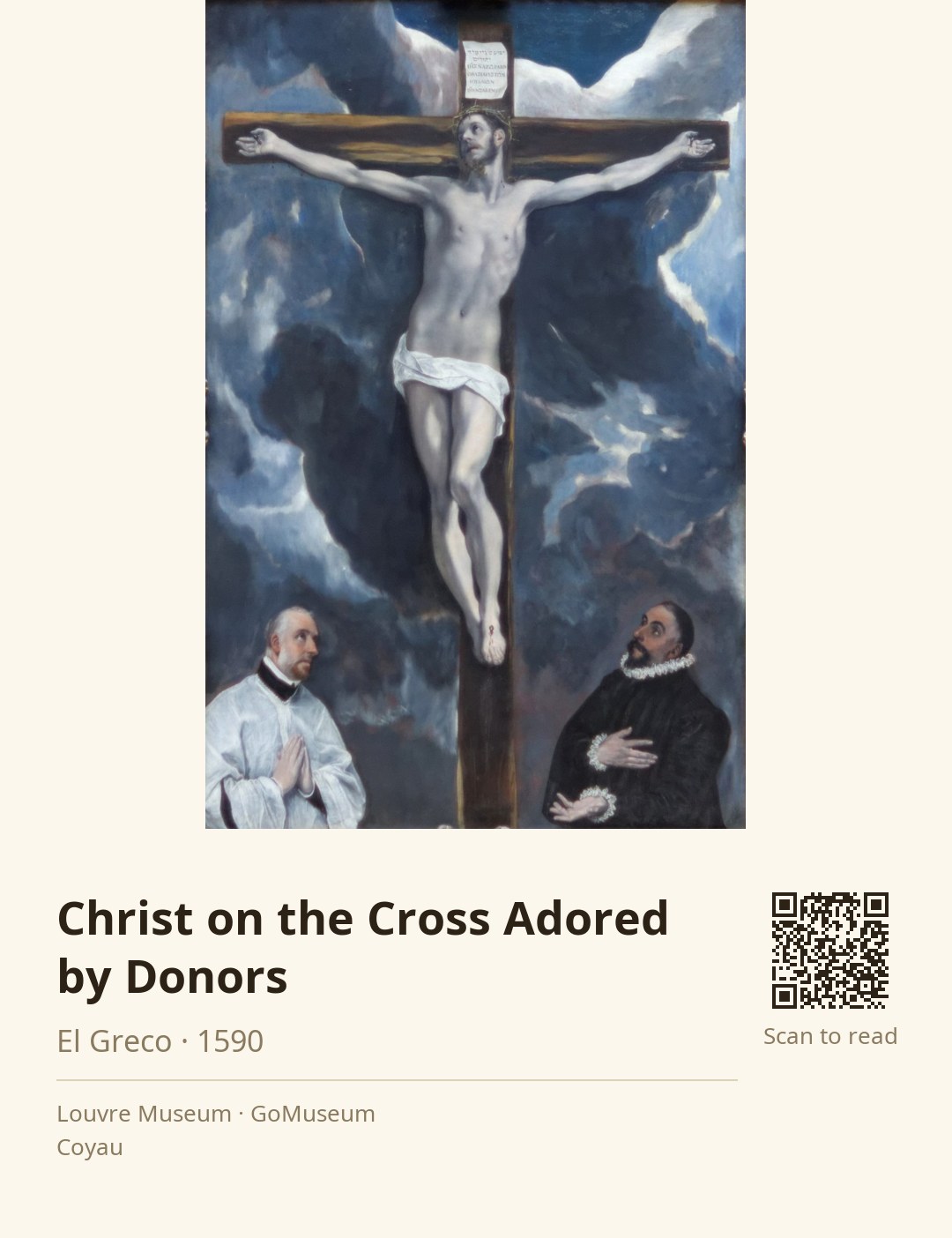
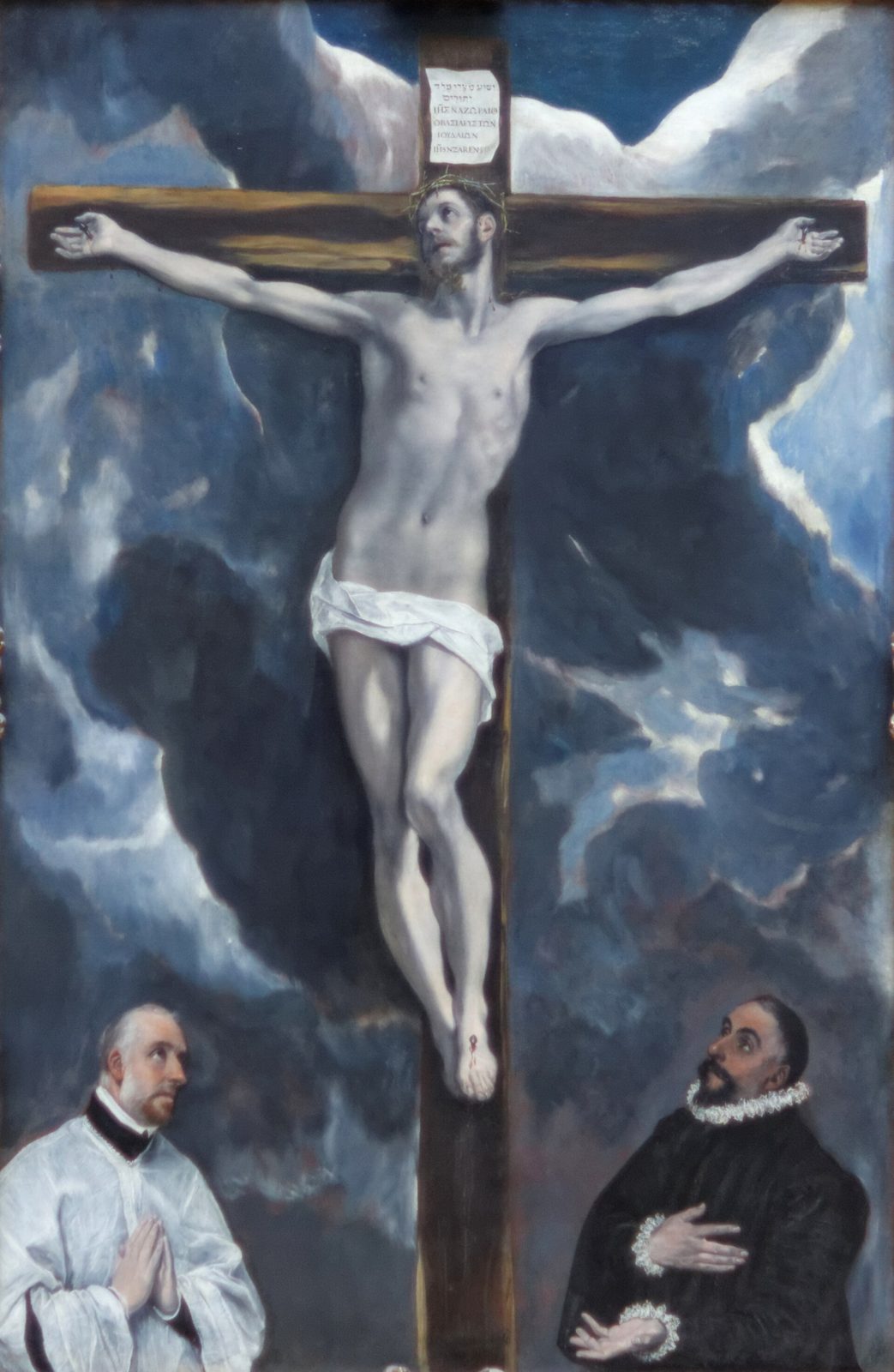
🎧 This work has audio narration — listen in the appTake a moment to really look at El Greco's "Christ on the Cross Adored by Donors." Notice how Christ’s body is elongated, almost stretching towards the heavens, while the stormy sky behind him adds a sense of drama. This isn’t just a depiction of suffering; it’s a powerful expression of divine connection and human devotion.
The two figures below, likely donors of the painting, are positioned where you’d typically find the Virgin Mary and St. John. Their presence here emphasizes their humble worship and the personal relationship they sought with Christ. It’s a striking reminder that faith can be deeply personal, even in the grand narratives of religious art.
Commissioned for a chapel in Toledo, this piece reflects El Greco’s unique blend of Byzantine and Western styles, capturing the emotional intensity of the moment. Born in Crete and trained in Italy, El Greco brought a fresh perspective to Spanish art, which was often more restrained.
So, as you stand here, consider: what does this painting say about your own relationship with faith or devotion? How does it resonate with your experiences today?
Doménikos Theotokópoulos, known as El Greco, was born on October 1, 1541, in Crete, then part of the Venetian Republic. He trained as an icon painter in the Cretan school, mastering Byzantine traditions before moving to Venice at 26, where he absorbed Mannerist influences. By 1577, he settled in Toledo, Spain, where he created some of his most renowned works, including "View of Toledo" and "The Opening of the Fifth Seal." His unique style, characterized by elongated figures and vivid colors, initially puzzled contemporaries but later garnered acclaim, positioning him as a precursor to Expressionism and Cubism. Despite being overlooked for centuries, El Greco's innovative approach profoundly influenced artists like Picasso and Goya. His legacy endures, marking him as a pivotal figure in art history, celebrated for his originality and emotional depth. El Greco's life reflected a blend of cultures, embodying the spirit of the Spanish Renaissance while remaining distinctively Greek.
El Greco's 'Christ on the Cross Adored by Donors' was painted around 1590, specifically commissioned for a chapel in the Hieronymite monastery in Toledo. The two figures at the foot of the cross are believed to be Dionisio Melgar, a canon of the monastery, and another unidentified local, possibly Blas de Fuentechada or Pablo Rodríguez de Belalcázar. After its completion, the artwork remained in the monastery until 1715, when it was acquired by Louis Philippe of France in the 19th century. It was later displayed at the 1908 autumn salon in Paris, where it caught the attention of art collectors and eventually found its home in the Louvre, Paris.
As you gaze at this painting, notice the dramatic interplay of light and shadow that El Greco masterfully employs. The elongated forms of Christ and the donors create a sense of verticality, drawing your eye upward, as if inviting you to join in their reverent gaze towards the heavens. The brushwork is fluid yet deliberate, with swirling strokes that evoke the turbulence of the stormy sky, mirroring the emotional intensity of the scene. The color palette is striking, with deep blues and grays contrasting against the pale flesh tones, enhancing the divine aura surrounding Christ. El Greco's choice of composition, placing the donors in the foreground, not only personalizes the scene but also establishes a direct dialogue between them and the viewer, making the experience of devotion feel immediate and intimate.
His unique style, characterized by elongated figures and expressive color, paved the way for future movements such as Expressionism and Cubism. Artists like Francisco Goya and Pablo Picasso drew inspiration from his bold approach, seeing in his work a way to express deeper emotional truths. This painting serves as a testament to how art can transcend its immediate context, influencing generations and reshaping the landscape of Western art.
Interestingly, El Greco's full name, Doménikos Theotokópoulos, reflects his Greek heritage, yet he is often celebrated as a Spanish artist. His unique blend of Byzantine and Western styles was initially met with confusion by his contemporaries, but it later became a source of inspiration for many modern artists, illustrating how an artist's vision can take time to be fully appreciated.
When El Greco first arrived in Spain, his dramatic and expressionistic style was met with confusion and skepticism by many of his contemporaries, who were accustomed to more traditional forms of painting. This initial rejection highlights how ahead of his time he was, as his unique approach would later influence numerous modern art movements.
After its completion, 'Christ on the Cross Adored by Donors' remained in the Hieronymite monastery until 1715, illustrating how it was initially appreciated within a religious context. Its acquisition by Louis Philippe in the 19th century and subsequent display at the 1908 autumn salon in Paris show a shift in taste, as collectors began to recognize and value El Greco's innovative style.
Many viewers might overlook the fact that the two donors are depicted in a manner that traditionally would have been reserved for saints, suggesting their elevated status in the eyes of the church and their deep devotion. This artistic choice not only personalizes their worship but also invites the viewer to consider the significance of their presence in the scene.