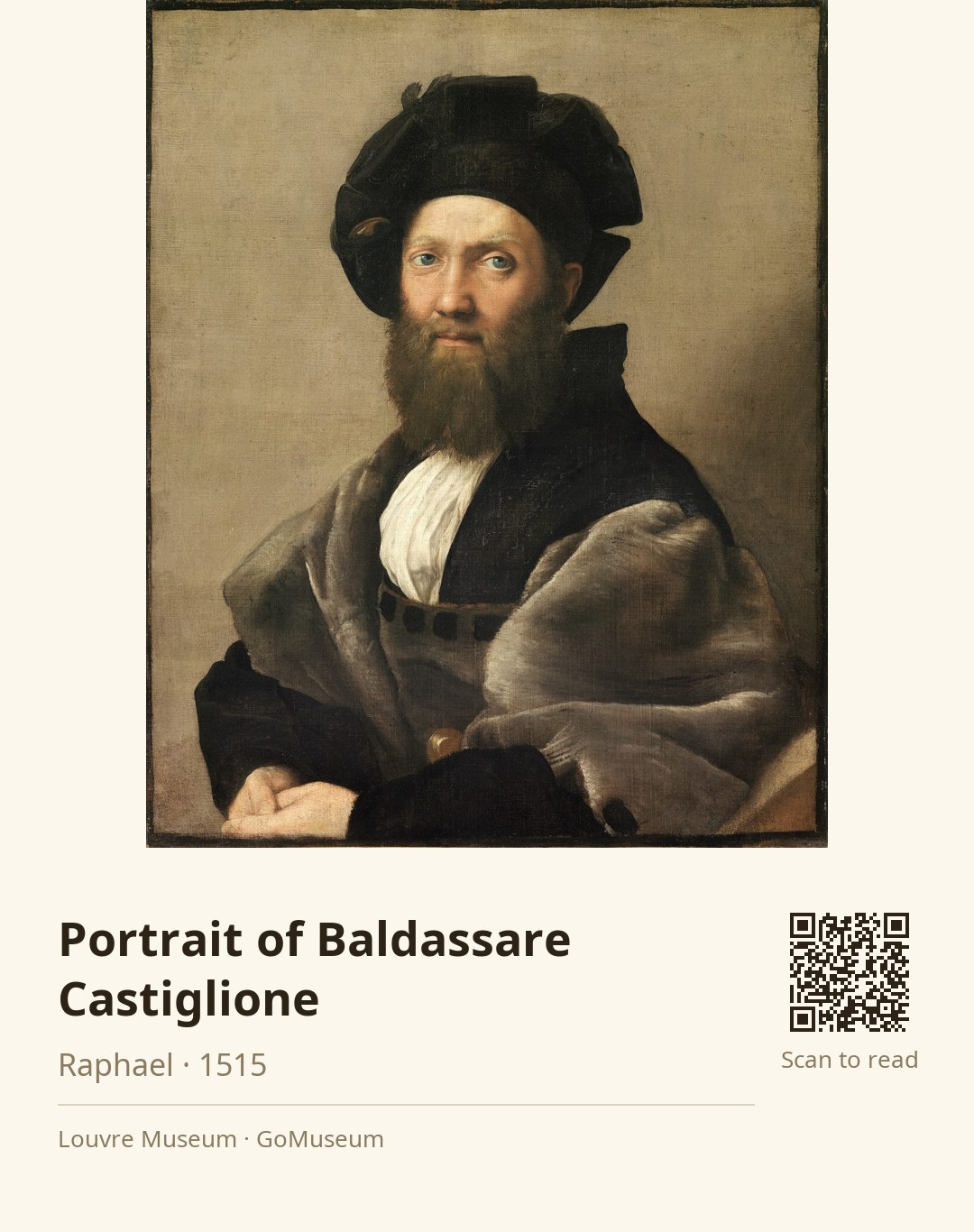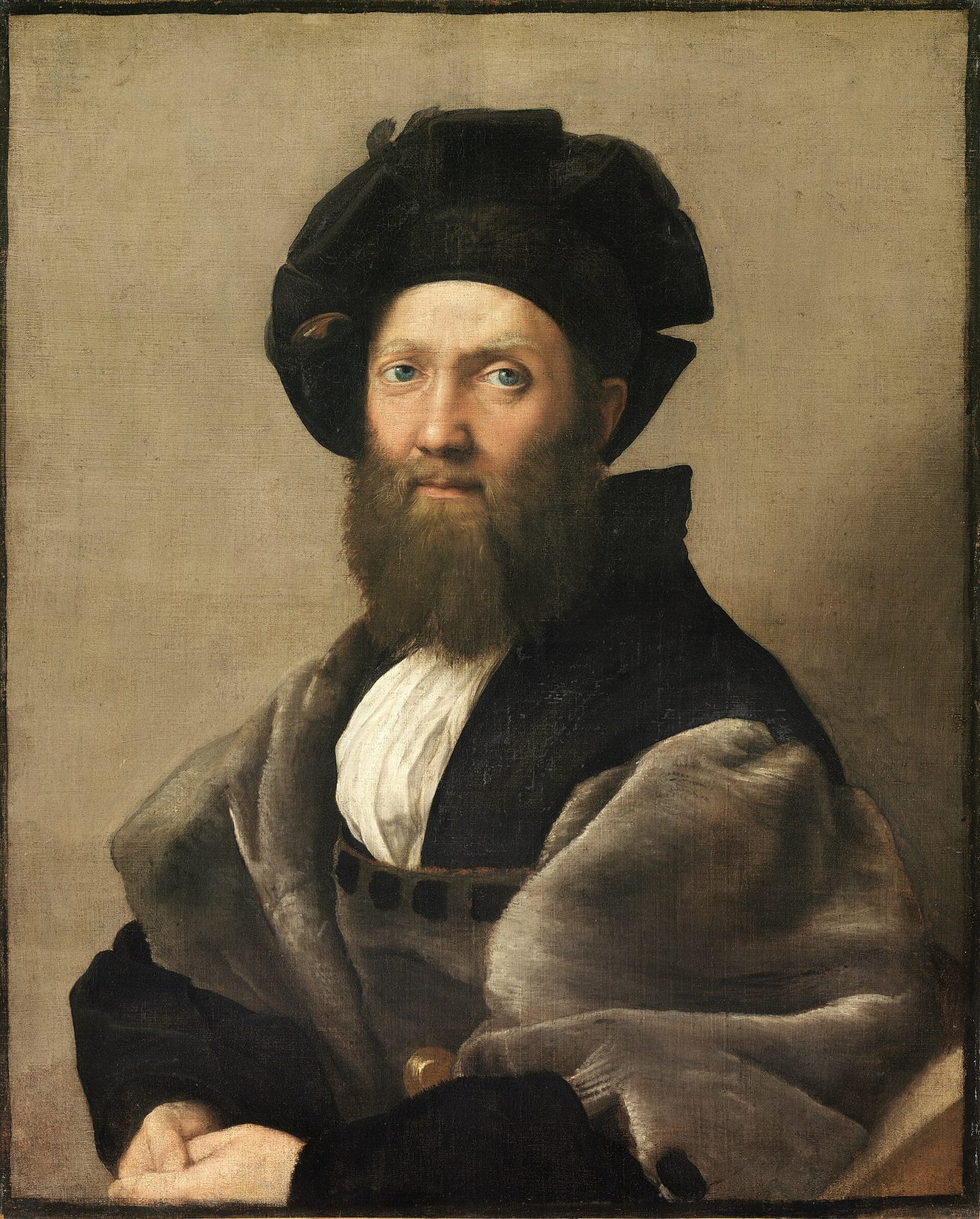
Portrait of Baldassare Castiglione
🎧 This work has audio narration — listen in the appTake a moment to really look at Raphael's "Portrait of Baldassare Castiglione." Notice how Castiglione's gaze meets yours, a blend of confidence and introspection. His dark doublet, trimmed with fur, contrasts beautifully with the soft white of his shirt, drawing your eye to his serene expression.
These details matter because they encapsulate the essence of the High Renaissance gentleman—an ideal Castiglione himself championed in his writings. The way he carries himself, dressed in understated elegance, speaks volumes about the values of grace and refinement that defined his era.
Raphael painted this portrait around 1515, during a time when Castiglione was deeply embedded in the cultural and diplomatic life of Rome, serving under Pope Leo X. Their friendship blossomed in the court of Urbino, where both men navigated the complexities of art and politics.
As you stand here, think about the legacy of this portrait. It not only captures a man but also embodies the spirit of an age that celebrated intellect and artistry. What does Castiglione's expression say to you about the ideals of his time?
Raffaello Sanzio da Urbino, known as Raphael, was an Italian painter and architect of the High Renaissance, born in Urbino in 1483. Orphaned by age eleven, he managed his family's workshop and trained under Pietro Perugino, establishing himself as a master by 1500. His move to Rome in 1508 marked the beginning of a prolific period, where he received significant commissions, including the renowned frescoes in the Vatican's Raphael Rooms. His art is celebrated for its clarity, harmonious composition, and embodiment of Neoplatonic ideals. Raphael's influence was profound, shaping the trajectory of Western art and serving as a model for academies until the 19th century. His legacy, characterized by serenity and grace, was later revived in the 18th and 19th centuries, contrasting with the dramatic styles of his rival Michelangelo. Despite his early death at 37, Raphael's extensive body of work and innovative techniques left an indelible mark on the art world, influencing generations of artists and extending into contemporary culture.
Raphael's 'Portrait of Baldassare Castiglione' was painted between 1514 and 1515, during a pivotal time in both the artist's and the subject's lives. Castiglione, a diplomat and humanist, was a close friend of Raphael, and their relationship blossomed in the cultured court of Urbino. This portrait was likely commissioned by Guidobaldo da Montefeltro, Castiglione's patron, and it reflects the ideals of the High Renaissance gentleman that Castiglione himself advocated in his writings. The painting has a rich history, having been part of the collection of the Duke of Urbino before passing to Cardinal Mazarin and eventually to Louis XIV. Its journey through time showcases its significance, as it was admired and sought after by various collectors and artists, solidifying its place in art history.
Notice the way Raphael captures the essence of Castiglione through his masterful brushwork. The composition is pyramidal, guiding your eye to the serene expression on Castiglione's face, which is illuminated against the earth-toned background. The dark doublet, trimmed with fur, contrasts with the soft white of his shirt, creating a striking visual balance. Raphael's handling of light is particularly noteworthy; the soft contours of Castiglione's clothing and the gentle play of light on his face evoke a sense of vulnerability and depth. The subtlety in the rendering of textures, especially the gray velvet, showcases Raphael's skill in creating a sense of realism while maintaining an elegant simplicity. This painting is a testament to Raphael's ability to blend classical ideals with the intimate portrayal of his subjects.
Artists like Titian and Rembrandt drew inspiration from Raphael's approach, with Rembrandt even referencing this portrait in his own self-portraits. The painting's elegance and refinement became a model for the Baroque period and beyond, shaping the way portraiture was conceived and executed. Its impact can be seen in the works of later masters and continues to resonate in the art world today.
One intriguing anecdote about this portrait is that Castiglione, while away in Rome, wrote a poem imagining his wife and son finding solace in his likeness. This intimate connection adds a layer of emotional depth to the painting, transforming it from a mere representation into a cherished keepsake that bridged the distance between family members.
Castiglione wrote a poem imagining his wife and son finding comfort in his likeness while he was away in Rome, suggesting that the portrait served as an emotional connection for his family.
The pyramidal composition and serene expression in Castiglione's portrait suggest an homage to Leonardo da Vinci's Mona Lisa, indicating Raphael's recognition of his predecessor's impact on portraiture.
Historical copies of the portrait show Castiglione's hands in full, implying that the original painting may have been cropped at the bottom, although later research determined it has not actually been cut.