The Astronomer
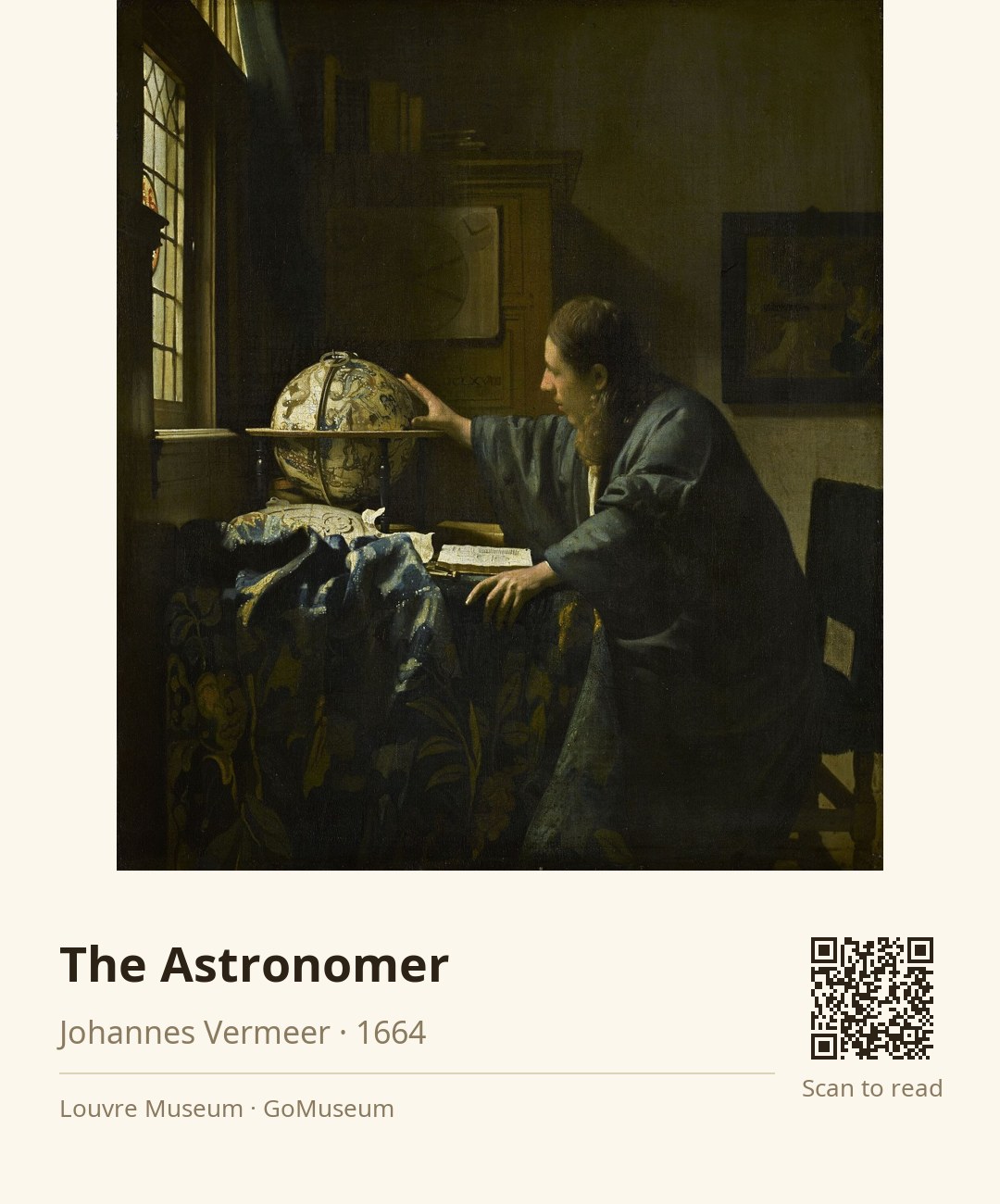
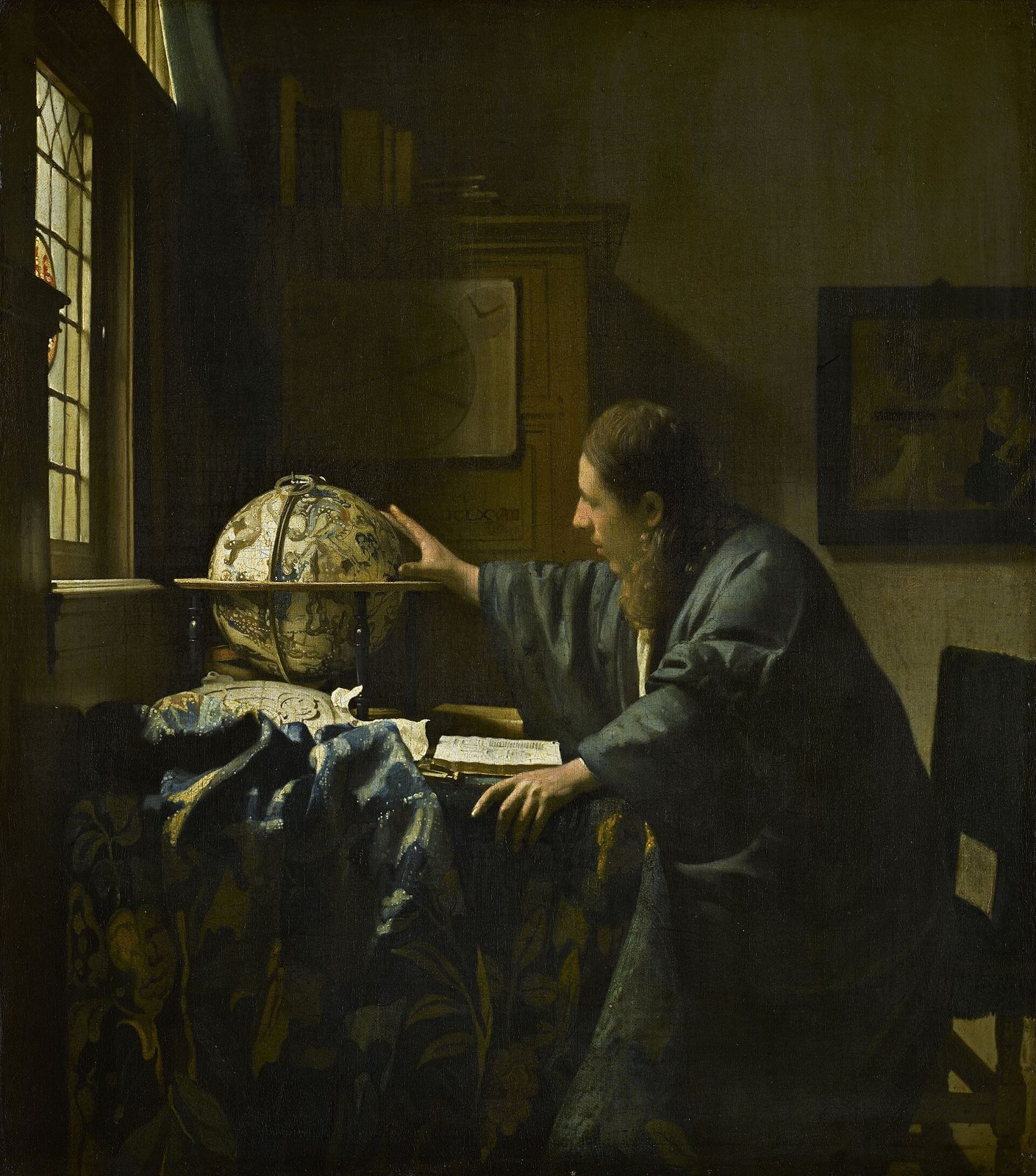
🎧 This work has audio narration — listen in the appTake a moment to really look at Vermeer’s "The Astronomer." Notice how the light spills into the room, illuminating the figure of the astronomer as he studies the celestial globe. His hand is poised delicately, almost as if he’s about to reach out and touch the stars themselves. Look closely at the intricate details of the globe; you can see the constellations mapped out, a testament to the scientific curiosity of the 17th century.
These details matter because they reveal Vermeer’s fascination with knowledge and exploration. The globe, crafted by Jodocus Hondius, symbolizes the merging of astronomy and geography, two fields that were deeply intertwined during this period. The open book on the table, with its advice to seek divine inspiration, suggests that Vermeer saw science not just as a pursuit of facts, but as a spiritual journey as well.
Painted in 1668, this work is part of a tradition in Dutch art that celebrated scientists and scholars, reflecting the Enlightenment ideals of the time. Vermeer’s meticulous technique and use of light make this scene feel intimate and contemplative, inviting you to share in the astronomer’s quest for understanding.
As you stand here, think about the role of science in our lives today. What mysteries are you curious about? What knowledge are you seeking? Let this painting inspire you to explore the universe in your own way.
Johannes Vermeer, born in Delft in 1632, was a Dutch painter renowned for his intimate domestic scenes that capture the essence of middle-class life. His meticulous approach and masterful use of light set him apart during the Dutch Golden Age, yet he remained relatively obscure during his lifetime, primarily recognized in his local circles. Vermeer produced only about 34 paintings, often depicting the same interiors and figures, predominantly women, which contributed to his unique style that blends familiarity with mystery.
Despite his artistic talent, Vermeer struggled financially, operating an art dealership and leaving his family in debt upon his death in 1675. His work fell into obscurity until the 19th century when critics like Théophile Thoré-Bürger rediscovered him, leading to a resurgence of interest. Today, Vermeer is celebrated alongside masters like Rembrandt and Hals, with iconic works such as "Girl with a Pearl Earring" and "The Milkmaid" solidifying his place in art history. His paintings continue to captivate audiences, showcasing a harmonious blend of color, light, and composition that reflects a world more perfect than his own.
Johannes Vermeer completed 'The Astronomer' in 1668, a time when Dutch painting was flourishing and artists were increasingly depicting scenes of scientific inquiry. This particular piece was likely commissioned by a private patron, although the exact identity remains a mystery. The painting first appeared in a sale in Rotterdam on April 27, 1713, alongside another of Vermeer’s works, 'The Geographer.' It was described as an 'Astrologist' and praised for its quality. Over the years, it changed hands several times, including a notable sale to the banker Alphonse James de Rothschild in the late 19th century. However, its journey took a dark turn during World War II when it was seized by the Nazis. After the war, it was returned to the Rothschild family and eventually became part of the Louvre's collection in 1983, where it has been displayed ever since. The painting's provenance reflects a rich history, intertwined with the tumultuous events of European history, making its presence in the Louvre even more significant.
As you gaze at 'The Astronomer,' take a moment to appreciate Vermeer’s masterful technique. The painting is a small-scale oil on canvas, measuring just 51 by 45 centimeters, yet it feels expansive due to the way light floods the room. Vermeer’s brushwork is meticulous; notice how he layers the paint to create depth and texture, particularly in the rich blue of the astronomer’s robe. The light source, likely from the window to the left, casts soft shadows that enhance the three-dimensionality of the scene. The celestial globe, with its intricate details, is rendered with such precision that you can almost feel the weight of knowledge it represents. Vermeer’s composition draws your eye to the astronomer’s hand, poised delicately over the globe, creating a moment of suspended action. This careful arrangement of elements not only highlights the subject’s focus but also invites you into a contemplative space, where the pursuit of knowledge feels both intimate and profound.
Completed in 1668, this work captures the essence of the Dutch Golden Age, a time when scientific exploration and artistic innovation flourished side by side. Vermeer’s meticulous attention to detail and masterful use of light influenced generations of artists, particularly in the realm of genre painting. The way he portrays the astronomer, surrounded by symbols of knowledge and inquiry, invites viewers to reflect on the pursuit of understanding the universe. This painting, along with its companion piece 'The Geographer,' showcases the intellectual spirit of the era, reminding us that art can illuminate the wonders of science.
One intriguing detail about 'The Astronomer' is that it is one of the few paintings by Vermeer that includes a date—1668—painted on the cabinet in the background. This date was once questioned due to the irregularity of the letters, but scientific analysis in 1997 confirmed its authenticity.
After being seized by the Nazis during World War II, 'The Astronomer' was marked with a swastika, symbolizing its dark history during the war. Its eventual return to the Rothschild family and acquisition by the French state in 1983 highlights the painting's resilience and the complex narratives surrounding art ownership during times of conflict.
It has been proposed that Vermeer utilized a camera obscura to aid in the composition of 'The Astronomer,' allowing him to achieve the precise geometry and light effects seen in the work. This technique reflects his innovative approach to capturing reality in his art.