Pietà of Villeneuve-lès-Avignon
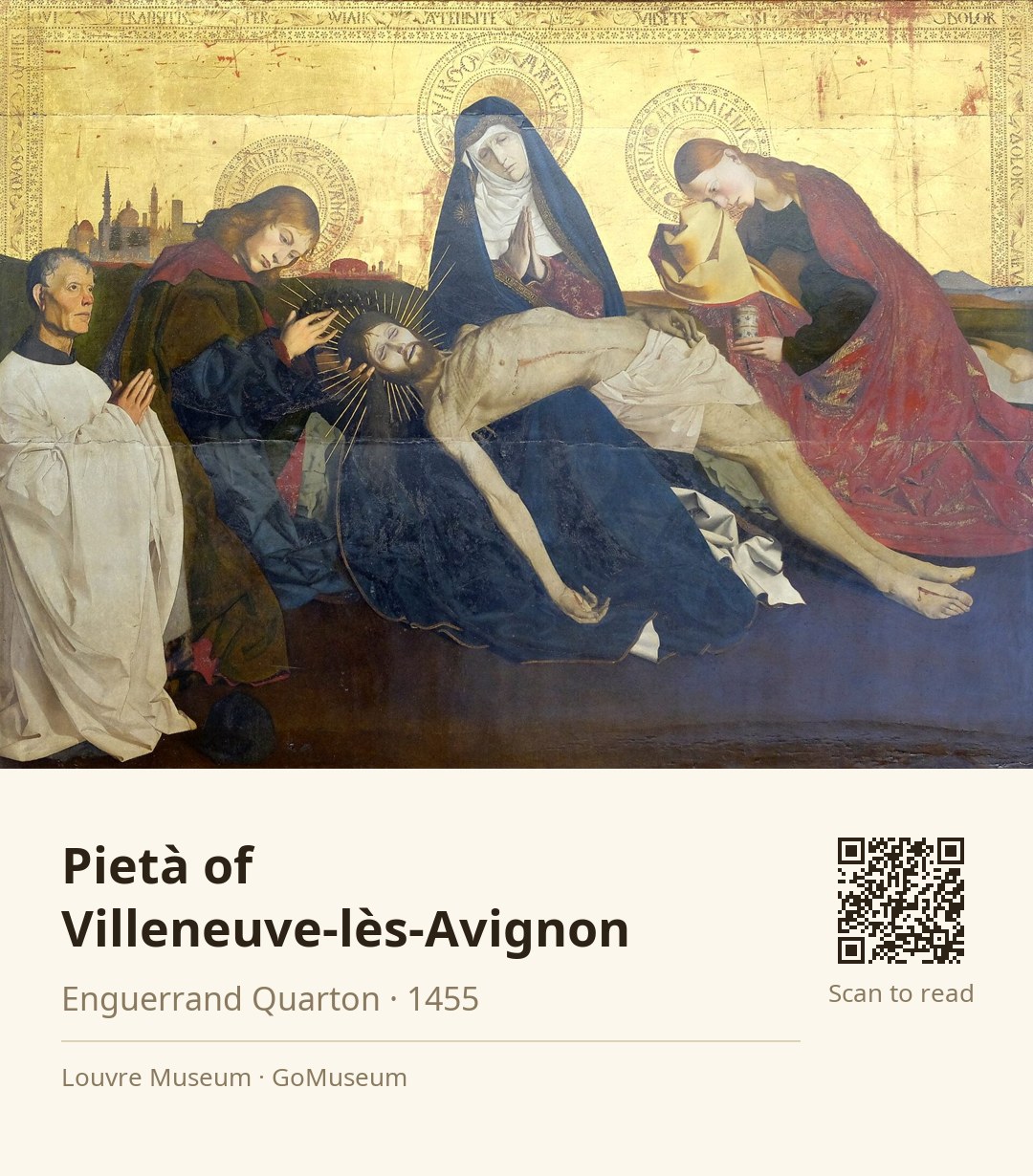
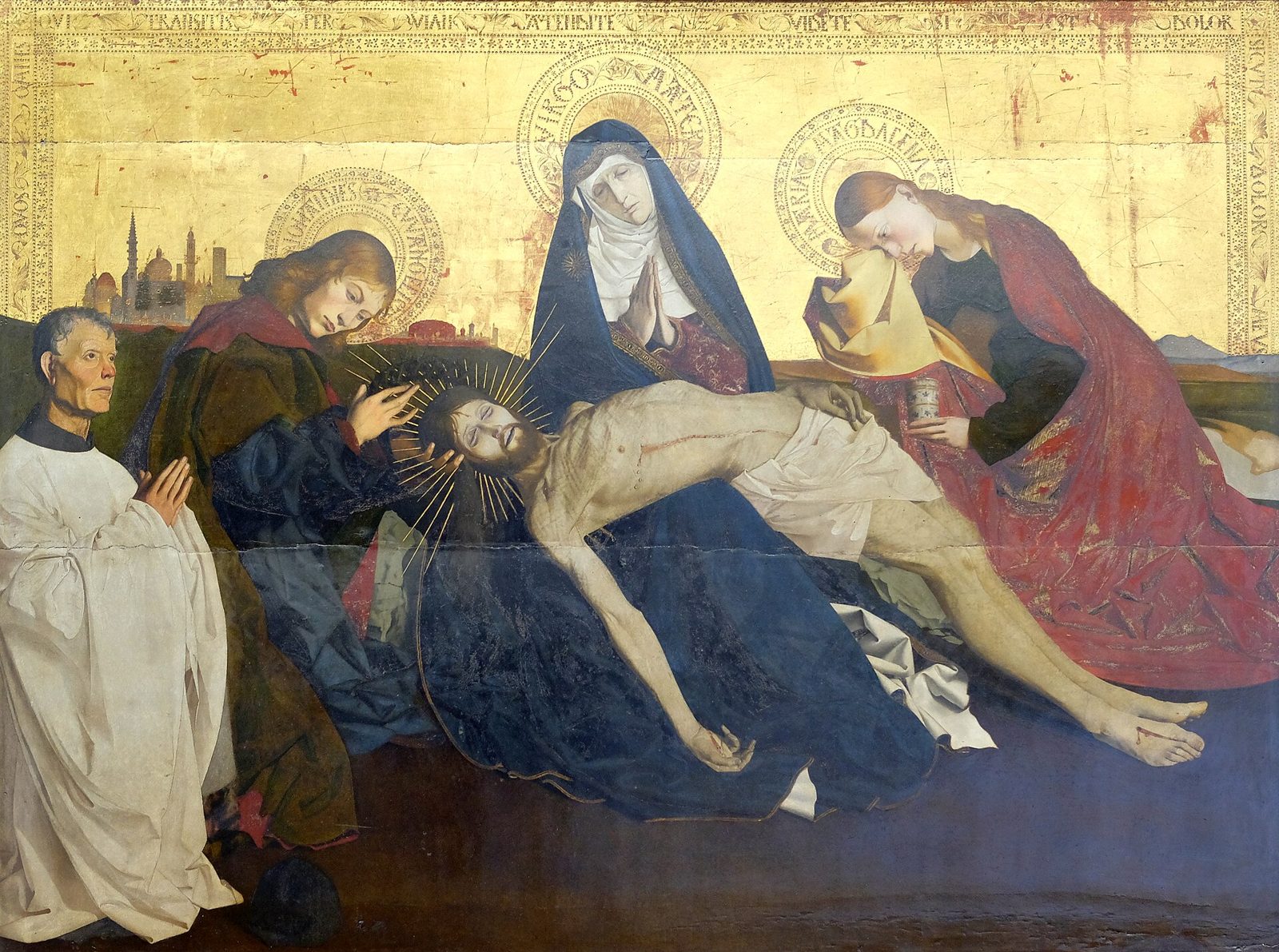
🎧 This work has audio narration — listen in the appTake a moment to really absorb the Pietà of Villeneuve-lès-Avignon. Notice how the Virgin Mary holds her son, Christ, with such a serene dignity. Look closely at her hands, clasped in prayer rather than clutching his body. Unlike many other depictions of this scene, which often lean into dramatic displays of grief, Quarton’s work invites us to reflect on the quiet agony of loss.
The way Christ's body is positioned, with a gentle curve, adds to the painting's unique character. It’s a moment frozen in time, where the figures exude a stillness that contrasts sharply with the more animated styles of Italian and Netherlandish art of the period. This painting is often hailed as one of the greatest masterpieces of 15th-century France, not just for its technical skill but for its emotional depth.
Quarton, who worked primarily in Avignon, was influenced by both the Northern and Southern European styles, yet he carved out a distinct voice that resonates even today. As you stand here, consider how this artwork reflects not just a moment of mourning, but also a broader commentary on the state of Christendom during Quarton’s time, especially with the fall of Constantinople just a few years earlier.
What feelings does this serene portrayal evoke in you? Can you see the quiet strength in Mary’s prayerful pose?
Enguerrand Quarton, a French painter and manuscript illuminator born around 1410 in the diocese of Laon, emerged as a pivotal figure in late medieval art. His career flourished in Provence after 1444, where he became a key member of the second Avignon school. Quarton's style, distinct from Italian and Early Netherlandish influences, is characterized by a unique blend of local traditions and the emerging Renaissance aesthetics.
His most notable works include the "Coronation of the Virgin" and "The Virgin of Mercy," both showcasing his mastery of color and composition. The former, completed in 1454, is remarkable for its innovative representation of the Holy Trinity, while the latter features a striking gold background and a hieratic scale of figures. Quarton's influence extended beyond Provence, impacting artists as far as Germany and Italy, though he fell into obscurity after his death around 1466.
Revived interest in his work began in the early 20th century, particularly with the exhibition of the "Coronation of the Virgin" in Paris. Today, Quarton is recognized as a foundational figure in the development of a French painting style, bridging the gap between medieval traditions and the Renaissance, and his contributions continue to resonate in art history.
Initially discovered in 1834 by Prosper Mérimée in the Collégiale Notre-Dame de Villeneuve-lès-Avignon, its provenance was uncertain—was it there before the French Revolution or brought in later? It was likely commissioned for a religious establishment, possibly the Chartreuse Notre-Dame-du-Val-de-Bénédiction. The painting gained significant attention during a major exhibition in 1904 at the Louvre, where it was displayed alongside other masterpieces. This event sparked debates over its authorship, with some attributing it to various artists until Quarton's name became widely accepted in the 1960s. The painting was eventually acquired by the Louvre in 1905 for 60,000 francs, a significant sum at the time, marking its transition into the realm of celebrated art. Today, it stands as a testament to Quarton's unique style and the emotional depth he brought to his work.
As you gaze upon the Pietà, take a moment to appreciate Quarton's masterful technique. The brushwork is both delicate and deliberate, creating a sense of stillness that envelops the figures. Notice how the gold leaf background, devoid of clouds or sky, draws your focus to the figures, enhancing their solemnity. The composition is strikingly stable, with the Virgin's hands clasped in prayer, a choice that evokes a profound sense of restraint and dignity. The gentle curve of Christ's body, almost cradled in Mary's lap, contrasts with the rigid forms often seen in earlier works. The use of light and shadow is subtle yet effective, illuminating the faces and creating a depth that invites you to explore their expressions. Quarton's unique approach to scale and proportion gives the figures a hieratic quality, emphasizing their spiritual significance. This painting isn't just a visual experience; it's a deeply emotional one, capturing the essence of grief with a quiet, haunting beauty.
The Pietà garnered significant attention during the 1904 exhibition at the Louvre, sparking debates over its authorship and leading to a renewed interest in Quarton and other forgotten artists of the period.
The gold leaf background is notable for its lack of clouds or sky, which was unusual for the time, and it enhances the solemnity of the figures while drawing the viewer's focus directly to them.