The Oath of the Horatii
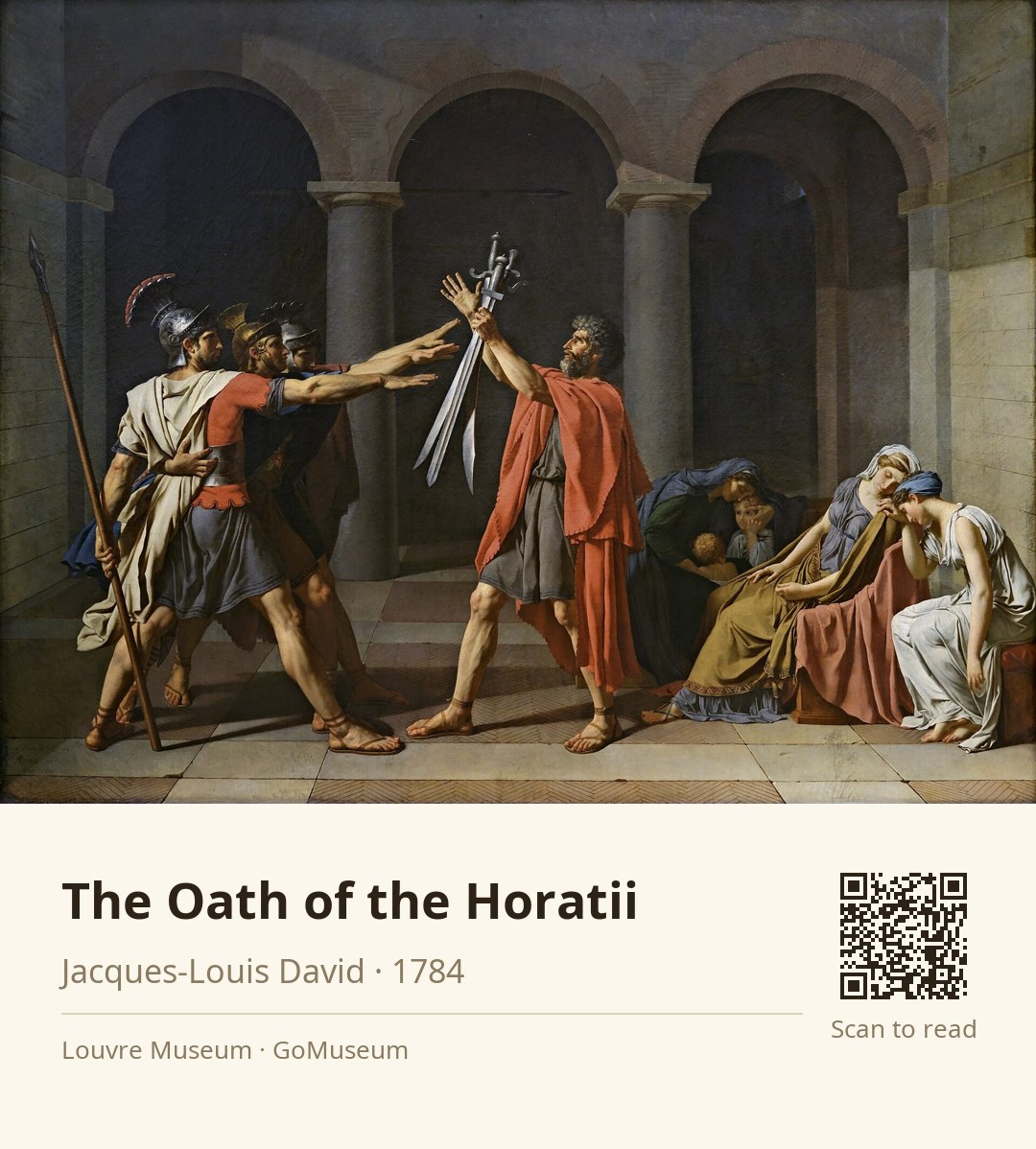
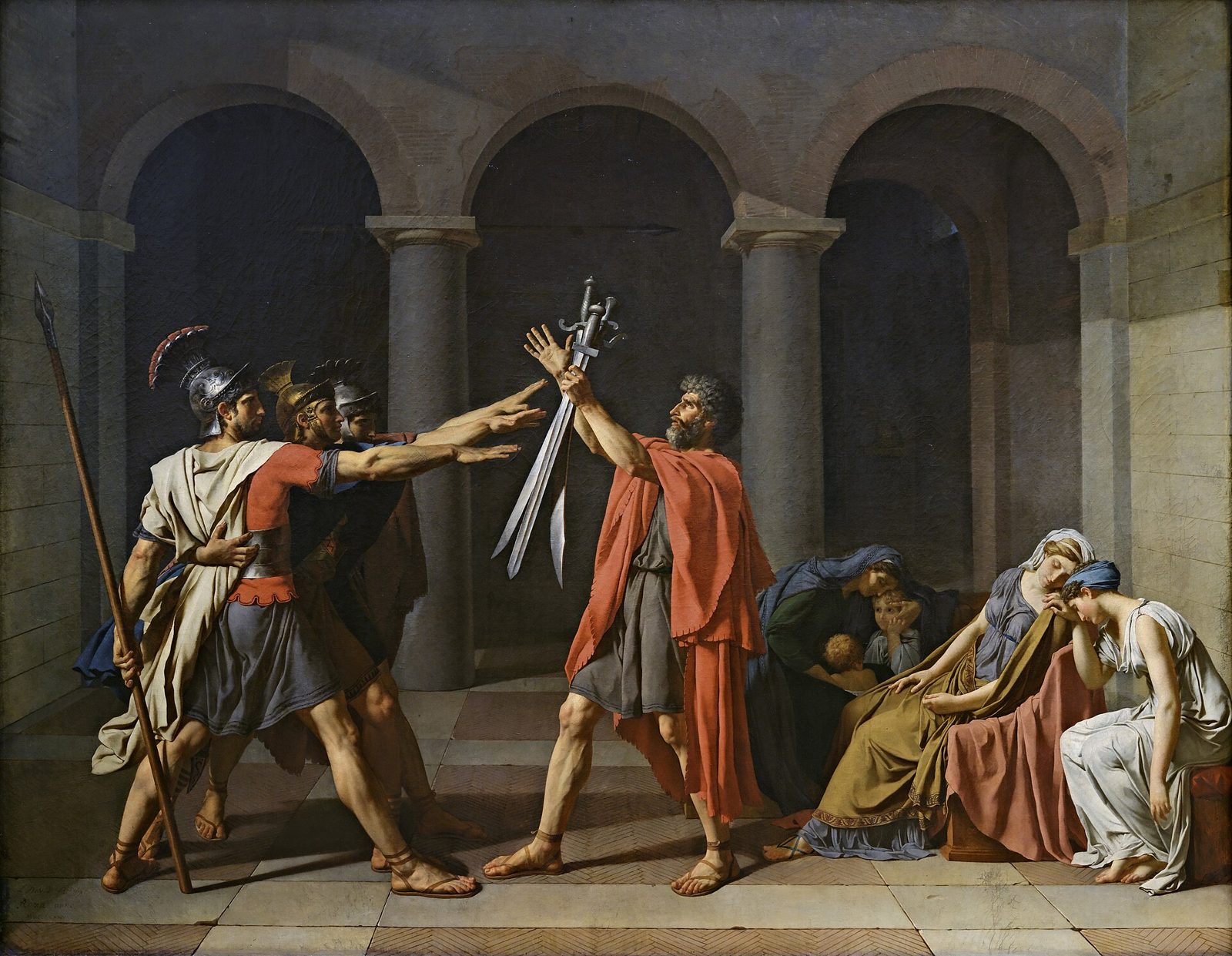
🎧 This work has audio narration — listen in the appTake a moment to really absorb the powerful scene in front of you. Jacques-Louis David’s "The Oath of the Horatii" captures a dramatic moment of loyalty and sacrifice, where three brothers stand resolute, arms outstretched toward their father, who holds their swords. Notice the intensity in their faces—the determination and courage radiate from their expressions.
What’s striking is the way David uses the brothers’ outstretched arms to create a triangle, symbolizing strength and unity. This isn’t just a painting; it’s a visual manifesto of patriotism. The brothers are not merely preparing for battle; they are pledging their lives for the glory of Rome, embodying the ideals of duty and sacrifice that were so crucial in the late 18th century, especially as the French Revolution loomed.
David painted this scene in 1784, a time when France was rife with political tension. The Horatii brothers represent a shift in values—from familial loyalty to a broader allegiance to the state.
As you stand here, consider this: What does loyalty mean to you? Are we bound by family ties, or do we owe our allegiance to something greater? David invites us to ponder these questions through the lens of his art, making "The Oath of the Horatii" not just a historical depiction, but a timeless exploration of sacrifice and duty.
Jacques-Louis David was a pivotal French painter born on August 30, 1748, in Paris. He emerged as the leading figure of the Neoclassical movement, marking a significant shift in artistic taste from the frivolity of Rococo to a more austere and emotionally charged classical style. His early life was marked by personal tragedy, losing his father at a young age, which shaped his character and determination to pursue art against familial expectations.
David's career flourished during the tumultuous political landscape of France, where he became an ardent supporter of the French Revolution, aligning himself with figures like Robespierre. His political engagement influenced his art, producing iconic works such as "The Death of Marat" and "The Coronation of Napoleon," which reflect both historical narratives and his personal convictions. After the fall of Napoleon, David faced exile but continued to influence generations of artists, establishing a legacy that shaped academic painting in the early 19th century. His works remain celebrated in major museums, particularly the Louvre, solidifying his status as a cornerstone of Western art history. David's life and art were inextricably linked to the evolving identity of France, embodying the spirit of revolution and the quest for artistic integrity.
Jacques-Louis David's 'The Oath of the Horatii' was commissioned in 1784 by Charles-Claude Flahaut de la Billaderie, an assistant to King Louis XVI. This painting was intended to serve as an allegory of loyalty to the monarchy, reflecting the values of the time. However, David took creative liberties, choosing to depict a scene of intense patriotism instead. He began his studies for the painting in Paris but completed it in Rome, where he was living after winning the prestigious Prix de Rome in 1774. The painting was first exhibited in Rome in 1785, where it garnered immense acclaim, and later displayed at the Salon in Paris the same year, solidifying David's reputation as a leading artist of the Neoclassical movement.
As you gaze at 'The Oath of the Horatii,' take a moment to appreciate David's masterful technique. The painting is a grand composition, measuring over three meters tall and nearly four and a half meters wide, which commands attention. Notice how David employs a strong triangular composition formed by the outstretched arms of the three brothers, creating a sense of stability and unity. The use of bold, contrasting colors enhances the dramatic tension; the deep reds and blues of the brothers' attire stand out against the muted tones of the background. David's brushwork is deliberate and precise, contributing to the painting's clarity and emotional impact. The figures are rendered with a sculptural quality, emphasizing their muscular forms and expressions of determination. The stark division between the men and women in the painting—straight lines for the brothers and softer curves for the women—visually reinforces the themes of strength and vulnerability. This careful structuring, along with the chiaroscuro technique that highlights the figures against the light background, draws your eye to the pivotal moment of the oath, encapsulating the essence of duty and sacrifice.
It epitomized the Neoclassical style, steering art away from the frivolity of the Rococo period toward a focus on moral and civic virtues. The painting's themes of loyalty and sacrifice resonated deeply during the French Revolution, making it a visual rallying cry for revolutionary ideals. David's work inspired a wave of historical painting that emphasized the importance of patriotism and civic duty, shaping the direction of art in the 19th century. His influence extended beyond his lifetime, as he trained many students who carried his ideals into their own works, ensuring that the legacy of 'The Oath of the Horatii' would endure in the annals of art history.
One intriguing aspect of 'The Oath of the Horatii' is that the moment David chose to depict—the brothers swearing their oath—was entirely his invention. While the story of the Horatii and Curiatii is rooted in Roman history, the actual oath scene is not documented in ancient texts. David's creative decision to focus on this dramatic moment allowed him to explore themes of loyalty and sacrifice in a way that resonated with the political climate of his time, making the painting a powerful statement about the values of duty and patriotism.
David broke traditional compositional rules by decentralizing the main subjects, which creates a dynamic tension and draws the viewer's eye toward the pivotal moment of the oath, rather than placing the figures symmetrically.
The number three is a recurring motif in the painting, represented by the three brothers, the three swords held by their father, and the three women, which symbolizes unity and strength while also emphasizing the themes of sacrifice and familial bonds.