The Raising of Lazarus
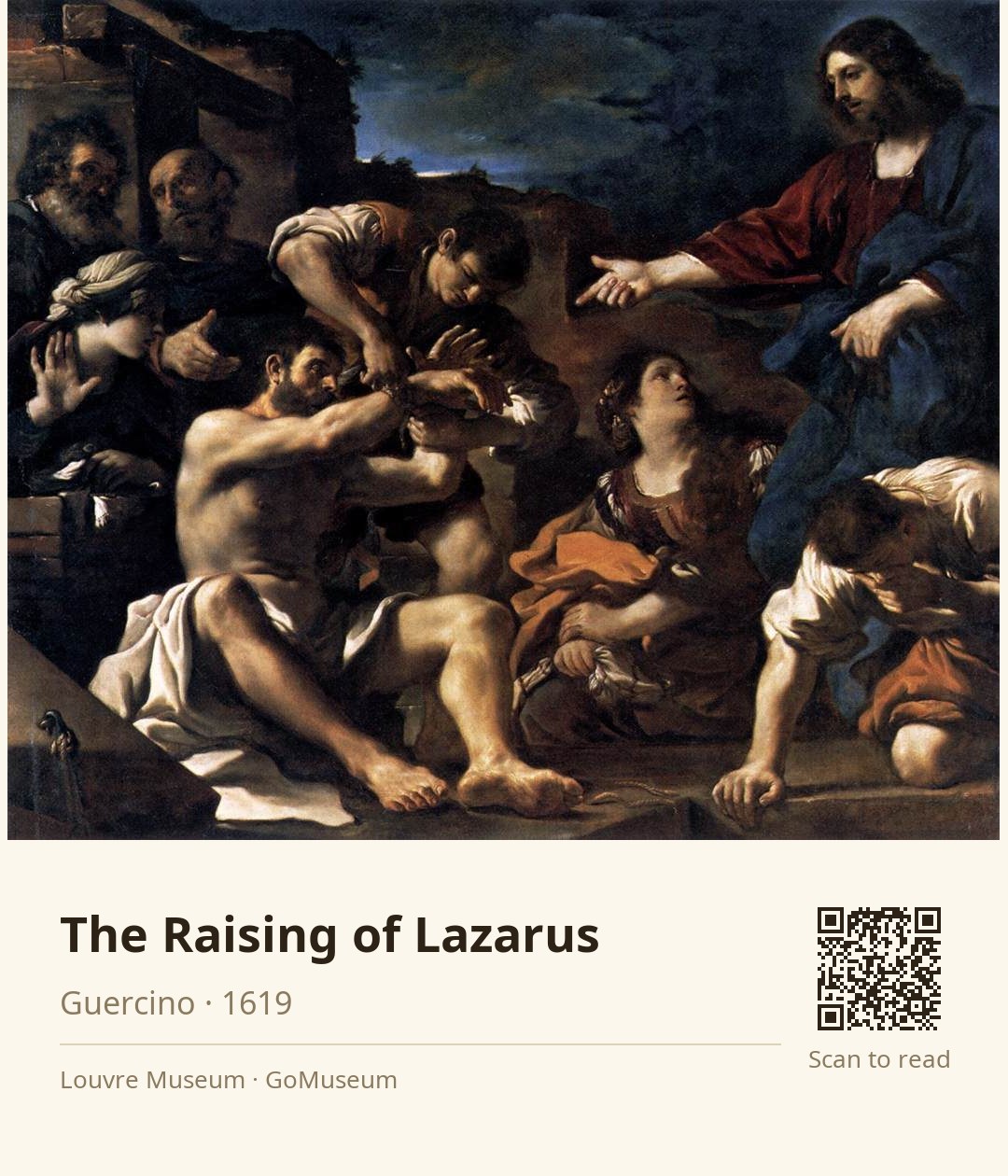
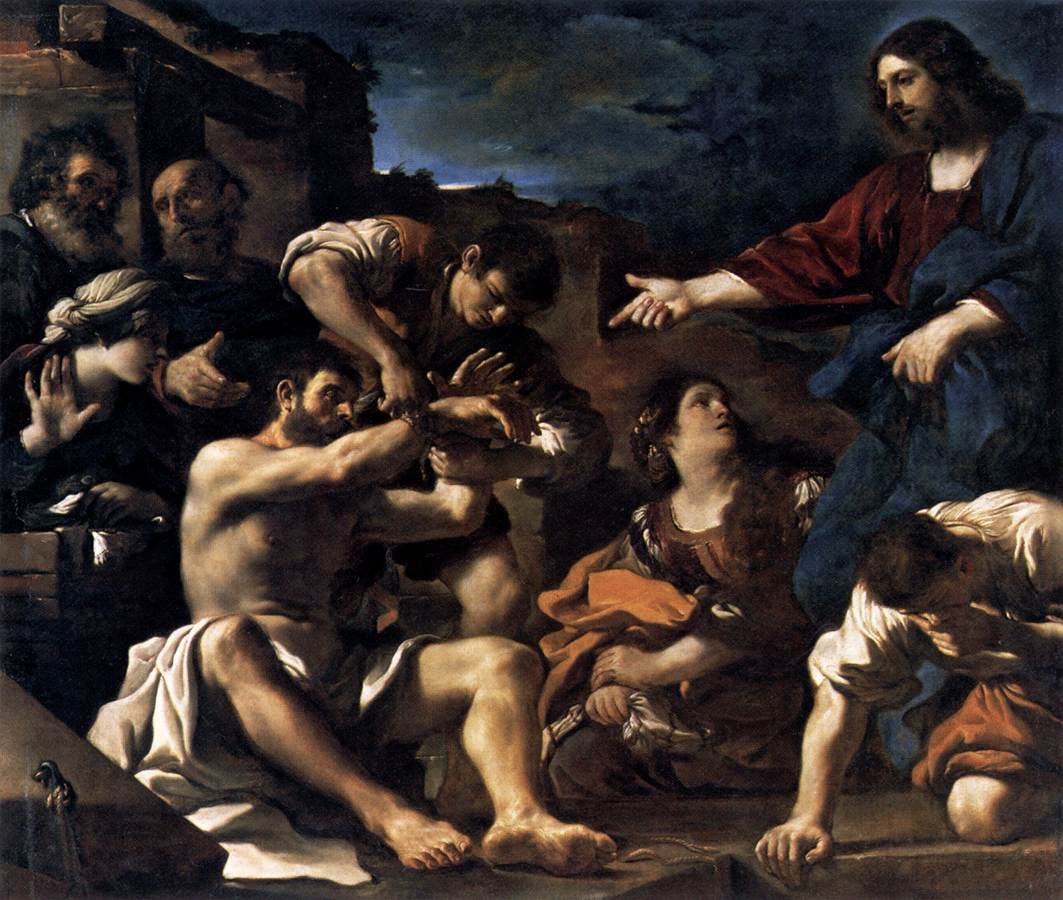
🎧 This work has audio narration — listen in the appTake a moment to really look at "The Raising of Lazarus" by Guercino. Notice how the light spills dramatically across the scene, illuminating Lazarus as he emerges from the shadows of his tomb. Look closely at his expression—it's a mix of confusion and awe, perfectly capturing the moment of his miraculous return to life.
These details matter because they pull you into the emotional heart of the story. Guercino masterfully uses light and shadow to create a sense of divine intervention, making you feel the weight of this miraculous moment. The contrast between the dark tomb and the bright figure of Jesus emphasizes the triumph of life over death, a central theme in Baroque art.
Painted in 1619, this work is a striking example of Guercino's early style, which was influenced by the naturalism of Caravaggio. It was commissioned for a church in Bologna and has since traveled through history, eventually finding its home in the Louvre.
As you stand here, think about the power of this moment. What does it mean to you to witness a miracle? How does this painting challenge your understanding of life and death?
Giovanni Francesco Barbieri, known as Guercino, was an influential Italian Baroque painter born on February 8, 1591, in Cento, Italy. His early life was marked by modest beginnings in a peasant family, and his cross-eyed condition earned him the nickname "Guercino," meaning "squinter." Largely self-taught, he began his artistic journey as an apprentice to Benedetto Gennari, where he developed a distinctive style characterized by vigorous naturalism.
Guercino's early works, such as the frescoes for Casa Pannini and the altarpiece for Santi Gregorio e Siro, showcased his ability to blend dramatic compositions with a keen observation of light and shadow. His time in Rome from 1621 to 1623 was particularly fruitful, yielding masterpieces like the fresco Aurora and the St. Petronilla Altarpiece for St. Peter's Basilica.
Returning to Bologna after the death of Pope Gregory XV, Guercino became the city's leading painter, producing a remarkable volume of work, including over 100 altarpieces. His style evolved from tumultuous early pieces to more classical equilibrium, yet he maintained a unique luminosity in his drawings and paintings. Guercino's legacy endures as a master of Baroque art, celebrated for his ability to convey depth and emotion, despite the challenges posed by his vision. He passed away on December 22, 1666, leaving behind a rich artistic heritage.
By 1682, it was recorded in the collection of the Garofali brothers in Naples. The painting made its way into the hands of Vivant Denon, who purchased it for Louis XVI in 1785 for a hefty sum of 26,000 livres. After the French Revolution, it was exhibited at the Muséum des Arts. Turner encountered this work during the Peace of Amiens in 1802, and even sketched it in his Louvre Sketchbook, showcasing its impact on fellow artists of the time. Its journey through history reflects the evolving appreciation for Guercino's dramatic style and masterful use of light and shadow.
As you gaze at 'The Raising of Lazarus,' take a moment to appreciate Guercino's brushwork. The way he layers paint creates a palpable texture, inviting you into the scene. Notice how the light isn't just illuminating Lazarus; it dances across the figures, creating a dynamic interplay of shadow and brightness that heightens the emotional intensity. The composition is carefully structured, with Lazarus positioned at the center, drawing your eye immediately to his expression of bewilderment. Guercino's choice of a horizontal format enhances the drama, allowing the viewer to feel as if they're part of the unfolding miracle. The vibrant colors, especially the reds and golds, evoke a sense of warmth and life, contrasting sharply with the dark tomb, which feels almost oppressive. This contrast not only underscores the theme of resurrection but also showcases Guercino's mastery of chiaroscuro, making the moment feel both immediate and timeless.
Interestingly, Guercino was known for his rapid execution of paintings, completing an astonishing 106 large altarpieces during his career. His ability to work quickly did not compromise the quality of his art; instead, it showcased his remarkable skill and confidence.
Due to his strabismus, Guercino had monocular vision, which might have enhanced his perception of light and shade, allowing him to create depth in his works despite the visual limitation.
The preparatory sketch for 'The Raising of Lazarus' is now housed in the Metropolitan Museum of Art, showcasing Guercino's meticulous planning and the evolution of his ideas before executing the final painting.