Ship of Fools
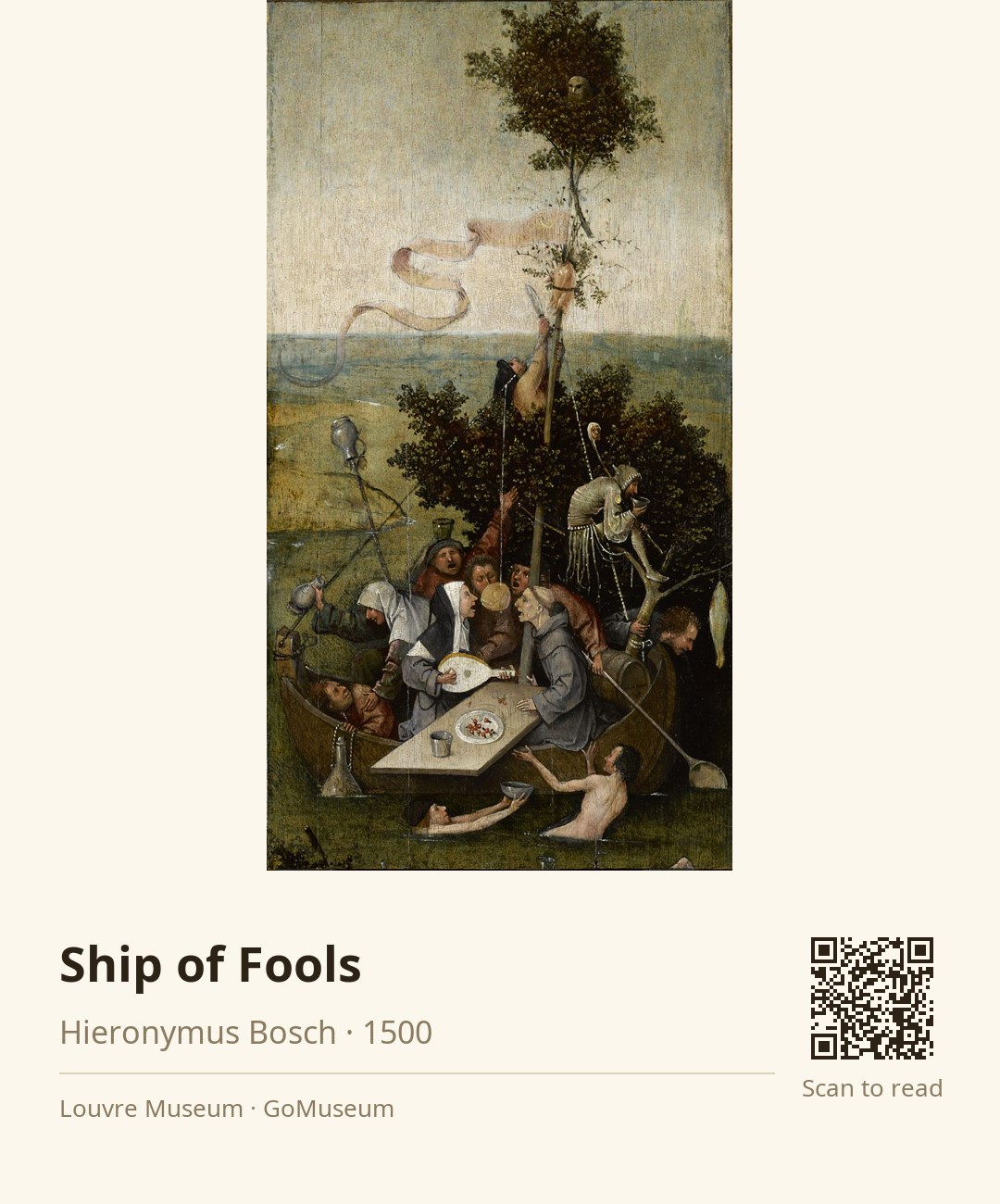
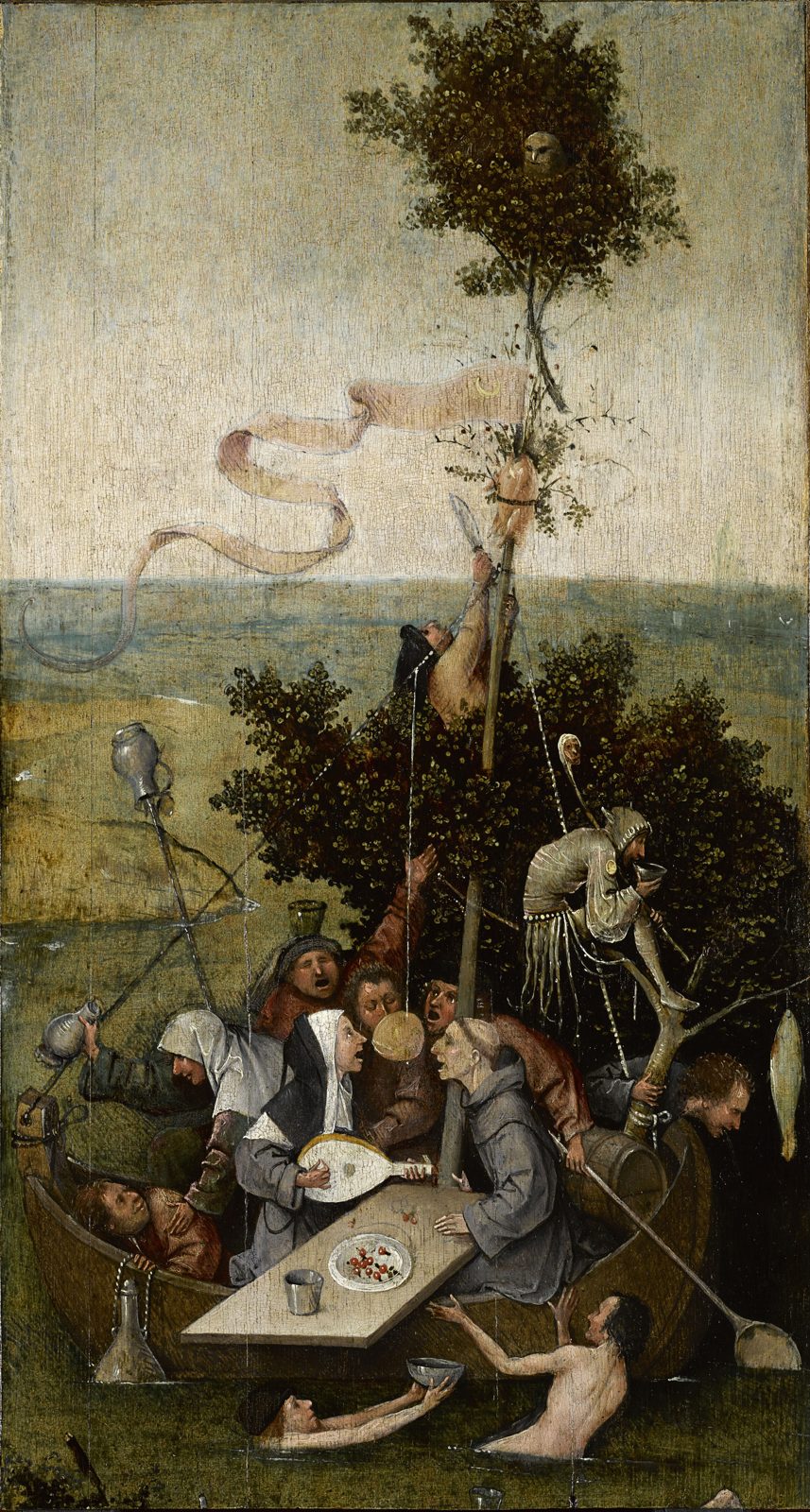
🎧 This work has audio narration — listen in the appTake a moment to really look at Bosch's "Ship of Fools." Notice how the figures are crammed into that tiny boat, their expressions a mix of glee and absurdity. The monk and nun in the center, mouths wide open, seem to be singing—or perhaps trying to bite into a dangling crepe. This chaotic scene is more than just a whimsical depiction; it’s a biting commentary on human folly and excess.
Bosch painted this around 1500, during a time when society was grappling with the consequences of indulgence and moral decay. The ship, a metaphor for humanity, is adrift, filled with characters oblivious to their fate. The oversized ladle used as an oar and the broken jug in the hands of one of the rowers highlight the ridiculousness of their situation—these people are literally steering their lives toward disaster, consumed by gluttony and vice.
Originally part of a larger triptych, this fragment reflects Bosch's fascination with the seven deadly sins, specifically gluttony. The work resonates with the themes found in Sebastian Brant's "Das Narrenschiff," which critiqued the follies of society. Bosch's art invites us to laugh, but it also serves as a warning about the dangers of excess.
As you stand here, think about the absurdity of the scene. What do you see in these characters that reflects our own world today?
Hieronymus Bosch, born Jheronimus van Aken around 1450 in 's-Hertogenbosch, was a Dutch painter whose visionary works have left an indelible mark on art history. Little is known about his personal life, but he spent most of it in his hometown, where he was likely influenced by his family's artistic background. Bosch's paintings, characterized by their intricate and fantastical depictions of religious themes, often explored the complexities of human desire and morality. His most famous work, "The Garden of Earthly Delights," exemplifies his unique style, blending surreal imagery with profound commentary on the human condition.
Bosch's artistry flourished during the late 15th and early 16th centuries, a time when he gained recognition both locally and abroad, with his works collected in various European countries. His influence extended to later artists, notably Pieter Bruegel the Elder, who drew inspiration from Bosch's imaginative approach. Despite the challenges of attributing his works—only about 25 paintings are confidently identified as his—Bosch is celebrated as a pioneering figure in Early Netherlandish painting. His legacy continues to resonate, as contemporary audiences are captivated by the enigmatic narratives and moral complexities embedded in his art. Bosch passed away in 1516, leaving behind a rich tapestry of artistic innovation that still intrigues and inspires today.
The 'Ship of Fools' was painted by Hieronymus Bosch around 1500 and is now housed in the Musée du Louvre, Paris. This piece is a fragment of a larger triptych that was originally divided into several parts. The painting was donated to the Louvre in 1918 by Camille Benoit and was restored in 2015. Interestingly, dendrochronological studies indicate that the wood used for this painting dates back to 1491, suggesting that Bosch may have been directly responding to the popular satirical work 'Das Narrenschiff' by Sebastian Brant, published in 1493. This work critiqued human folly and excess, themes that resonate deeply in Bosch's depiction of a chaotic boat filled with oblivious characters.
As you gaze at the 'Ship of Fools,' take a moment to appreciate Bosch's masterful technique. The brushwork is both intricate and frenetic, capturing the chaotic energy of the scene. Notice how the figures are crammed into the small boat, their exaggerated expressions and postures creating a sense of movement and absurdity. The use of vibrant colors, particularly the reds and greens, draws your eye and emphasizes the folly of the characters. Bosch's choice of composition—placing the monk and nun at the center, their mouths agape—invites you to question their intentions: are they singing or simply lost in their own indulgence? The oversized ladle as an oar and the broken jug serve as symbols of their misguided efforts, reinforcing the painting's commentary on human folly. The overall effect is a blend of humor and horror, making you reflect on the consequences of excess while simultaneously engaging with the absurdity of the scene.
Painted around 1500, it serves as a fragment of a larger triptych that critiques human folly, particularly the sin of gluttony. This work draws on the popular literary trope established by Sebastian Brant's 'Das Narrenschiff,' which satirized societal vices. Bosch's vivid imagery and complex symbolism influenced countless artists, notably Pieter Bruegel the Elder, who adopted similar themes of moral commentary. Remember, Bosch's work invites us to laugh at our weaknesses while also urging us to confront them head-on.
One surprising aspect of the 'Ship of Fools' is that it was originally part of a larger triptych, which was cut into fragments over time. The central panel has been lost, leaving only the wings that depict gluttony and miserliness.
Dendrochronological studies show that the wood used for the 'Ship of Fools' dates back to 1491, suggesting that Bosch may have been directly responding to contemporary literature, particularly Sebastian Brant's 'Das Narrenschiff,' which critiques human folly.
This painting is part of a larger triptych, with the other surviving panels representing themes of gluttony and miserliness, showcasing Bosch's exploration of the seven deadly sins and the extremes of human behavior.
The central panel of the triptych has been lost to history, leaving only the surviving wings that depict gluttony and miserliness, which together would have provided a more complete commentary on human vice.