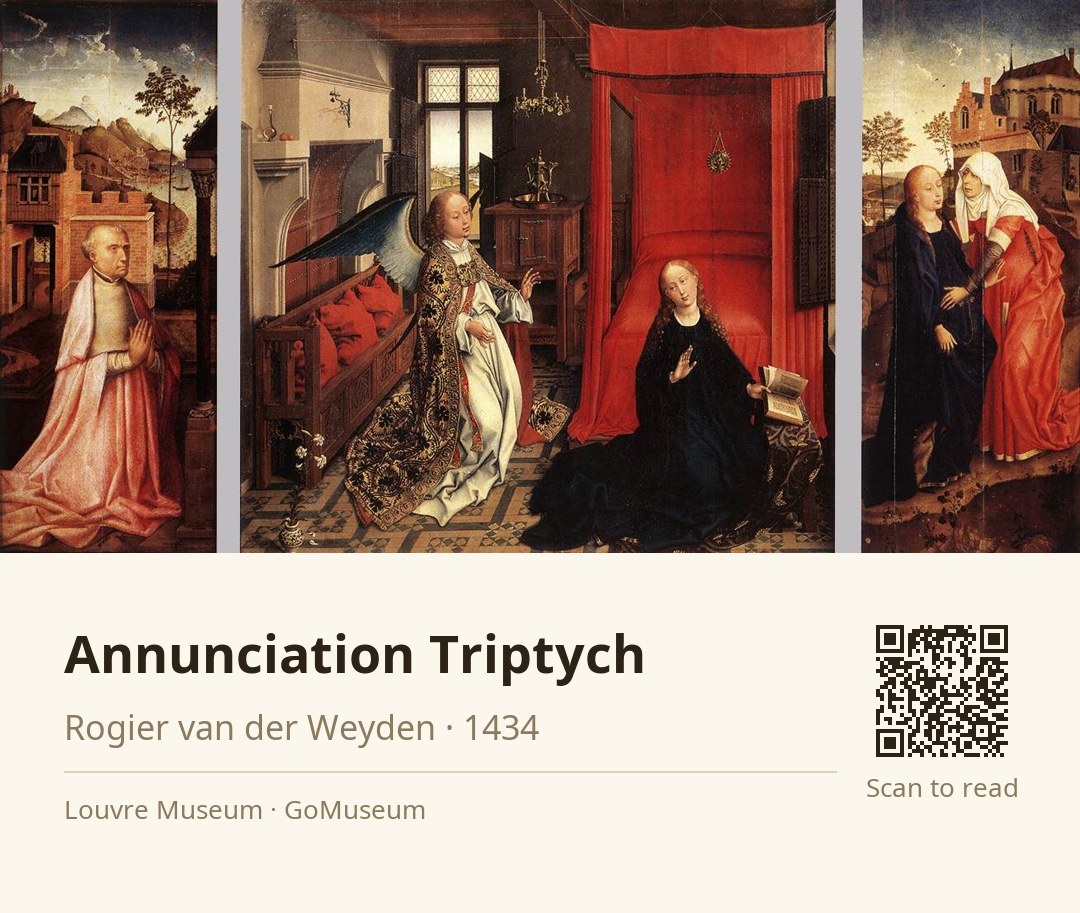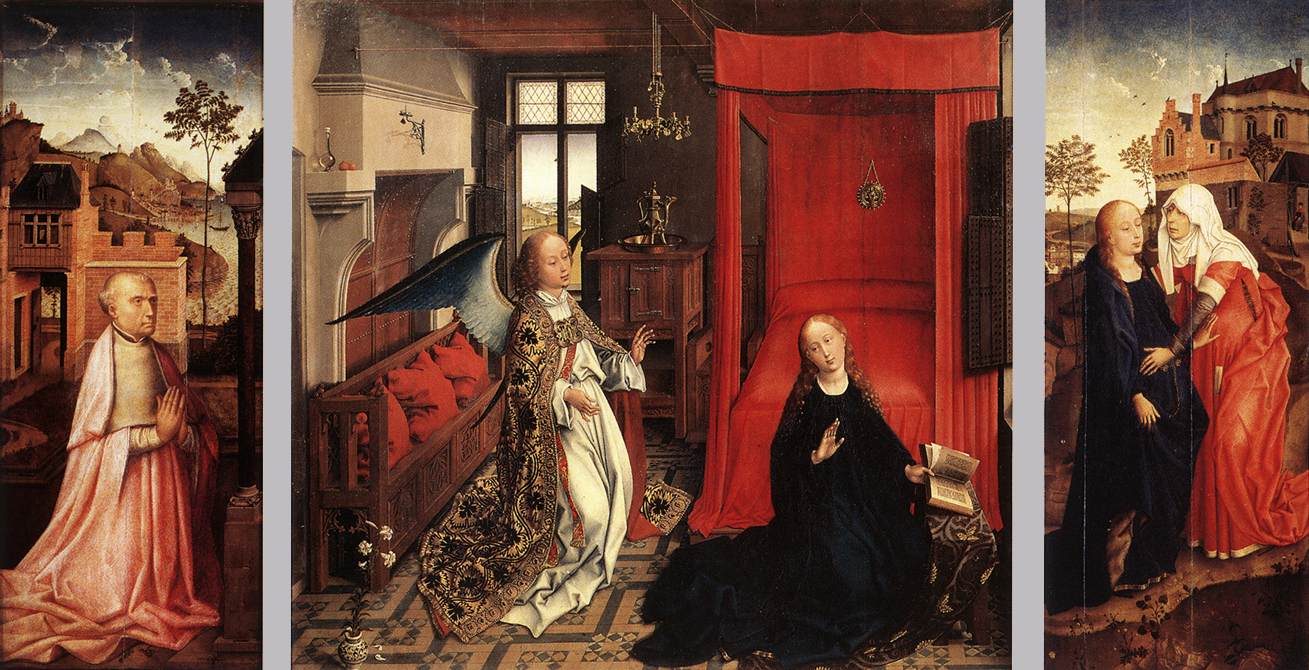
Annunciation Triptych
🎧 This work has audio narration — listen in the appTake a moment to really look at the Annunciation Triptych by Rogier van der Weyden. Notice how the angel, dressed in rich, flowing robes, seems to float into the room, startling the Virgin Mary as she reads. Look closely at the lamp and the jar beside her; the way they catch the light is almost magical, isn’t it?
These details aren’t just for show; they symbolize the divine light entering Mary’s life and the sacredness of the moment. Van der Weyden was a master of oil painting, and his ability to create such luminous effects was groundbreaking for his time. This triptych, created around 1434, showcases his early style, influenced by the likes of Jan van Eyck, yet distinctly his own.
Originally, this piece was part of a larger altar, meant to inspire devotion in a private chapel. Imagine the families who gathered here, their eyes drawn to this moment of divine announcement, feeling the weight of its significance.
As you stand here, think about the emotions this scene evokes. What does it mean to you to witness such a pivotal moment in history, captured in paint?
Rogier van der Weyden, born around 1399 in Tournai, was a pivotal figure in early Netherlandish painting. Initially known as Roger de le Pasture, he trained under Robert Campin before moving to Brussels in 1435, where he became the city's official painter. His career flourished as he received commissions from the Burgundian court and foreign aristocrats, leading to widespread acclaim across Europe. Van der Weyden's works, primarily religious altarpieces and portraits, are characterized by their emotional depth and meticulous detail, often idealizing the subjects' features while employing a rich palette that showcased his innovative approach to color.
Despite his popularity in the 15th century, his fame waned by the 17th century, and he was largely forgotten until the 18th century, when art historians began to recognize him alongside Jan van Eyck and Robert Campin as a master of the Flemish Primitives. His legacy is marked by a profound influence on Northern Renaissance art, particularly through his expressive naturalism and complex compositions. Van der Weyden's ability to convey human emotion and spirituality has cemented his place in art history as one of the most significant painters of his time. He passed away in Brussels in 1464, leaving behind a legacy of approximately forty surviving works that continue to captivate audiences today.
As you gaze at the Annunciation Triptych, take a moment to appreciate van der Weyden's masterful technique. His use of oil paint allowed for a depth of color and luminosity that was revolutionary. Notice how the light plays off the metallic surfaces of the lamp and jar, creating a sense of realism that draws you into the scene. The elevated horizon line enhances the viewer's immersion, almost inviting you into Mary’s chamber. The figures are monumental yet intimate, with the angel appearing to float, embodying the divine. Van der Weyden's brushwork is meticulous; each detail, from the folds of the angel's robes to the textures of the furniture, is rendered with precision. This attention to detail not only showcases his technical prowess but also serves to heighten the emotional gravity of the moment, making the sacred feel tangible.
It was meant for the De Villa family in Chieri, Italy, who had ties to the Netherlands. This connection highlights how art traveled across borders in the 15th century, linking cultures and communities through shared religious devotion. Imagine the anticipation of the family as they awaited this masterpiece, a blend of their faith and the artistic prowess of Rogier van der Weyden.
Van der Weyden was born in Tournai and trained in the workshop of Robert Campin, which provided him with a strong foundation in the techniques of early Netherlandish painting and exposure to the rich cultural environment of the time.
He served as the official painter for the city of Brussels, a prestigious title that, while largely honorific, allowed him to gain significant commissions and influence in the artistic community of the Burgundian court.