Portrait of a Gentleman
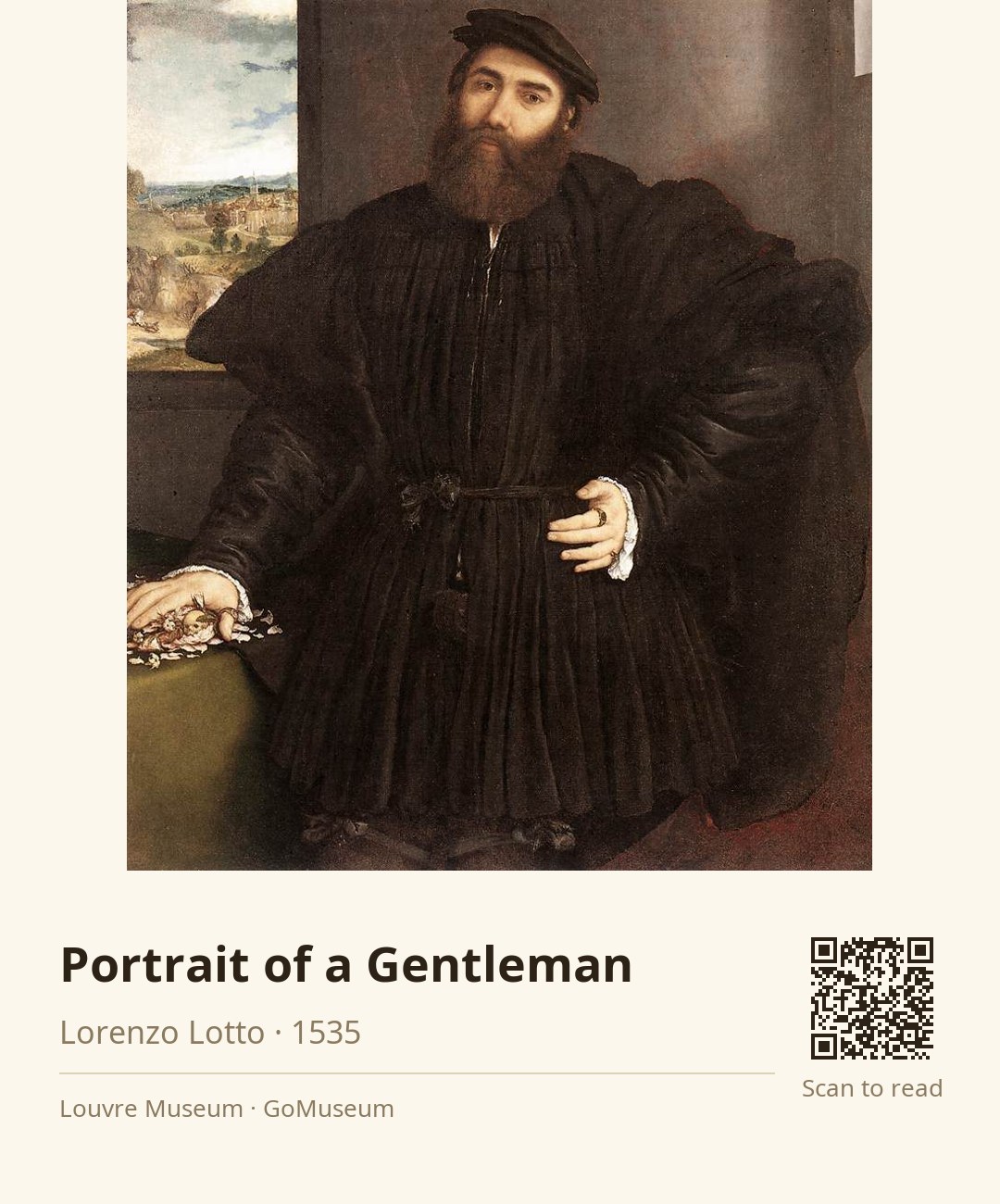
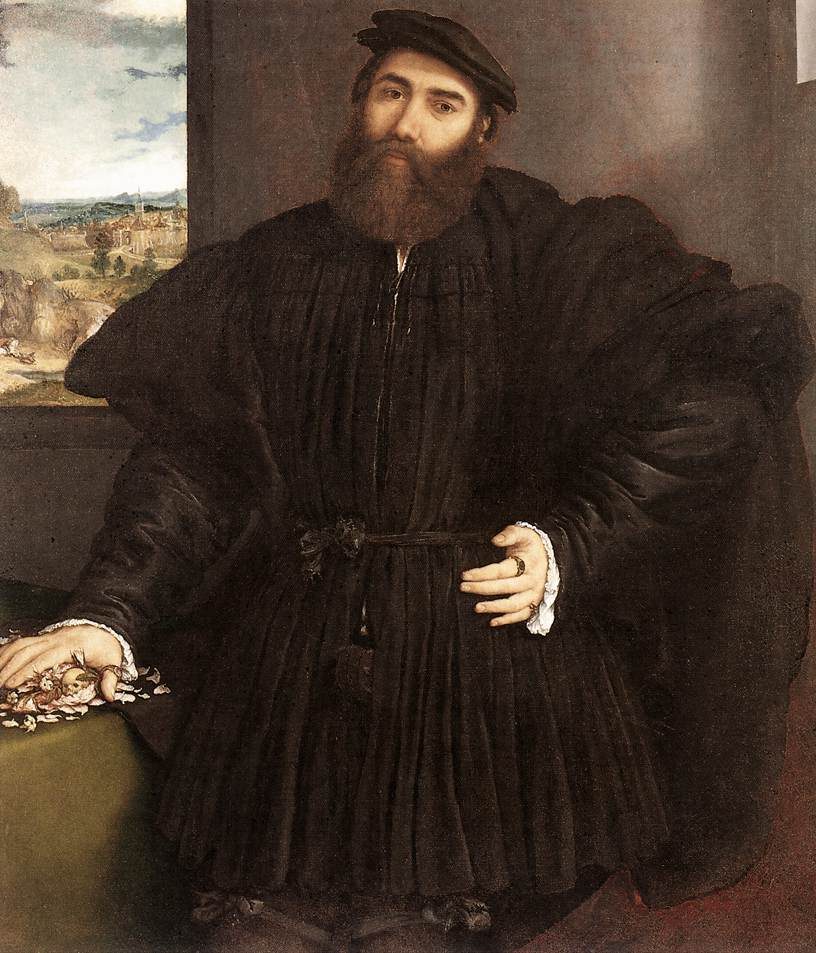
🎧 This work has audio narration — listen in the appTake a moment to really look at the "Portrait of a Gentleman" by Lorenzo Lotto. Notice how the man stands there, dressed in deep black, his hand resting on the table while the other is placed on his side. But what really catches your eye? It’s that melancholic expression on his face, isn’t it?
Now, focus on the details around him. On the table, you see flower petals and a tiny skull. These aren’t just random objects; they symbolize the fleeting nature of life and perhaps hint at a personal loss. The way he holds his hand over his spleen suggests a connection to melancholy, a nod to the belief that this organ was the seat of sorrow.
So, as you stand here, think about the story behind that somber gaze. What do you think he might be mourning? What secrets does this painting hold about his life?
Lorenzo Lotto, born around 1480 in Venice and passing away in 1556, was a notable Italian Renaissance painter whose career spanned various northern Italian cities. Although often associated with the Venetian school, his unique style and independent approach set him apart from contemporaries like Titian and Giorgione. Lotto's work primarily encompassed altarpieces, religious themes, and portraits, reflecting a distinctive blend of High Renaissance ideals with a personal touch that hinted at the emerging Mannerist style.
His artistic journey began in Treviso, where he gained recognition under the patronage of Bishop Bernardo de' Rossi. Lotto's early works, such as "Allegory of Virtue and Vice," showcased his ability to convey psychological depth through intricate symbolism. His time in Rome was marked by an invitation from Pope Julius II to decorate the papal apartments, although this opportunity did not yield lasting results.
Lotto's most fruitful period occurred in Bergamo, where he produced some of his finest works, characterized by rich color and dramatic compositions. Despite his initial acclaim, Lotto's reputation waned after his death, leading to a gradual obscurity. Today, he is celebrated for his idiosyncratic style and contributions to the transition between Renaissance and Mannerism, earning him a unique place in art history.
The 'Portrait of a Gentleman' by Lorenzo Lotto first enters the historical record in 1790, appearing in an inventory of the Galleria Borghese in Rome. This painting, created around 1535, showcases Lotto's unique style during a period when portraits began to delve deeper into the psychological state of their subjects. The inclusion of symbolic elements like the skull and flower petals hints at the themes of mortality and loss, resonating with viewers across centuries.
Notice how the deep blacks of the gentleman's attire create a striking contrast against the softer, muted tones of the background. The way Lotto handles light is particularly compelling; it gently illuminates the subject's face, enhancing that melancholic expression. The composition is structured to draw your eye to the gentleman's hands—one resting on the table, the other on his side—creating a sense of tension and introspection. The placement of the skull and flower petals on the table is not just decorative; it serves as a poignant reminder of life's transience, inviting you to ponder the deeper meanings behind the man's somber demeanor.
One intriguing aspect of the 'Portrait of a Gentleman' is its mysterious subject. While many believe he is the Albanian condottiero Mercurio Bua, the painting's symbols suggest deeper layers. The gentleman's hand rests on his spleen, a gesture once thought to signify melancholy. This, combined with the two rings on his finger, hints at a personal story of loss, possibly reflecting Bua's status as a widower.
The window shows Saint George and the dragon, a subject that resonated with the Balkan community in Venice, possibly hinting at the gentleman's cultural background or connections.
It was once thought to be a self-portrait of Lorenzo Lotto, but the symbolic elements present in the work, such as the skull and flower petals, contradict this idea.
The two rings, positioned close yet separate, could suggest themes of lost love or mourning, aligning with the identification of the subject as Mercurio Bua, a widower.