Charles I at the Hunt
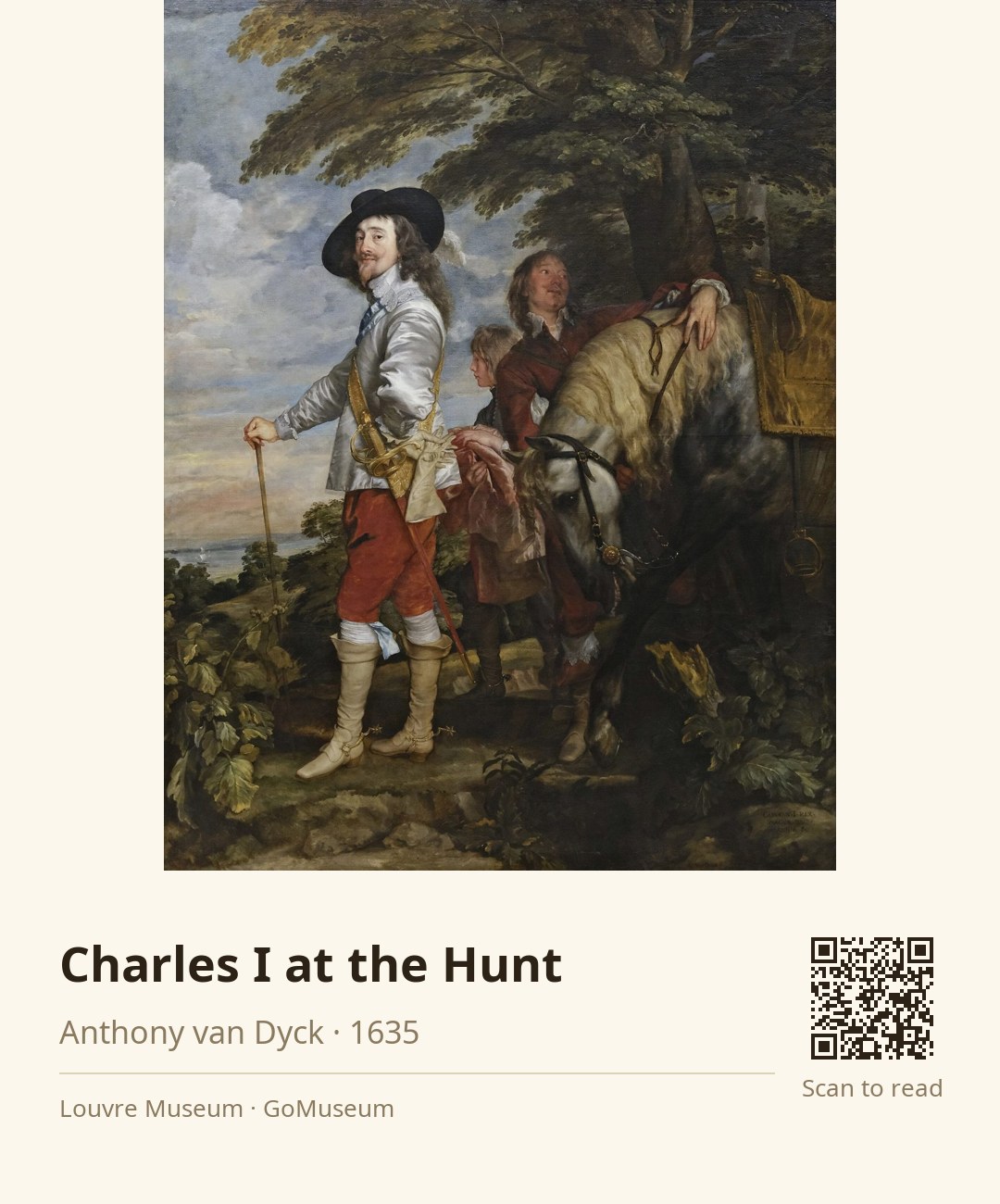
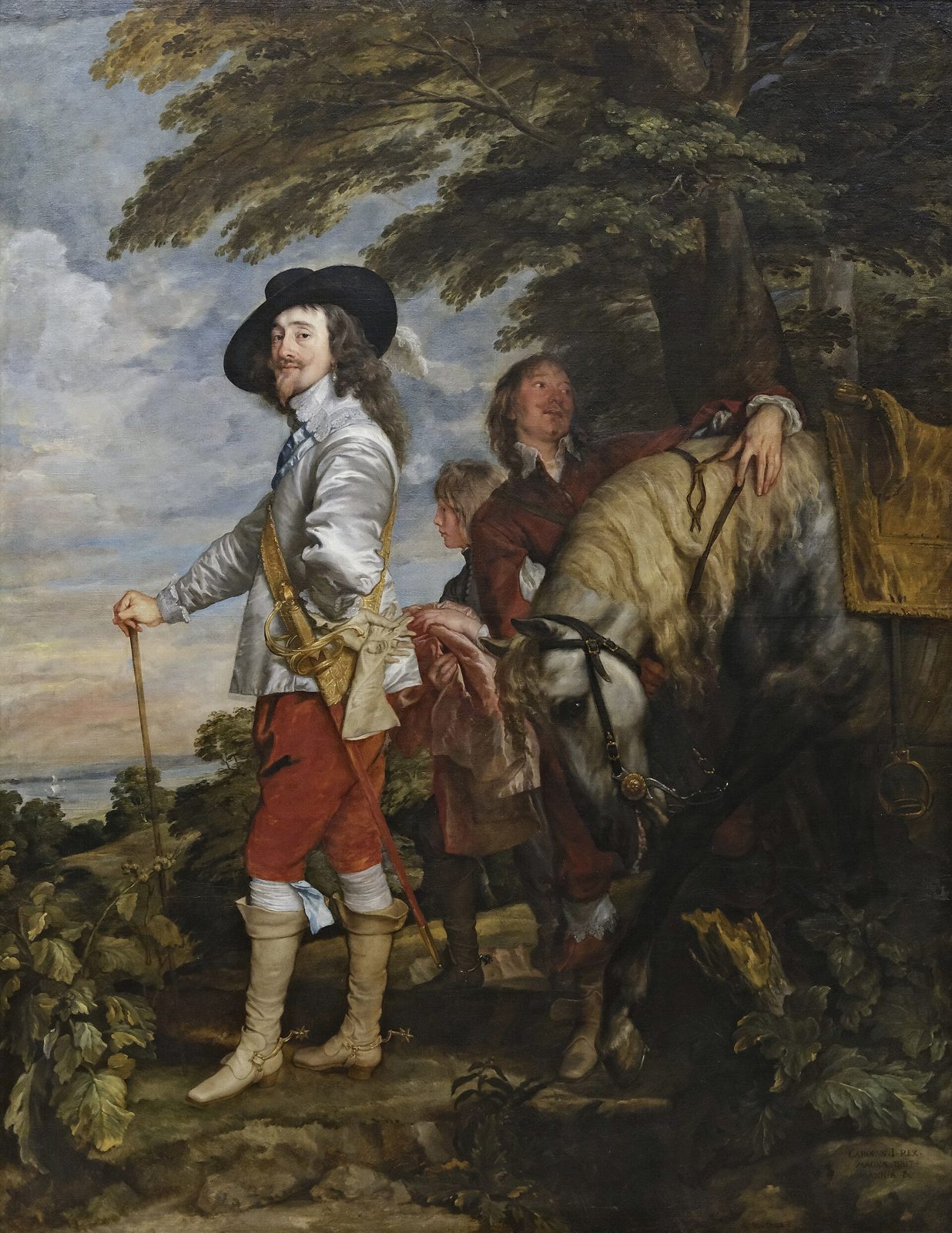
🎧 This work has audio narration — listen in the appTake a moment to really look at “Charles I at the Hunt.” Notice how the king stands confidently beside his horse, dressed in elegant civilian attire rather than armor. His wide-brimmed hat casts a shadow over his face, emphasizing that slight, disdainful smile. This isn’t just a portrait; it’s a masterclass in how to convey power through relaxed elegance.
Van Dyck captures Charles in a moment of leisure, yet the king’s posture and the way he holds his gloves speak volumes about his authority. The darker background, with shadowy figures and a horse, contrasts sharply with the lighter colors of Charles’ attire, making him the undeniable focal point. This choice highlights not just his royal status but also his desire to be seen as approachable, a gentleman rather than just a monarch.
Painted in 1635, during a time when Charles was consolidating his power, this artwork reflects the political climate of the era. The inscription on the rock, declaring Charles as “King of Great Britain,” serves as a reminder of the unification of crowns just a generation earlier, a bold assertion of his sovereignty.
As you stand here, think about the duality of this image: a king at ease, yet always aware of the weight of his crown. What do you think Van Dyck wanted us to feel about Charles I?
Sir Anthony van Dyck, born on March 22, 1599, in Antwerp, was a pivotal Flemish Baroque artist renowned for his portraits. As the seventh child of a wealthy silk merchant, his artistic talent emerged early, leading him to study under Hendrick van Balen and later become an assistant to the celebrated Peter Paul Rubens. By 1617, he was a master in the Guild of Saint Luke, establishing his independent workshop shortly thereafter.
Van Dyck's career flourished as he traveled to Italy, where he absorbed the styles of Titian and Veronese, and produced his acclaimed Iconography series. His return to England in 1632 as court painter to Charles I marked a significant turning point, as he became the leading portraitist of the English aristocracy, capturing the elegance and stature of his subjects with a relaxed sophistication that would influence portraiture for generations.
His innovative techniques in watercolor and etching, alongside his ability to blend mythological and biblical themes into his work, solidified his legacy. Van Dyck's impact on English art persisted long after his death on December 9, 1641, evident in the enduring popularity of the Van Dyke beard and his burial in St. Paul's Cathedral, a testament to his esteemed position in art history.
This was just three years after van Dyck became the Principal Painter in Ordinary to Charles I, a role that allowed him to capture the essence of the monarchy. The painting was intended to convey not just the king’s authority but also his desire to be seen as a relatable gentleman. After Charles's execution in 1649, the painting's fate became uncertain; it was not listed in the inventory of his possessions. By 1738, it had made its way to France, eventually sold to King Louis XVI by Madame du Barry in 1775. Today, it resides in the Louvre Museum, a testament to its enduring legacy and the complex history surrounding its creation and ownership.
Van Dyck's technique in 'Charles I at the Hunt' is a brilliant interplay of light and shadow, creating a striking contrast that draws your eye directly to the king. Notice how the lighter colors of Charles' attire pop against the darker background, enhancing his status as the focal point. The brushwork is fluid, almost effortless, capturing the relaxed yet regal posture of the king. Van Dyck employs a low-angle perspective, making Charles appear more imposing, compensating for his well-known sensitivity about his height. The careful placement of elements—like the horse bowing its head in submission—adds layers of meaning, suggesting both authority and a connection to nature. This naturalism is a hallmark of van Dyck's style, allowing the viewer to feel the weight of the king's dual identity as both a ruler and a man at leisure.
Endymion Porter, depicted holding the horse in the painting, was not only a favored courtier but also served as Charles I's picture-buying agent. His presence in the artwork emphasizes the king's social circle and the importance of art collection in the royal court.