The Toilette of Esther
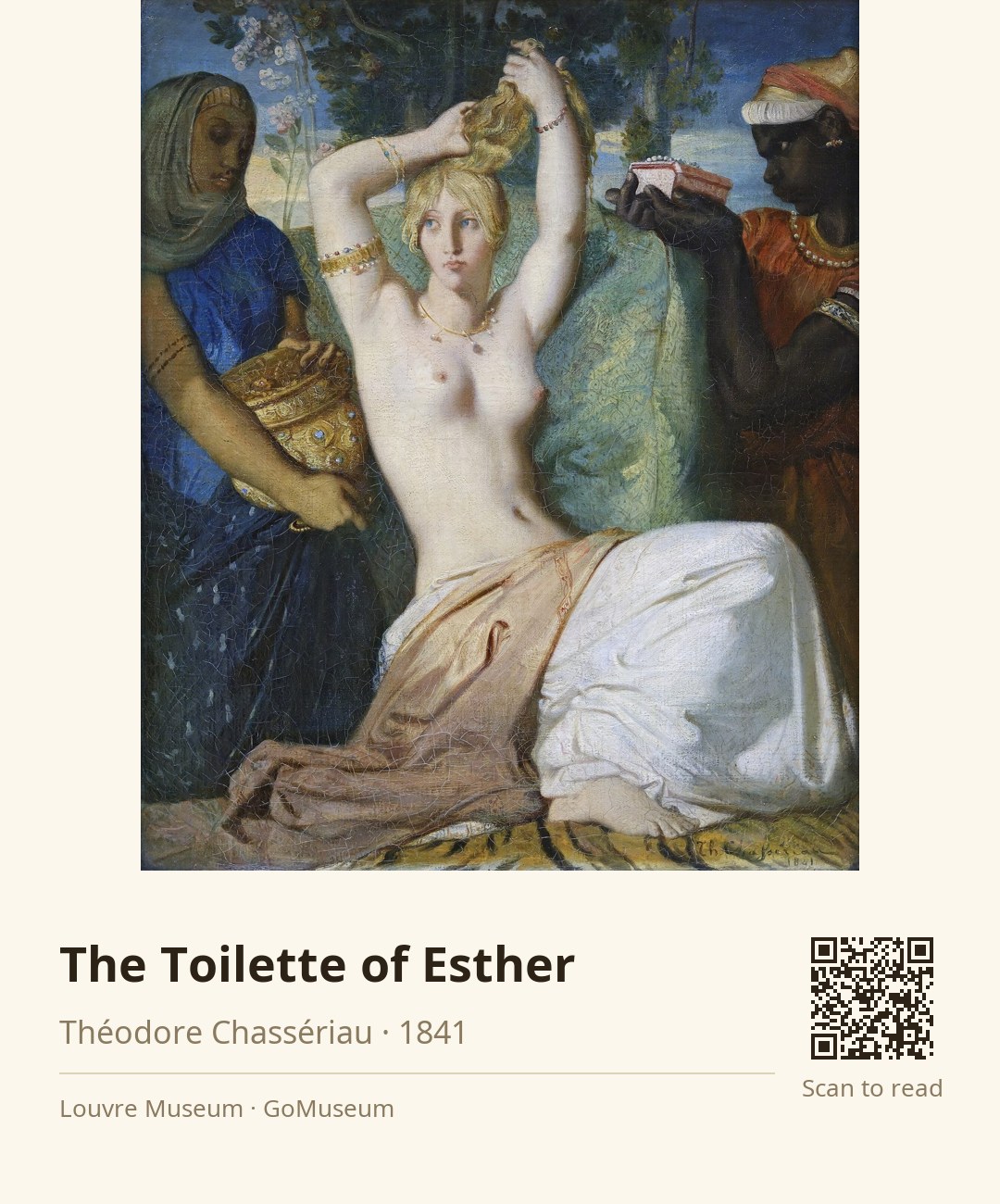
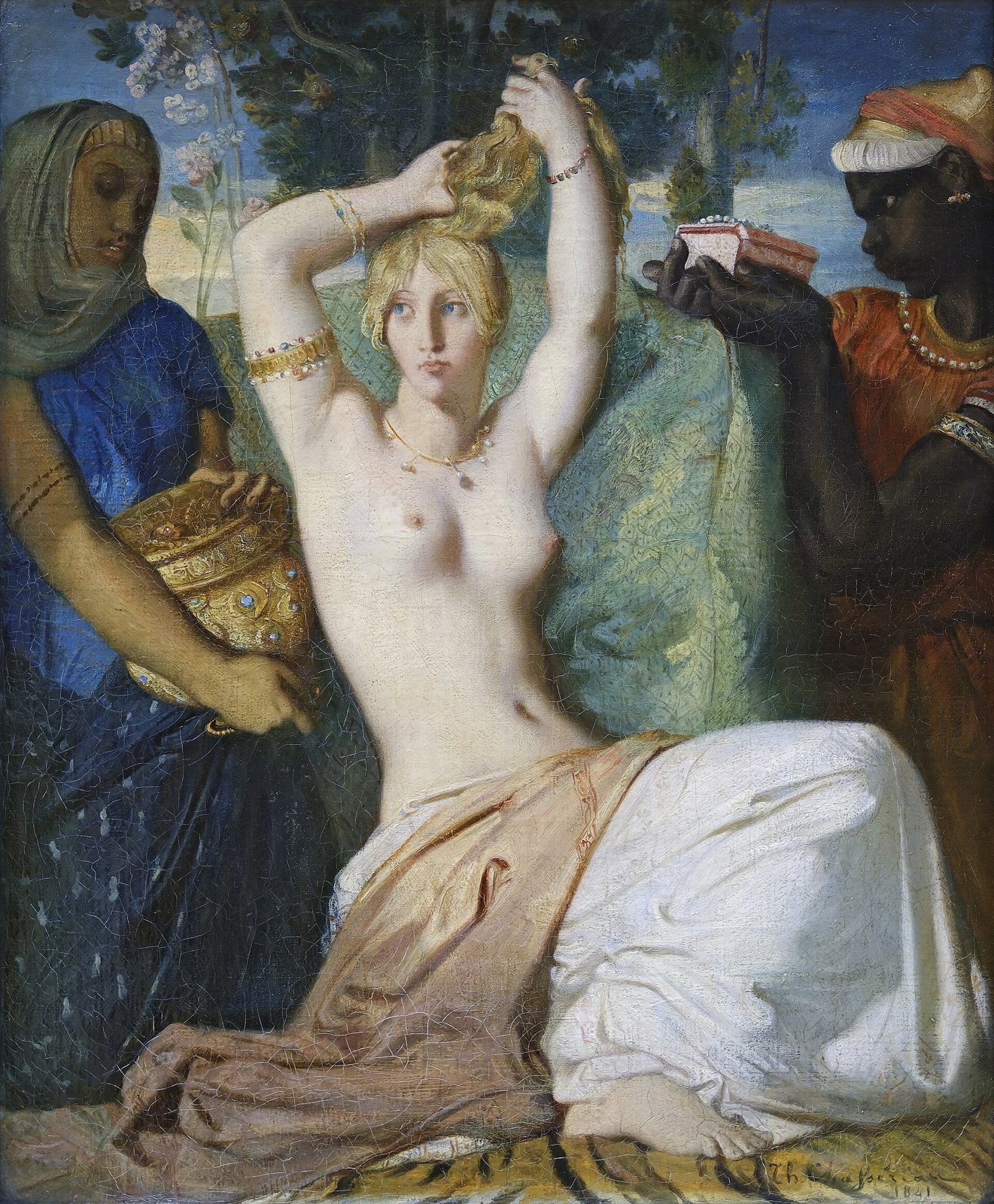
🎧 This work has audio narration — listen in the appTake a moment to really absorb the scene in front of you. Here’s Esther, poised and serene, preparing for her fateful encounter with King Ahasuerus. Notice how her arms are raised, elegantly arranging her golden hair, a gesture that feels both intimate and charged. The way her skin glistens against the soft drapery of her garments draws you in, doesn’t it?
These details matter because they encapsulate the tension between vulnerability and power. Esther is not just a passive figure; she’s actively engaging in her own presentation, embodying both beauty and strength. This moment, captured by Chassériau in 1841, is a bold reinterpretation of a biblical story rarely depicted in art. It’s not just about the physical; it’s about the eroticism and the allure of the unknown, which Chassériau masterfully conveys through color and composition.
Chassériau was influenced by both Ingres and Delacroix, blending classical elegance with romantic passion. This painting, part of a tradition of women at their toilette, reimagines Esther’s story in a way that was groundbreaking for its time, challenging the norms of female representation in art.
As you stand here, consider what Esther’s gaze, directed beyond the canvas, might be saying. Is she aware of her power, or is she lost in thought about the future that awaits her? What do you think she feels in this pivotal moment?
Théodore Chassériau, born on September 20, 1819, in the Dominican Republic, was a prominent French Romantic painter known for his portraits, historical scenes, and Orientalist works. His early talent was nurtured under the guidance of Jean-Auguste-Dominique Ingres, who recognized his potential at a young age. Chassériau's style evolved from Neoclassicism to embrace the vibrant Romanticism of Eugène Delacroix, reflecting a unique blend of both influences.
Chassériau's artistic journey began in Paris, where he quickly gained recognition, exhibiting at the Salon and earning accolades for his innovative approach to the female form. His notable works include "Susanna and the Elders" and "The Toilette of Esther," showcasing his mastery of color and composition. He was also a skilled draftsman, producing a series of prints illustrating Shakespeare's "Othello."
His travels to Algeria inspired a series of dynamic works depicting Arab life, further establishing his reputation. Despite his success, Chassériau struggled with health issues and the pressures of his commissions, leading to his untimely death at 37 in 1856. He left behind a legacy that bridged classical and romantic styles, influencing future generations of artists. His contributions were celebrated by contemporaries like Théophile Gautier, who recognized him as a master in his own right, akin to Raphael.
The Toilette of Esther, painted by Théodore Chassériau in 1841, was first exhibited at the Paris Salon in 1842. This moment marked a significant point in the artist's career, as he sought to reinterpret a rarely depicted biblical story. The painting was not immediately well-received; critics struggled to appreciate its originality, with some dismissing Esther's expression as lacking depth. Despite this rocky reception, the work would later influence notable artists like François-Léon Benouville and Gustave Moreau. The painting was eventually bequeathed to the Louvre in 1934 by Baron Arthur Chassériau, a distant relative of the artist, as part of a larger donation that included many of Chassériau's works.
Chassériau's technique in The Toilette of Esther is a fascinating blend of classical and romantic styles. Notice how he uses soft, flowing brushwork to create a sense of movement and sensuality in Esther's pose. The way her arms are raised, combined with the delicate handling of light on her skin, draws your eye and emphasizes her beauty. The color palette is rich and vibrant, with warm tones that enhance the eroticism of the scene. The composition is carefully structured, with Esther at the center, flanked by her attendants, creating a dynamic yet harmonious balance. This arrangement not only highlights Esther's importance but also reflects the tension of the moment as she prepares for her encounter with the king.
This painting not only reinterprets a rarely depicted biblical story but also boldly embraces eroticism in a way that was groundbreaking for its time. Chassériau's lush portrayal of Esther, with her sensual pose and exotic accessories, challenged traditional representations of women in art. It opened the door for future artists like Gustave Moreau and François-Léon Benouville to explore similar themes, ultimately influencing the trajectory of 19th-century painting. Remember, this work was more than just a depiction; it was a statement that reshaped how female figures could be represented in art history.
Interestingly, Chassériau created several preparatory studies for this painting, including two drawings housed in the Louvre. These studies reveal that he initially envisioned the composition as a circular tondo, similar to his mentor Ingres's work, The Turkish Bath. This experimentation highlights Chassériau's desire to innovate and present historical themes in fresh, original ways.
When first exhibited in 1842, the painting received mixed reviews; critics struggled to appreciate its originality, with some dismissing Esther's expression as lacking depth.
Chassériau's affection for his sisters and his mistress Clémence Monnerot likely influenced the portrayal of female figures in his works, as noted by art historians who observed the resemblance of Esther's arms to those of his sister.
Chassériau initially envisioned The Toilette of Esther as a circular tondo composition, similar to his mentor Ingres's work, which highlights his desire to innovate and present historical themes in fresh ways.