Barbadori Altarpiece and Predella
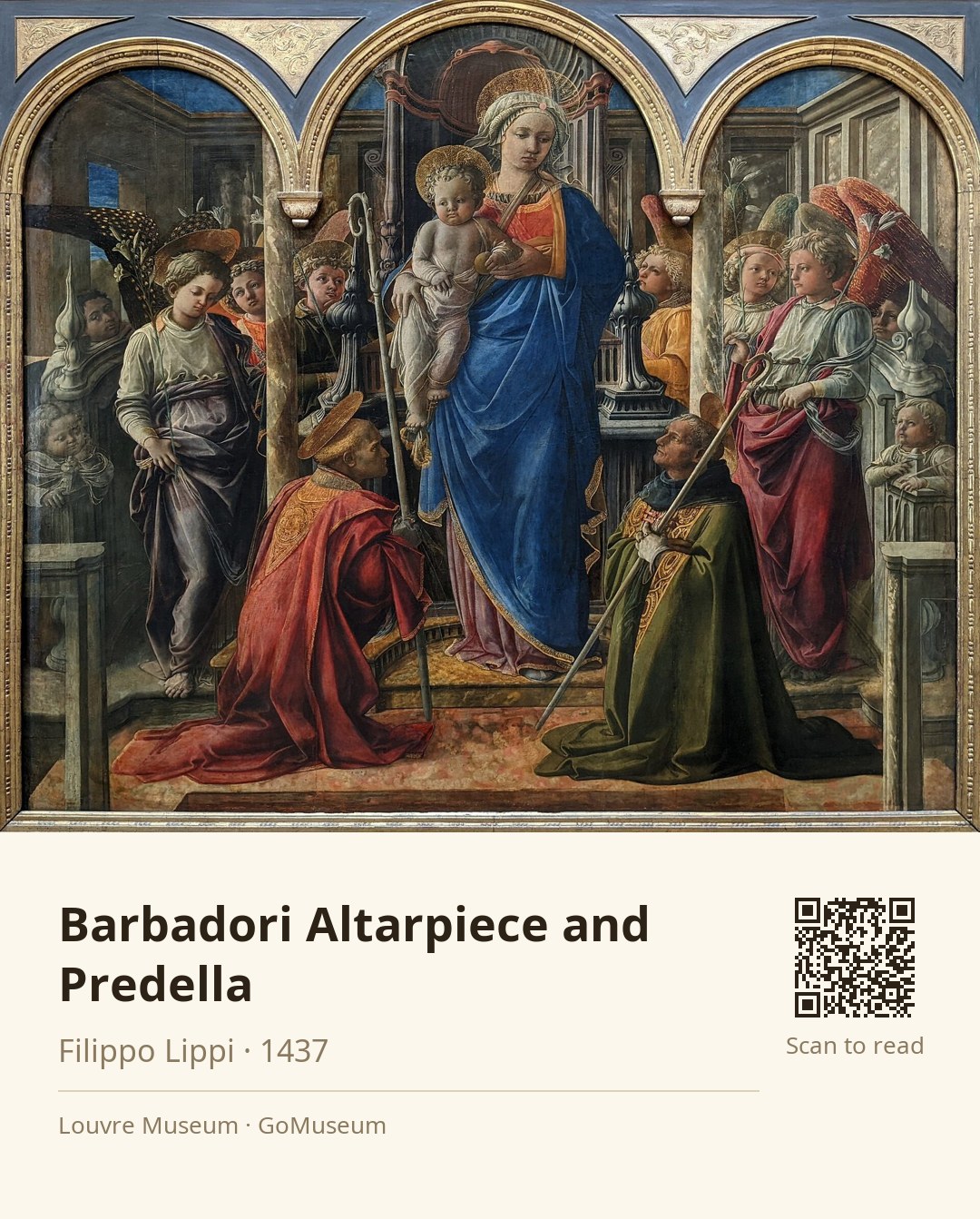
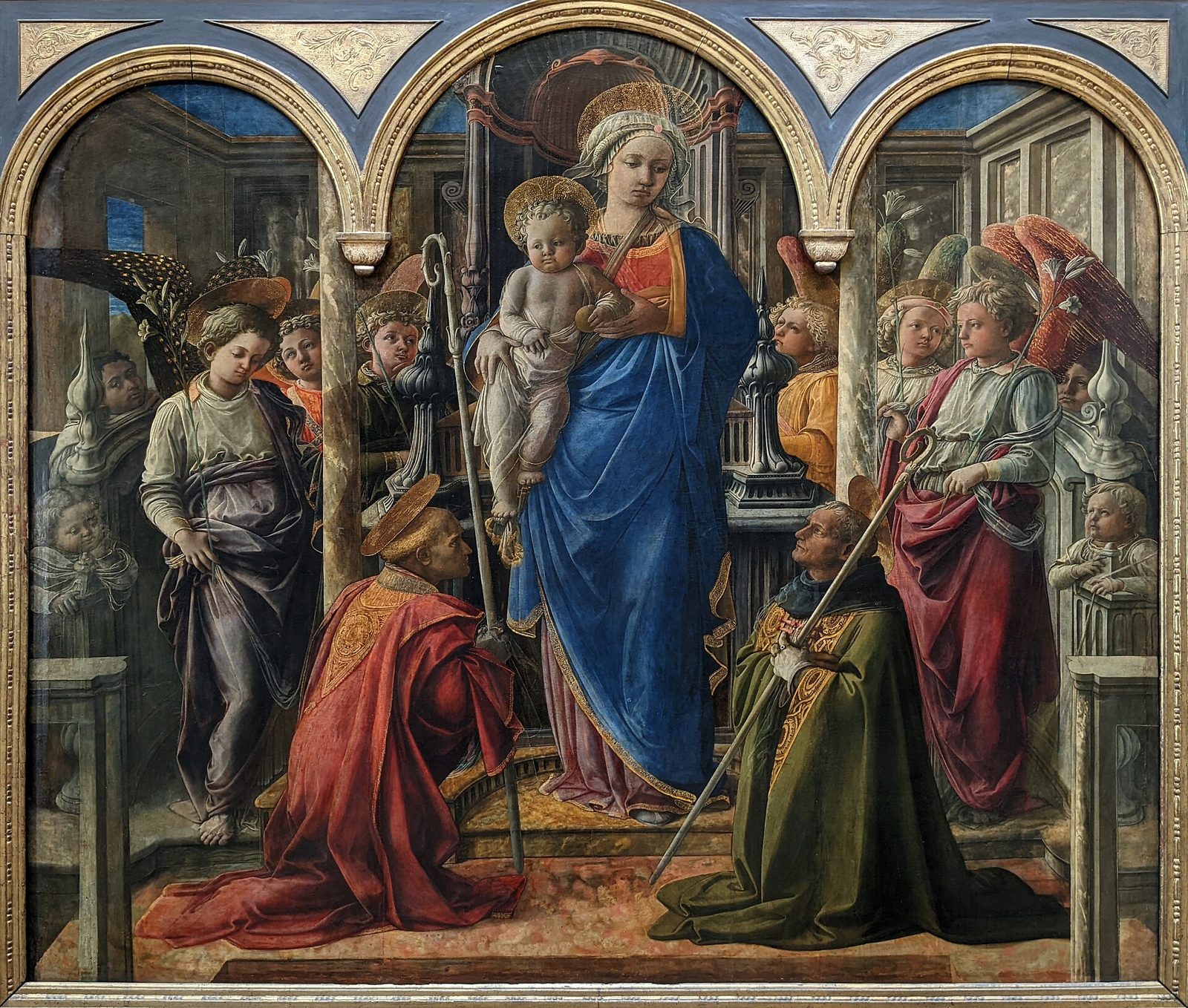
🎧 This work has audio narration — listen in the appTake a moment to really look at the Barbadori Altarpiece. Notice how the Virgin Mary stands at the center, her serene expression drawing you in. Look closely at the intricate details of her flowing robe, the way it drapes elegantly, and the delicate embrace of the Christ Child nestled against her side. This isn’t just a depiction of a mother and child; it’s a moment of divine connection, surrounded by angels and saints who seem to celebrate this sacred bond.
These details matter because they reflect Filippo Lippi’s innovative approach to composition and depth. By placing the figures in a hierarchical arrangement, he elevates their spiritual significance while also creating a sense of intimacy. The architectural elements, like the columns that seem to reach out towards you, break the traditional boundaries of altarpiece design, inviting you into the scene rather than keeping you as a distant observer.
Commissioned in 1437 by Gherardo Barbadori, a wealthy Florentine, this altarpiece was meant to honor his legacy after his death. Lippi, a Carmelite priest himself, infused the work with personal touches, including a self-portrait of himself as a young monk, gazing directly at us from the left side of the panel. It’s a reminder of his struggles and aspirations, a glimpse into the artist’s soul.
As you stand here, consider the emotions this piece evokes. What do you think Lippi wanted to convey about faith and community through this altarpiece? Let that question linger as you absorb the beauty and depth of this remarkable work.
Filippo Lippi, born in Florence around 1406, was a pivotal figure in the early Italian Renaissance. Orphaned at a young age, he was raised in a Carmelite convent, where his artistic talents flourished under the influence of Masaccio. Lippi's early works, characterized by a blend of realism and divine themes, reflect this mentorship. He left the monastery in 1432, embarking on a tumultuous life marked by artistic success and personal scandal. His relationship with Lucrezia Buti, a novice, produced notable works and a son, Filippino, who followed in his father's footsteps.
Lippi's style evolved to incorporate rhythmic contours and dynamic poses, drawing from both Italian and Flemish influences. His masterpieces, including the Coronation of the Virgin, showcased his ability to blend sacred themes with human emotion. Despite his struggles with poverty and a reputation for escapades, Lippi's workshop became a training ground for future masters like Botticelli. His legacy endures as a bridge between the Gothic traditions and the burgeoning Renaissance, cementing his place in art history as a master of both technique and narrative.
The Barbadori Altarpiece, created by Filippo Lippi, was commissioned in 1437 by Gherardo Barbadori, a wealthy Florentine. Following his death in 1429, Barbadori left his fortune to the Captains of Orsanmichele, requesting the construction of a chapel in his honor. Lippi was paid 40 florins to create this altarpiece for the Santo Spirito church, dedicated to Saint Fridianus. Interestingly, Lippi's profit from this piece was minimal, as much of the funding went to materials. By April 1438, the altarpiece was still unfinished, according to a letter from Domenico Veneziano. The first Mass was only held in August 1439. The painting faced a tumultuous fate; in 1810, it was taken to France by Napoleonic troops and, after restoration in 1815, it found its home in the Louvre, never to return to Florence. This journey reflects the turbulent history of art during times of conflict and change.
Notice how he uses a contrapposto pose for the Virgin, which not only adds elegance but also creates a dynamic tension in the scene. The figures flow into one another, a technique that enhances the sense of connection among them. Lippi's choice to place the Virgin at the center, surrounded by saints and angels, elevates her significance. The architectural elements, such as the columns, are cleverly designed to draw your eye back to the central figures, breaking traditional boundaries of altarpiece design. The faint fabric to the right, a later addition, hints at Lippi's willingness to experiment and adapt as he painted. His use of light and shadow creates a three-dimensional feel, while the slightly misaligned columns challenge the viewer's perception, inviting you into a space that feels both sacred and intimate.
Lippi's innovative approach to the sacra conversazione—a sacred conversation—transformed how figures interacted within the composition. Unlike previous altarpieces that often felt rigid, Lippi's work breathes life into the scene, with the Virgin Mary standing in a contrapposto pose, drawing the viewer's eye and inviting them into a dialogue with the figures. This shift not only influenced his contemporaries but also set the stage for future artists like Botticelli, who would adopt Lippi's rhythmic lines and dynamic poses. The altarpiece's blend of spiritual and human elements reflects a growing Renaissance interest in realism, making it a cornerstone in the transition from medieval to modern art. Remember, this piece is not just an artwork; it's a bridge connecting the sacred and the human experience.
One intriguing aspect of the Barbadori Altarpiece is the self-portrait of Lippi himself, cleverly tucked away as a young monk on the left side of the panel. This not only serves as a personal touch but also reflects Lippi's own struggles with his Carmelite vows, hinting at the artist's complex relationship with his faith and identity. It's as if he's reminding us to remain focused on the sacred scene while also acknowledging his own humanity.
Lippi's use of slightly misaligned columns challenges traditional perspective, creating a dynamic interaction between the viewer and the figures, which invites a more intimate engagement with the sacred scene.
The faint fabric, added later, indicates Lippi's willingness to adapt and experiment throughout the painting process, showcasing his evolving vision and the fluidity of his creative decisions.