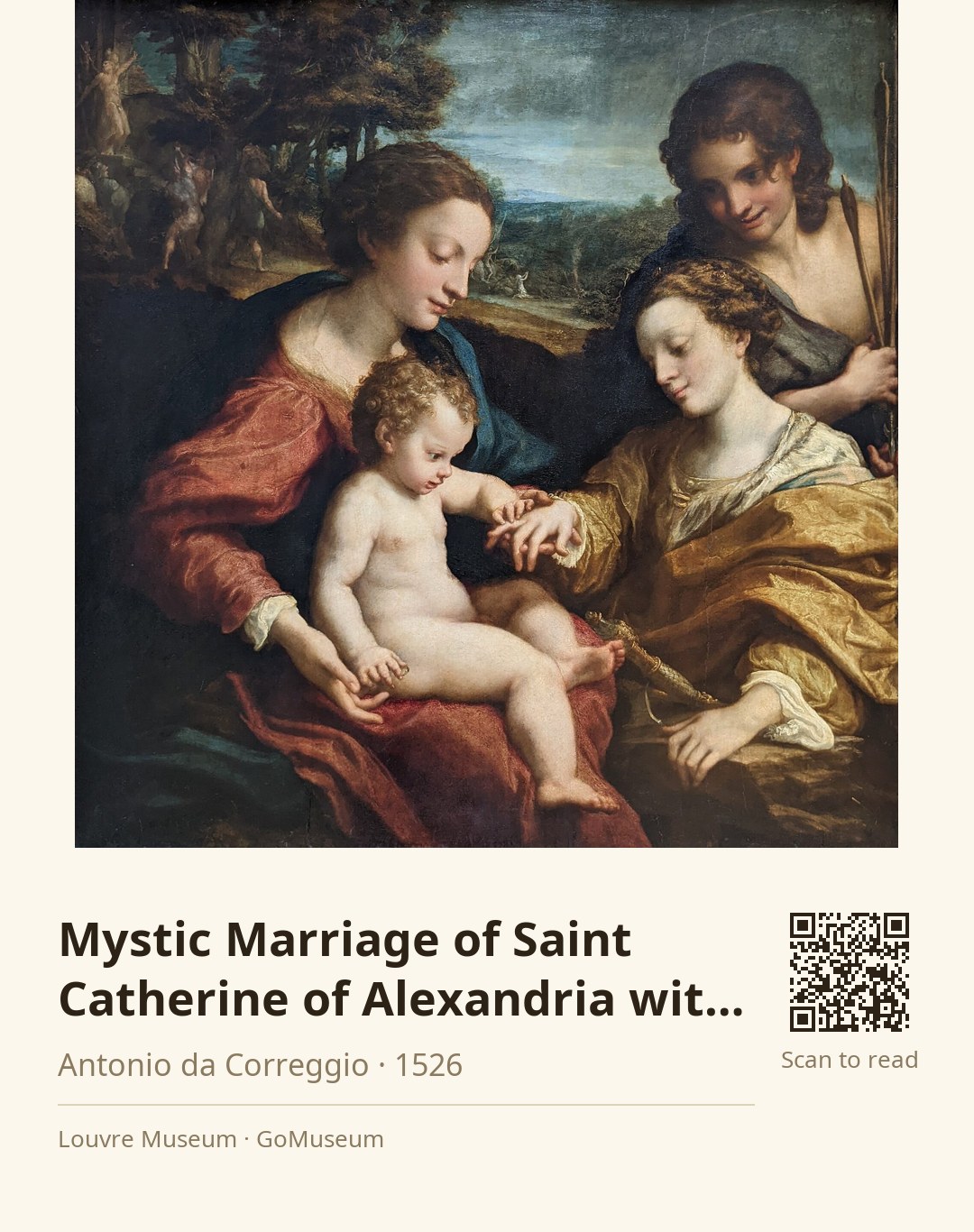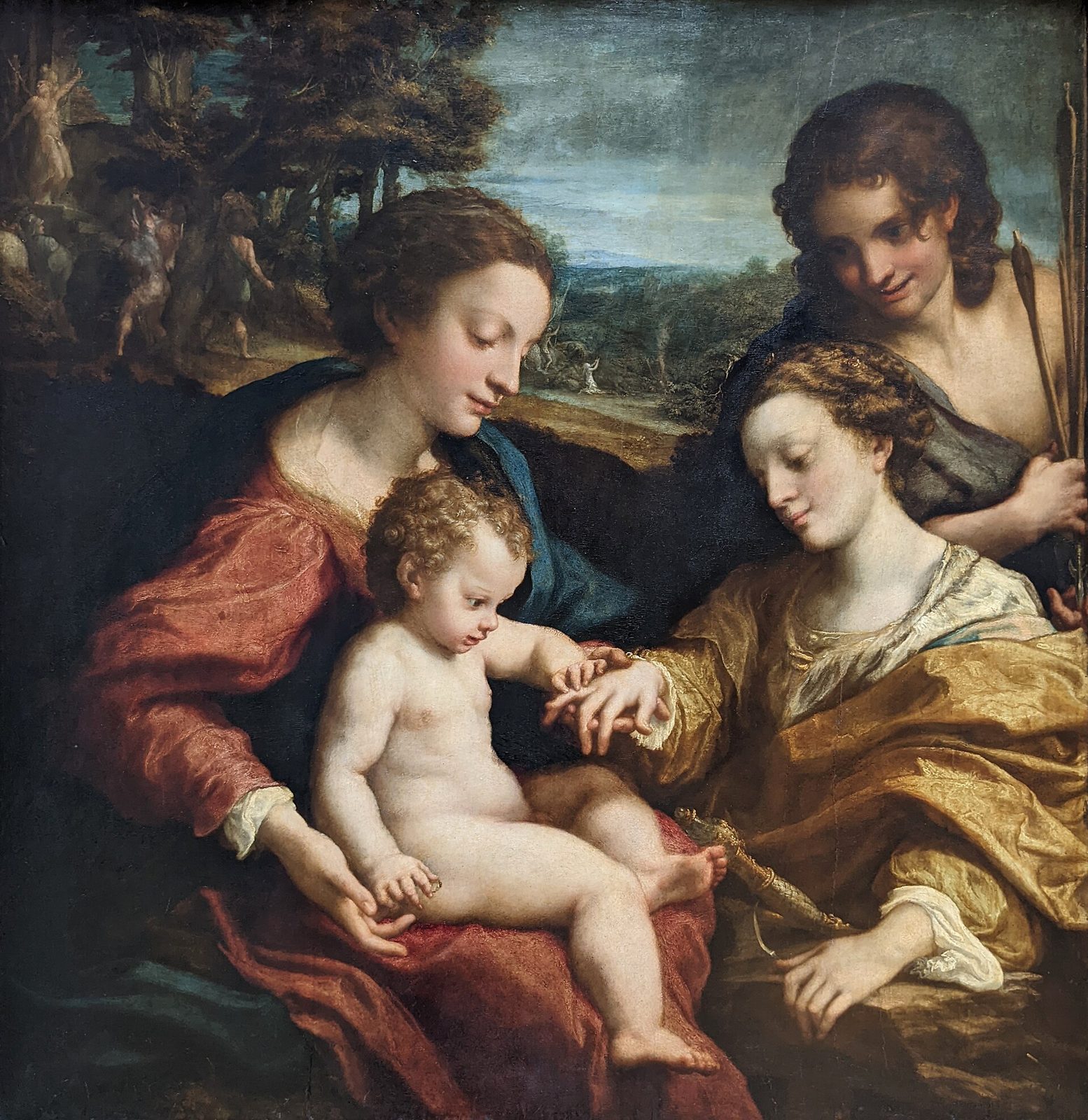
Mystic Marriage of Saint Catherine of Alexandria with Saint Sebastian
🎧 This work has audio narration — listen in the appTake a moment to really look at this painting, "Mystic Marriage of Saint Catherine of Alexandria with Saint Sebastian" by Correggio. Notice how the soft, glowing light bathes the figures, especially the delicate hands of the Child Jesus as He prepares to place a ring on Saint Catherine’s finger. Those hands, tender and almost ethereal, draw you into this intimate moment of divine union.
This detail matters because it encapsulates the essence of Correggio’s style — a blend of warmth and grace that invites viewers into a sacred experience. The way he captures light and shadow creates a sense of depth and movement, making the scene feel alive, as if you’re witnessing this mystical moment unfold right before your eyes.
Painted in 1526, this work reflects the Renaissance's fascination with human emotion and spirituality. Correggio was influenced by the likes of Leonardo da Vinci, and you can see that in the expressive faces and the fluidity of the composition. It’s not just a religious scene; it’s a celebration of connection, both human and divine.
As you stand here, think about the stories behind these saints. What do you think this moment meant for those who first viewed it? How does it resonate with your own understanding of love and commitment? Let that question linger as you take in the beauty of this piece.
Antonio Allegri da Correggio, known simply as Correggio, was an influential Italian Renaissance painter born around August 1489 in Correggio, Emilia-Romagna. He emerged as a leading figure in the Parma school, celebrated for his dynamic compositions and mastery of chiaroscuro. Little is known about his early life, but he likely received his initial training from his uncle, Lorenzo Allegri, and later apprenticed with Francesco Bianchi Ferrara in Modena.
Correggio's career flourished in Parma, where he created some of his most significant works, including the ceiling frescoes of the Camera di San Paolo and the dome of the Cathedral of Parma. His innovative use of illusionistic perspective and foreshortening prefigured the Baroque style, influencing future generations of artists. His mythological series, particularly the Loves of Jupiter, showcased his ability to blend sensuality with narrative depth.
Despite a relatively short life, ending in 1534, Correggio's contributions to art were profound, establishing him as a precursor to Baroque painting and a master of emotional expression. His legacy endures, with his works continuing to inspire artists and captivate audiences.
Initially, it was owned by Francesco Grillenzoni, a doctor from Modena, and by 1582, it caught the eye of Cardinal Luigi d'Este, who gifted it to Catarina Nobili Sforza, a grand-niece of Pope Julius III. By 1614, it was in Rome, belonging to Cardinal Sforza, and later passed through the hands of Scipione Borghese and Cardinal Antonio Barberini. In a twist of fate, Barberini gifted it to Cardinal Mazarin around 1650. Louis XIV, recognizing its value, purchased it in 1661 for a staggering 15,000 livres. This painting, created in the early 1520s, showcases Correggio's deep admiration for Leonardo's style, particularly in the delicate rendering of lips and hands, which adds a layer of intimacy to the divine scene. Its provenance reflects a rich tapestry of art history, moving from private collections to royal ownership, each transition adding to its allure.
As you gaze at this painting, pay attention to Correggio's masterful brushwork. The soft, almost ethereal quality of the light envelops the figures, creating a sense of warmth and intimacy. Notice how he employs chiaroscuro, the interplay of light and shadow, to give depth and dimension to the scene. The composition is carefully structured, with diagonal lines guiding your eye toward the central act of the mystical marriage. The figures are not just arranged; they are in a dynamic relationship, their gestures and expressions conveying a profound emotional connection. The scale of the painting, almost square, draws you in, making you feel as if you are part of this sacred moment. Correggio's choice of colors enhances the overall effect, with soft pastels that evoke a sense of serenity and grace. This technique creates a fluidity that makes the scene feel alive, as if the viewer is witnessing a divine moment unfolding in real time.
His innovative use of light and composition influenced not only his contemporaries but also future generations of artists. The emotional depth and dynamic movement he captured prefigured the Baroque style that would dominate the 17th century. Artists like Giovanni Lanfranco and Baciccio drew inspiration from Correggio's techniques, particularly his ability to create illusionistic space and emotional resonance.
Originally owned by a Modenese doctor, it eventually made its way into the hands of Cardinal Luigi d'Este, who gifted it to Catarina Nobili Sforza, a grand-niece of Pope Julius III. By the time it reached Louis XIV, it was a prized possession, bought for a staggering 15,000 livres. That's a hefty sum for a painting in the 17th century, highlighting just how much this piece was valued even then.
Correggio was born in a small town and received his initial artistic education from his uncle, Lorenzo Allegri, which set the foundation for his unique style. His early exposure to local painters and the classicism of artists like Francesco Bianchi Ferrara also shaped his approach to art.
Correggio's innovative use of chiaroscuro and dynamic composition not only defined his own work but also influenced later artists, paving the way for the Baroque style. His techniques in creating illusionistic space and emotional depth were particularly admired and emulated by artists like Giovanni Lanfranco.