Madonna with Child between Sts. Flavian and Onuphrius
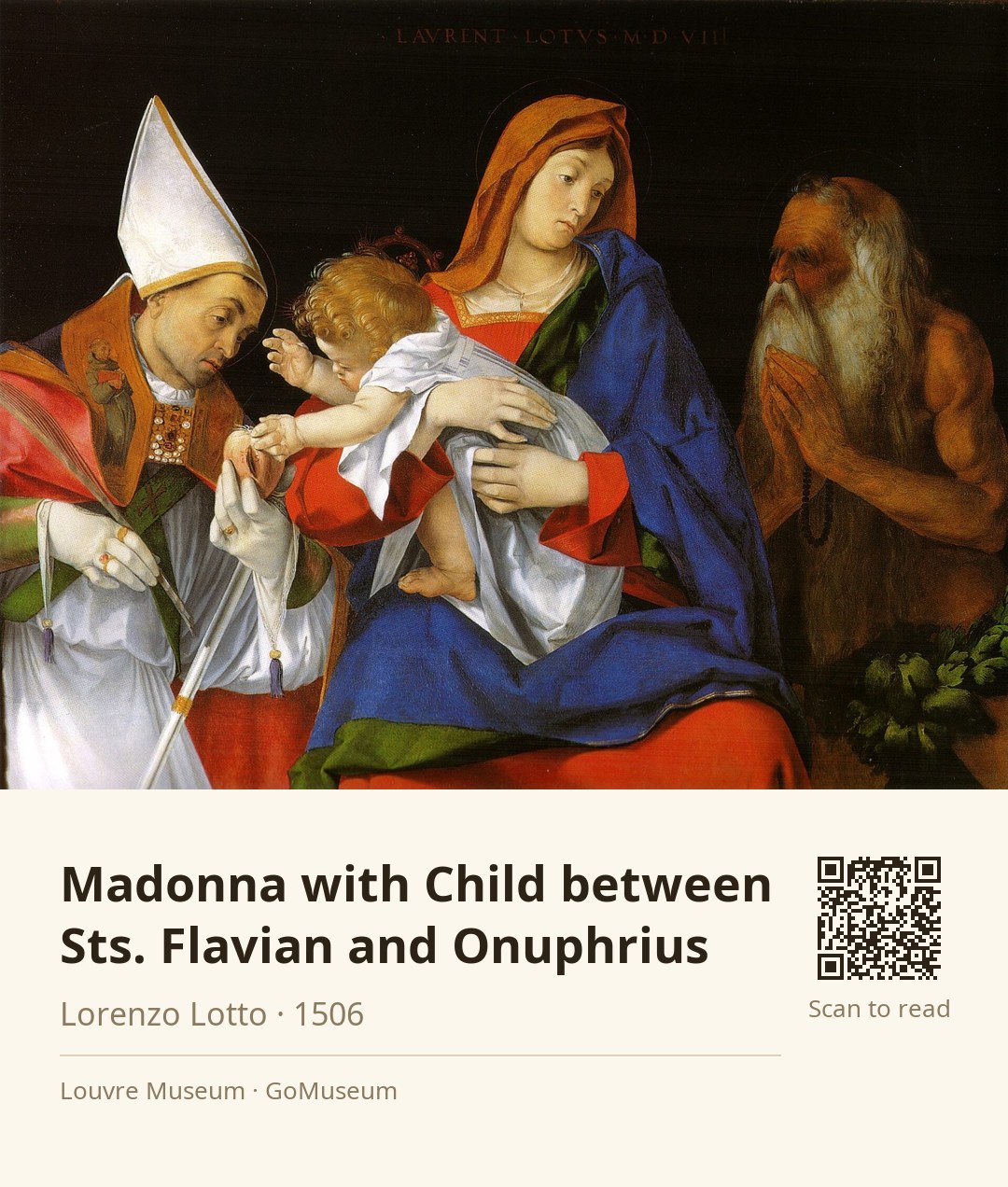
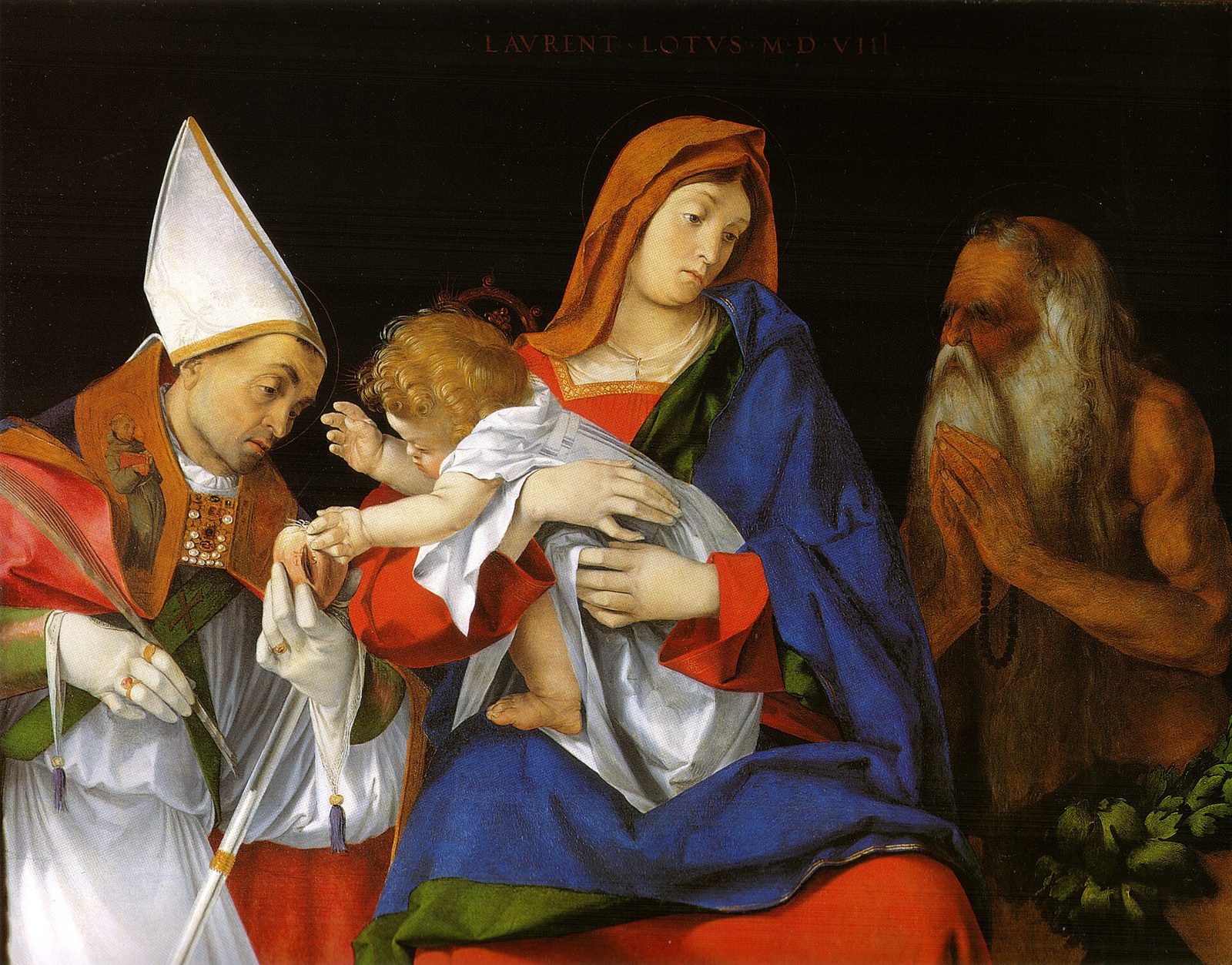
🎧 This work has audio narration — listen in the appTake a moment to really look at the expression on the Madonna’s face in Lorenzo Lotto’s "Madonna with Child between Sts. Flavian and Onuphrius." Notice how she seems lost in thought, her gaze distant yet tender as she cradles the chubby infant Jesus. Isn’t it striking how the child reaches out towards St. Flavian, who offers him a pierced heart? This detail isn’t just decorative; it symbolizes the future suffering of Christ, a poignant reminder of the Passion that awaits him.
Lotto, active during the early 1500s, was known for his unique approach to religious subjects, and this painting exemplifies his ability to blend emotion with narrative. The dark background enhances the figures, drawing your eye to their expressions and gestures. The saints flanking the Madonna are not mere bystanders; they engage with the divine moment unfolding between them.
This work was created in 1506, a time when Lotto was transitioning from the Marche region to Rome, and you can see the influence of Venetian styles in the vibrant colors and soft drapery.
As you stand here, consider what emotions this scene evokes for you. How does the interplay between the saints and the Madonna change your perception of this holy moment?
Lorenzo Lotto, born around 1480 in Venice and passing away in 1556, was a notable Italian Renaissance painter whose career spanned various northern Italian cities. Although often associated with the Venetian school, his unique style and independent approach set him apart from contemporaries like Titian and Giorgione. Lotto's work primarily encompassed altarpieces, religious themes, and portraits, reflecting a distinctive blend of High Renaissance ideals with a personal touch that hinted at the emerging Mannerist style.
His artistic journey began in Treviso, where he gained recognition under the patronage of Bishop Bernardo de' Rossi. Lotto's early works, such as "Allegory of Virtue and Vice," showcased his ability to convey psychological depth through intricate symbolism. His time in Rome was marked by an invitation from Pope Julius II to decorate the papal apartments, although this opportunity did not yield lasting results.
Lotto's most fruitful period occurred in Bergamo, where he produced some of his finest works, characterized by rich color and dramatic compositions. Despite his initial acclaim, Lotto's reputation waned after his death, leading to a gradual obscurity. Today, he is celebrated for his idiosyncratic style and contributions to the transition between Renaissance and Mannerism, earning him a unique place in art history.
As you gaze at this painting, notice how Lotto employs a dark background to create a striking contrast with the figures, allowing their expressions to take center stage. The brushwork is both meticulous and fluid, capturing the softness of the Madonna's drapery and the chubby form of the infant Jesus. Lotto's use of color is particularly noteworthy; the rich, vibrant hues draw you in, while the asymmetrical composition adds a dynamic quality to the scene. The Madonna's thoughtful gaze and the outstretched hand of the child towards St. Flavian create a palpable tension, inviting you to ponder the deeper meaning behind their interaction. This technique of blending emotional resonance with visual storytelling is what makes Lotto's work so compelling, as he captures a moment that feels both sacred and intimately human.
Flavian, who offers the pierced heart to Jesus, has been a subject of debate among scholars. While traditionally identified as the patron saint of Recanati, some recent interpretations suggest he could also be St. Ignatius of Antioch. This ambiguity adds an intriguing layer to the painting, inviting viewers to consider the multiple narratives and meanings that can arise from a single work of art.
Lotto's style transitioned from a more detached classicism influenced by Giorgione to a vibrant and dramatic approach, particularly evident in his later works. This evolution reflects his unique artistic voice, distinguishing him from his contemporaries in the Venetian school.