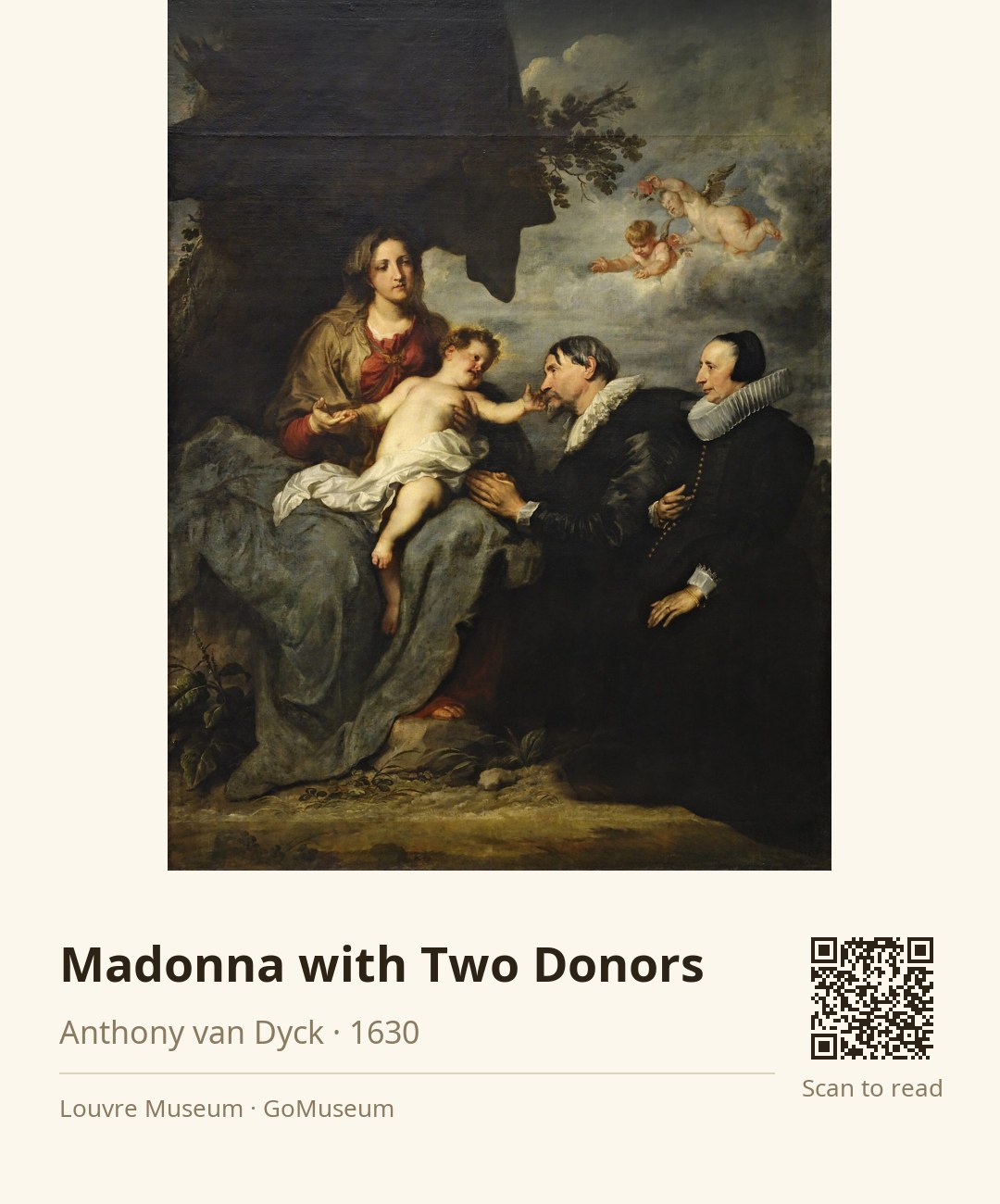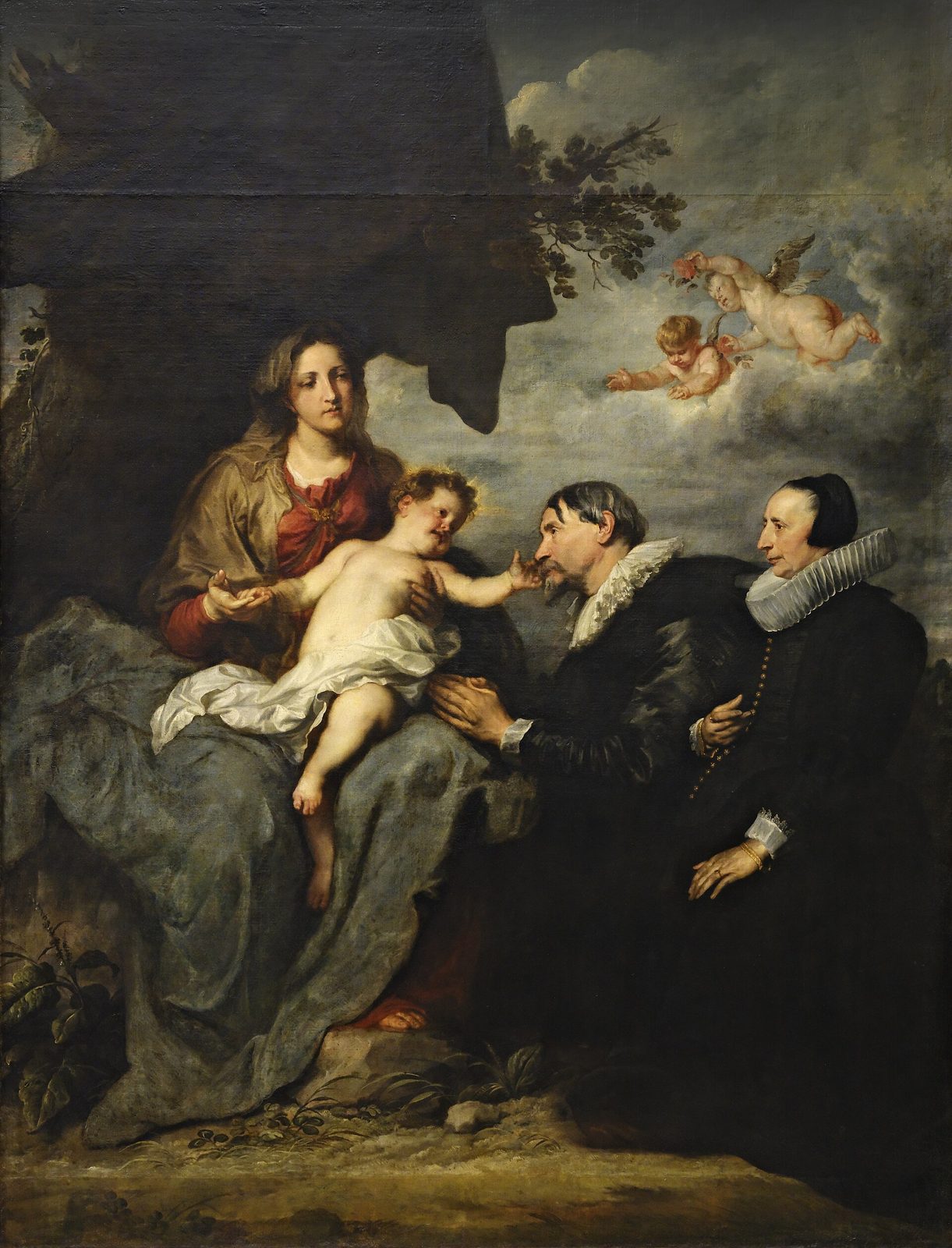
Madonna with Two Donors
🎧 This work has audio narration — listen in the appAs you stand before "Madonna with Two Donors," let your eyes linger on the tender moment captured in this painting. Notice how Mary cradles the Christ Child, who reaches out with a gentle hand toward the kneeling man. The soft, warm colors envelop the figures, creating an intimate atmosphere that draws you in.
The donors, likely a wealthy couple from Antwerp, are not just passive observers; they are part of this sacred scene, inviting us to consider their devotion and the personal nature of faith. Van Dyck masterfully blends the spiritual with the earthly, making it clear that these figures are not just painted subjects, but real people seeking divine grace.
Painted in 1630, this work reflects Van Dyck's transition from a court painter in Flanders to a master of emotional depth and portraiture. His ability to convey character and intimacy would later influence generations of artists.
So, as you take in this beautiful piece, think about the stories behind the faces. What might the donors have been praying for in that moment? What does their presence tell us about the relationship between art, faith, and personal devotion?
Sir Anthony van Dyck, born on March 22, 1599, in Antwerp, was a pivotal Flemish Baroque artist renowned for his portraits. As the seventh child of a wealthy silk merchant, his artistic talent emerged early, leading him to study under Hendrick van Balen and later become an assistant to the celebrated Peter Paul Rubens. By 1617, he was a master in the Guild of Saint Luke, establishing his independent workshop shortly thereafter.
Van Dyck's career flourished as he traveled to Italy, where he absorbed the styles of Titian and Veronese, and produced his acclaimed Iconography series. His return to England in 1632 as court painter to Charles I marked a significant turning point, as he became the leading portraitist of the English aristocracy, capturing the elegance and stature of his subjects with a relaxed sophistication that would influence portraiture for generations.
His innovative techniques in watercolor and etching, alongside his ability to blend mythological and biblical themes into his work, solidified his legacy. Van Dyck's impact on English art persisted long after his death on December 9, 1641, evident in the enduring popularity of the Van Dyke beard and his burial in St. Paul's Cathedral, a testament to his esteemed position in art history.
The painting 'Madonna with Two Donors' was created by Anthony van Dyck in 1630, during a pivotal time in his career. Commissioned by an unknown wealthy couple from Antwerp, it reflects van Dyck's deepening exploration of emotional depth and portraiture. After its completion, the painting quickly left its original location and found its way into the collection of Louis XIV of France by 1685. This transition marked a significant moment in the painting's history, as it became part of the royal collection, elevating its status. The identity of the donors remains a mystery, but their presence in the artwork suggests a personal connection to faith and devotion, inviting viewers to ponder their stories and motivations.
As you gaze at 'Madonna with Two Donors,' pay attention to the brushwork and the way van Dyck handles light and color. The soft, warm palette envelops the figures, creating a sense of intimacy that pulls you into the scene. Notice how the light falls gently on Mary's face, highlighting her serene expression, while the Christ Child's outstretched hand seems to reach out to the viewer, inviting a connection. The composition is carefully structured, with the kneeling donors positioned in a way that emphasizes their devotion while still allowing them to be part of the divine moment. Van Dyck's technique showcases a mastery of chiaroscuro, where light and shadow play off one another, giving the figures a three-dimensional quality. This dynamic interplay enhances the emotional resonance of the piece, making it feel alive and deeply human.
One intriguing aspect of 'Madonna with Two Donors' is its mysterious patrons. The identities of the kneeling couple remain unknown, but they are believed to be a wealthy pair from Antwerp, where van Dyck was making his mark. Imagine the conversations they must have had with the artist, discussing their hopes for immortality through this painting. Interestingly, this artwork was recorded in the collection of Louis XIV of France as early as 1685, showing how quickly it gained prominence and traveled far from its original home.