Madonna and Child with Saint Anna and Four Saints - Jacopo Pontormo - Louvre
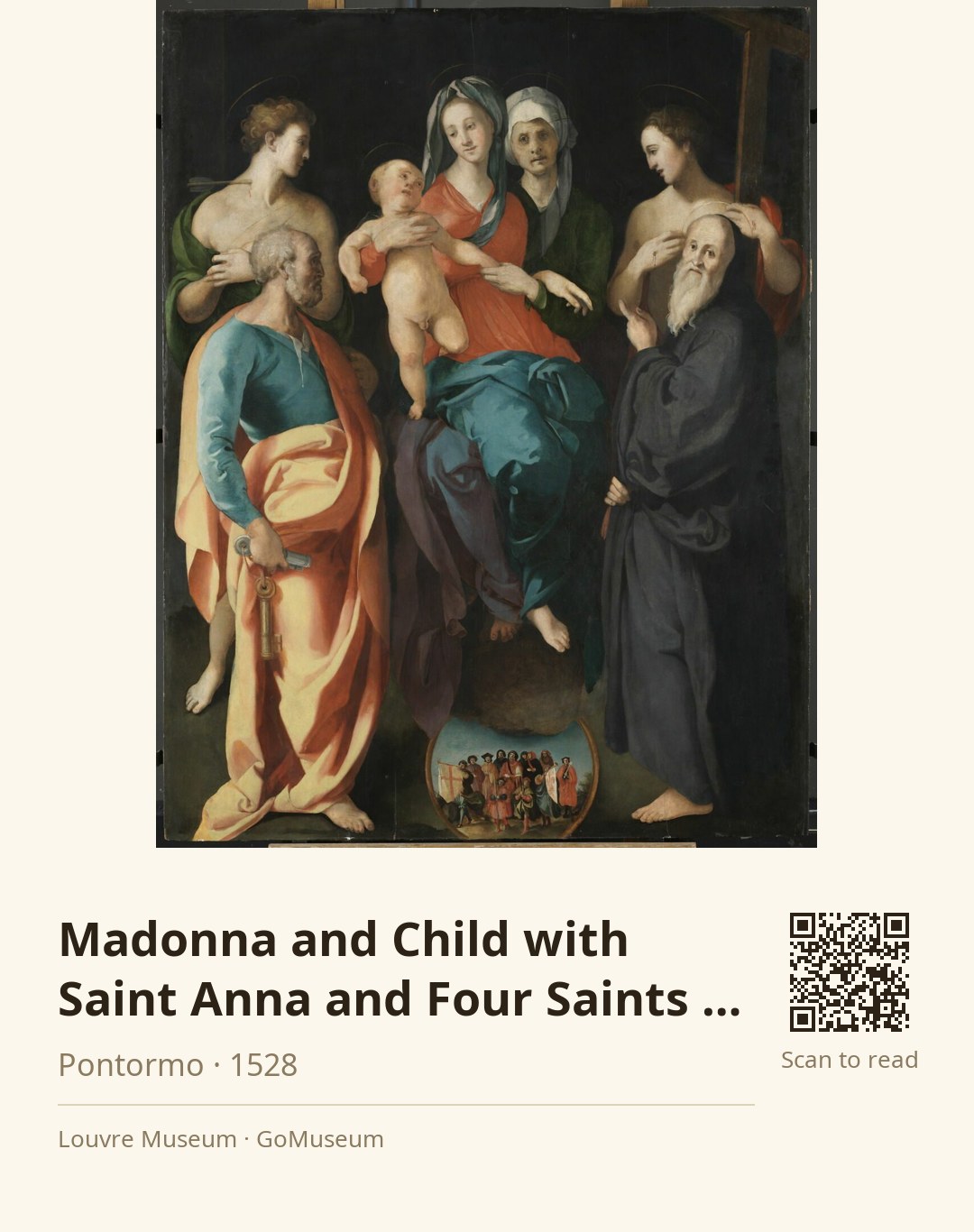
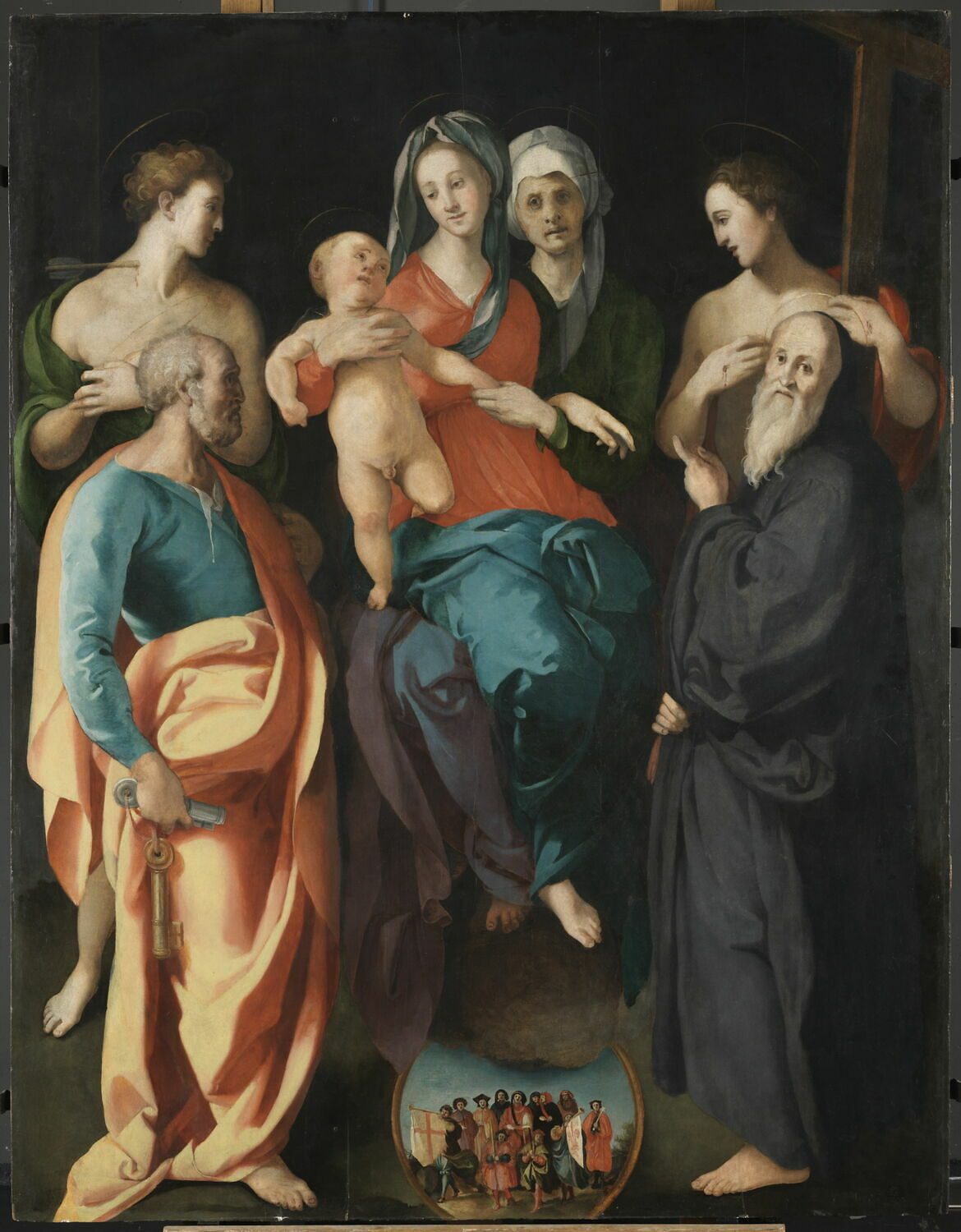
🎧 This work has audio narration — listen in the appTake a moment to really look at Pontormo's "Madonna and Child with Saint Anna and Four Saints." Notice how the Virgin Mary and her child are almost floating in the center, surrounded by a vibrant assembly of saints. Look closely at Saint Anne behind Mary; her intense gaze seems to pull you in, doesn't it?
These details matter because they reflect Pontormo's unique Mannerist style, where figures appear to defy gravity and traditional composition. The swirling colors and elongated forms create a sense of movement and emotion that was revolutionary for its time.
Created around 1528, this work was not just a religious piece; it was a response to the cultural and political turbulence of Florence. The monastery itself was destroyed during the Siege of Florence, making this artwork a poignant reminder of a lost community.
As you stand here, think about the stories this painting holds. What emotions does it evoke in you? How does it connect to the history of Florence and its people?
Jacopo Carucci, known as Pontormo, was an influential Italian Mannerist painter born on May 24, 1494, in Pontorme, near Empoli. Orphaned at a young age, he was shaped by a solitary and melancholic childhood, which later influenced his art. Trained under prominent Florentine artists, including Andrea del Sarto, Pontormo developed a distinctive style characterized by elongated figures and ambiguous perspectives, marking a departure from the balanced compositions of the High Renaissance.
His early works, such as the Visitation fresco, reflect a transition from traditional Renaissance ideals to a more expressive and dynamic approach. Pontormo’s mature pieces, like The Deposition from the Cross, showcase his mastery of color and form, presenting figures that seem to float in an ethereal space. His art often evokes emotional intensity, with haunting faces and intricate poses that challenge gravity.
Pontormo's work was supported by Medici patronage, and he contributed significantly to the fresco decoration of the Medici villa at Poggio a Caiano. His later years were marked by a retreat to a monastery during the plague, where he created poignant frescoes on Christ's passion. Recognized as a precursor to Baroque art, Pontormo's innovative style and emotional depth have secured his place in art history, influencing generations of artists, including his own pupil, Bronzino. He passed away on January 2, 1557, leaving behind a legacy of artistic exploration and emotional resonance.
Pontormo's "Madonna and Child with Saint Anna and Four Saints" was commissioned by the Benedictine nuns of the monastery of Sant'Anna in Verzaia, located just outside Florence. This painting, created around 1528, was intended for the monastery's altar, which had been a significant site for the city's annual procession on Saint Anne's feast day. The work reflects the community's history, as the monastery was destroyed during the Siege of Florence in 1529, just before the painting could be installed. After the siege, the artwork was relocated to the Ospedale Sant'Eusebio al Prato and eventually looted by Napoleon in 1811, finding its way to the Louvre in Paris by 1814.
As you gaze at this painting, notice how Pontormo's brushwork creates a sense of ethereal movement. The figures seem to float, defying gravity, a hallmark of Mannerism. The vibrant colors contrast sharply against the dark background, drawing your eye to the central figures of Mary and Child. Look at the way the drapery flows; the folds are rendered with a delicate touch, giving life to the garments. The composition is carefully structured yet dynamic, with the saints arranged symmetrically but each with a unique pose that adds to the overall tension. The use of light enhances the emotional intensity, illuminating the faces and creating a palpable connection with the viewer. This isn't just a static image; it's a dialogue between the figures and the audience, inviting you into their sacred moment.
One intriguing detail about this painting is the medallion at the foot of the Madonna's throne. It depicts a lively procession featuring various figures, including an infantry captain, who was the work's commissioner.
The medallion depicts a lively procession that includes various figures, such as an infantry captain, who was the commissioner of the work. This detail connects the painting to the local community and its traditions, highlighting the importance of the annual procession on Saint Anne's feast day.
The painting was commissioned for a monastery that was destroyed during the Siege of Florence in 1529, preventing it from being installed as intended. This historical event adds a layer of poignancy to the artwork, as it symbolizes the loss of a community and its cultural heritage.