 Image: After Leonardo da Vinci
Leda and the Swan
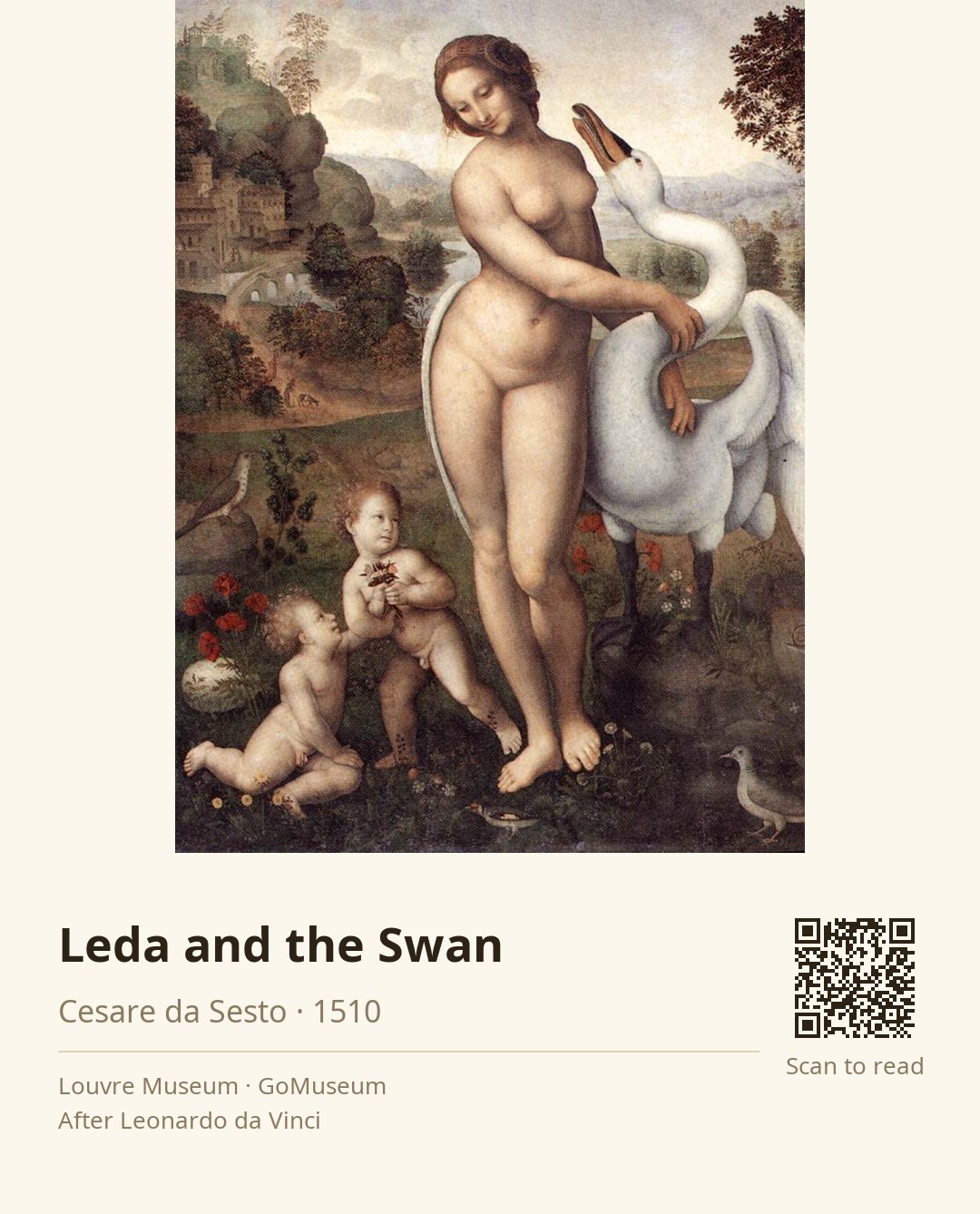
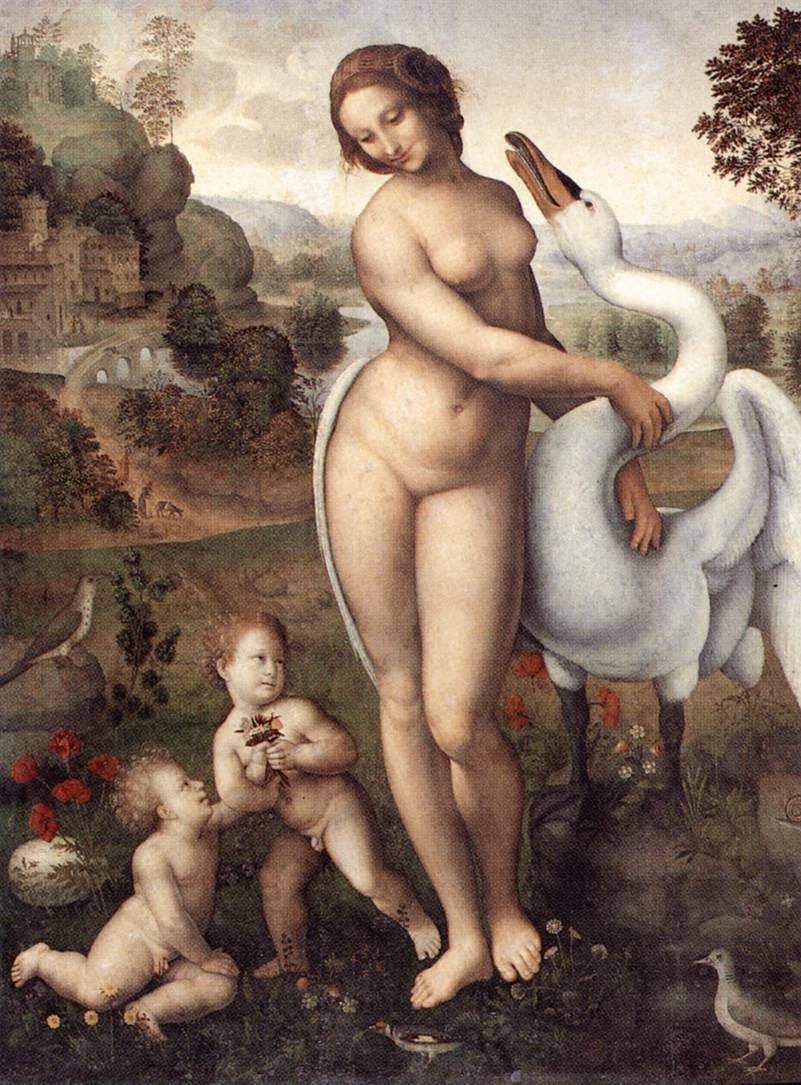
🎧 This work has audio narration — listen in the appTake a moment to really look at "Leda and the Swan." Notice how Leda’s body seems to flow into the swan’s feathers, almost as if they’re merging into one. The soft curves and gentle colors create a sense of intimacy, don’t they? This isn’t just a beautiful scene; it’s a powerful moment from mythology, where Leda is seduced by Jupiter, who has transformed into a swan.
The way the artist, Cesare da Sesto, captures this connection speaks volumes about human desire and transformation, themes that were central to Renaissance thought. The two eggs at Leda’s feet hint at the legendary offspring of this union—Helen of Troy and the Dioscuri twins, Castor and Pollux—reminding us of the far-reaching consequences of this mythical encounter.
Created around 1510, this painting is part of a lineage of works inspired by Leonardo da Vinci’s lost original. Da Sesto, influenced by Leonardo, brings his own interpretation to life, showcasing the era’s fascination with classical myths and human emotion.
As you stand here, think about the stories we tell through art. What feelings does this scene evoke for you?
Cesare da Sesto (1477–1523) was an Italian Renaissance painter from Sesto Calende, Lombardy, known for his connection to Leonardo da Vinci's artistic legacy. Considered part of the Leonardeschi, he was influenced by Leonardo's techniques and aesthetics, which shaped his own style. Cesare likely trained under Baldassare Peruzzi in Rome around 1505, producing notable works such as a lunette in Sant'Onofrio and various paintings in Campagnano Romano.
His career took him to Naples, where he created significant pieces, including a monumental polyptych for La Trinità della Cava and a copy of Leonardo's Leda and the Swan. Returning to Milan, he collaborated with Bernardino Bernazzano on the Baptism of Christ and produced a Salomè that gained recognition. His Adoration of the Magi, completed in Messina, left a lasting impact on southern Italian artists.
Cesare returned to Milan in 1520, where he painted the Madonna in Glory with Saints for the church of San Rocco. He died in Milan in 1523, leaving behind a legacy that reflects the transition from the High Renaissance to the Mannerist style, marking him as a significant figure in the evolution of Italian art.
This painting, attributed to Cesare da Sesto, a painter from the circle of Leonardo da Vinci, is now housed in the Galleria Borghese in Rome. It is one of the most celebrated copies of Leonardo's lost original, which adds an intriguing layer to its history. The painting's reception was quite favorable, as it showcases the era's deep interest in mythological themes and human emotion.
As you gaze at 'Leda and the Swan,' pay attention to the tempera grassa technique that da Sesto employs. This method, a richer form of tempera, allows for a smooth application of color, creating a soft, almost ethereal quality in the flesh tones and the swan's feathers. Notice how the brushwork feels both delicate and dynamic, capturing the fluidity of Leda's form as she intertwines with the swan. The composition is carefully structured, with Leda positioned centrally, drawing your eye to her gentle embrace of the swan. The background, featuring lush landscapes and hints of classical architecture, employs aerial perspective, creating depth and inviting you into this mythological moment. The use of light and shadow enhances the intimacy of the scene, making the viewer feel almost like a silent witness to this transformative encounter.
As a copy of Leonardo da Vinci's lost original, it showcases the enduring fascination with classical mythology during the Renaissance, particularly the story of Leda, who was seduced by Jupiter in the form of a swan. This work not only reflects the humanist ideals of the time but also influenced a generation of artists who sought to capture the sensuality and complexity of mythological subjects. It serves as a bridge between the classical past and the evolving narrative of Renaissance art, reminding us how stories from ancient times continue to inspire creativity and provoke thought in the art world. Remember, this painting is a testament to how the echoes of one artist can resonate through the ages, shaping the work of many who followed.
Did you know that this painting, 'Leda and the Swan,' is not just a standalone piece? It's one of several interpretations of a mythological story that has captivated artists for centuries. The original work by Leonardo da Vinci has been lost to time, but Cesare da Sesto's version is considered one of the best copies. Imagine the pressure on da Sesto to live up to the legacy of a master like Leonardo! It's fascinating to think about how artists in the Renaissance were not just creators but also part of a larger dialogue about art and mythology, each trying to capture the essence of these timeless tales.
The favorable reception of 'Leda and the Swan' highlights the Renaissance's deep interest in classical mythology and human emotion, showcasing how artists of the time were inspired by ancient stories.
Cesare da Sesto was part of the Leonardeschi, a group of artists influenced by Leonardo da Vinci, and he interacted with notable figures like Raphael and Baldassare Peruzzi during his career.