Allegory of Isabella d'Este's Coronation
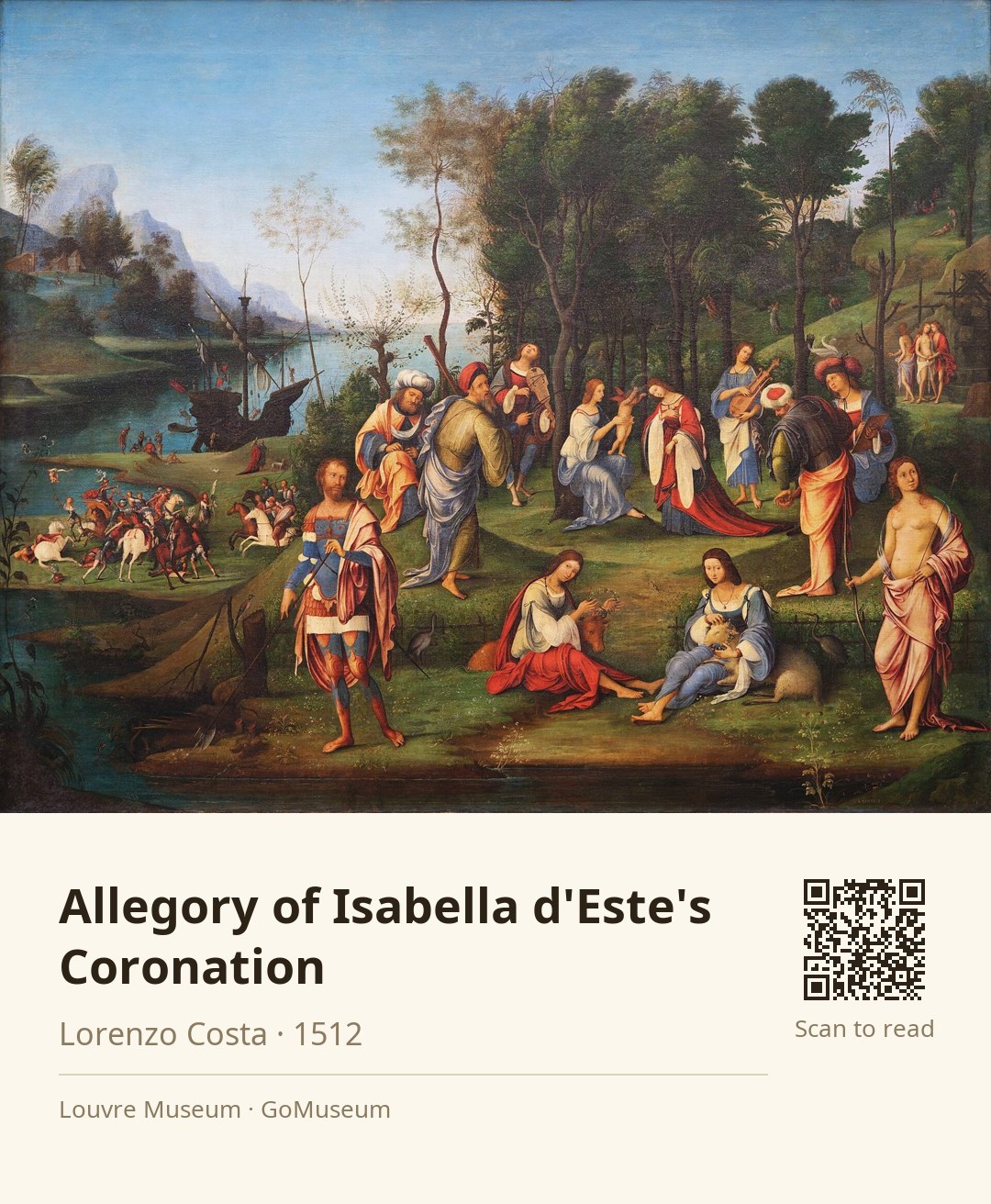
🎧 This work has audio narration — listen in the appIsabella d'Este, the influential Renaissance figure, is at the heart of this vibrant scene, crowned by Anteros, the personification of love. In the foreground, a woman in a striking red dress kneels with a small animal, while another plays a delicate stringed instrument, embodying the harmony of art and nature that Isabella championed. Nearby, a man reads from a book, and another musician adds to the lively atmosphere, showcasing the artistic flourishing of her court.
This gathering unfolds in a lush landscape, where mythological figures like Apollo and Cadmus mingle with elegantly dressed courtiers, symbolizing the virtues of poetry and music. The presence of Diana, representing chastity, and the two female figures crowning an ox and a lamb, signify Perseverance and Purity, reinforcing Isabella's role as a patroness of the arts. The painting reflects a harmonious garden where creativity thrives, a testament to Isabella's influence in the cultural life of Mantua.
Commissioned for her studiolo, this work was initially meant for Andrea Mantegna, but after his death, Lorenzo Costa took over, crafting a piece that would secure his position as the court painter.
Lorenzo Costa, born in Ferrara in 1460, was a pivotal Italian painter of the late Renaissance. He moved to Bologna in his early twenties, where he was likely influenced by the emerging Bolognese School and possibly trained under Cosimo Tura. His notable works include the Bentivoglio Altarpiece, created in 1483 for the Bentivoglio chapel, showcasing his mastery of fresco and altarpiece painting.
In 1509, Costa became the court painter for the Gonzaga family in Mantua, succeeding Andrea Mantegna. His works for Isabella d'Este, such as the Allegory of Isabella d'Este's Coronation, reflect a blend of mythological themes and the stylistic influences of his predecessors. Costa was well-respected in his time, collaborating with contemporaries like Francesco Francia and mentoring future artists, including Dosso Dossi.
Costa's style evolved to be more fluid and expressive, marking a transition in the artistic traditions of Ferrara and Bologna. He passed away in Mantua in 1535, leaving behind a legacy that influenced the trajectory of Renaissance art, particularly through his students and the continuation of his stylistic innovations.
Initially, the work was meant for Andrea Mantegna, but after his death in 1506, Lorenzo Costa took over the project. Costa deleted all of Mantegna's contributions and completed the painting, which ultimately secured his position as the court painter for the Gonzaga of Mantua. The painting later became part of Duke Charles I of Nevers' collection and was gifted to Cardinal Richelieu, leading it to Paris and eventually to the Louvre Museum.
In this vibrant scene, the lush landscape is alive with figures and activities. The color palette is rich, featuring deep greens, blues, and earthy tones that bring the garden to life. Prominent in the foreground, a woman in a striking red dress kneels, cradling a small animal, while another woman delicately plays a stringed instrument. A man reads from a book, and another musician contributes to the lively ambiance. To the right, a partially nude figure holds a staff, adding a dynamic element to the composition. In the middle distance, more figures engage in musical pursuits, while horsemen on the left hint at a hunt or battle, creating a sense of movement across the canvas.
The most accepted interpretation of this painting is that it exalts Isabella d'Este, her rule, and her role as a patron of the arts, generating harmony. The central figure, crowned by Anteros, symbolizes virtuous love, while the surrounding characters represent various artistic pursuits, emphasizing Isabella's influence in the cultural life of Mantua.
An interesting fact about this painting is that it was the fourth commissioned by Isabella d'Este for her studiolo, following two canvasses by Andrea Mantegna and a work by Perugino.
The painting was gifted to Cardinal Richelieu by Duke Charles I of Nevers, which led to its arrival in Paris.
Lorenzo Costa removed all of Andrea Mantegna's contributions before completing the painting.
Isabella's approval of the painting led to Lorenzo Costa being appointed as the new court painter for the Gonzaga family.