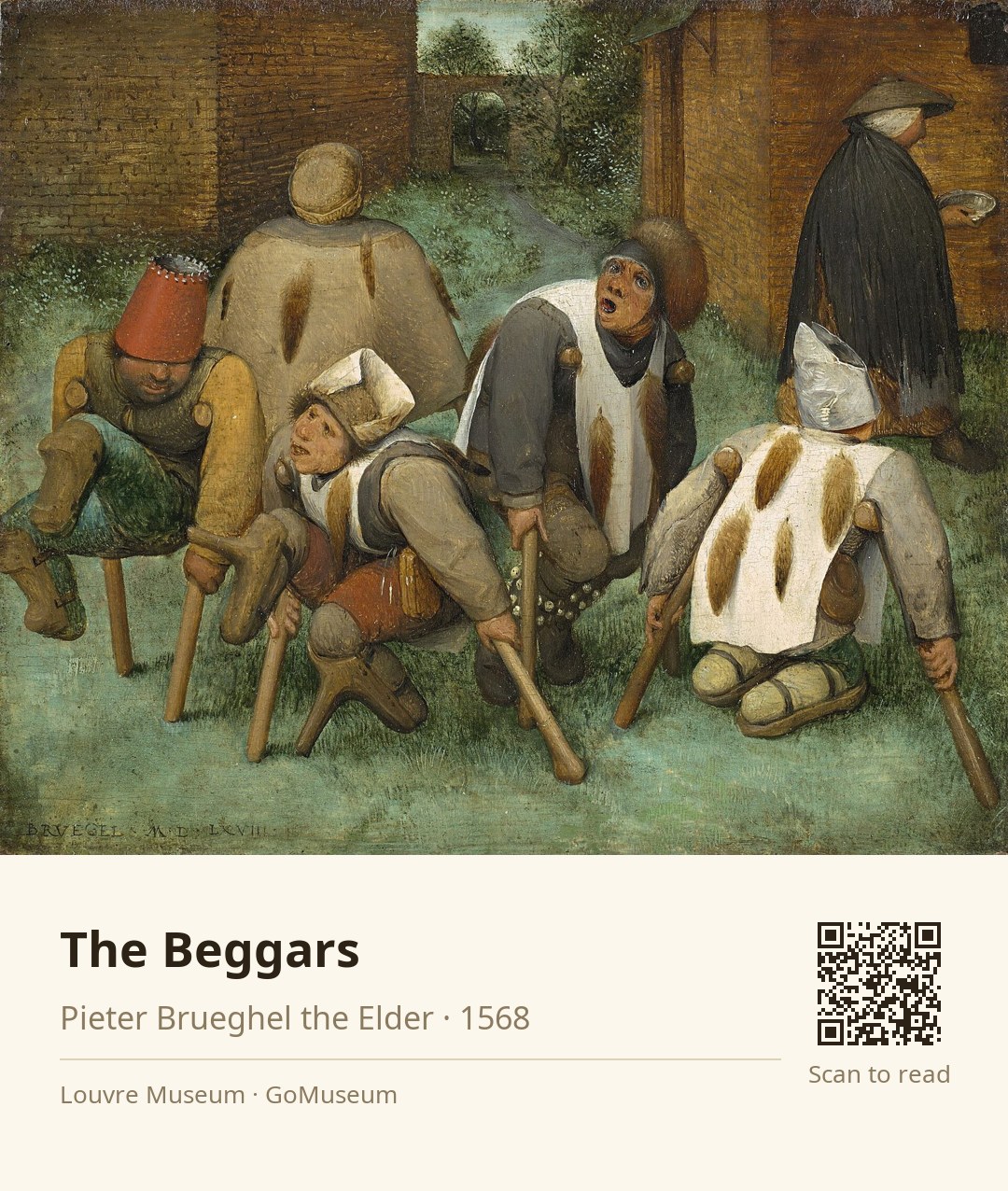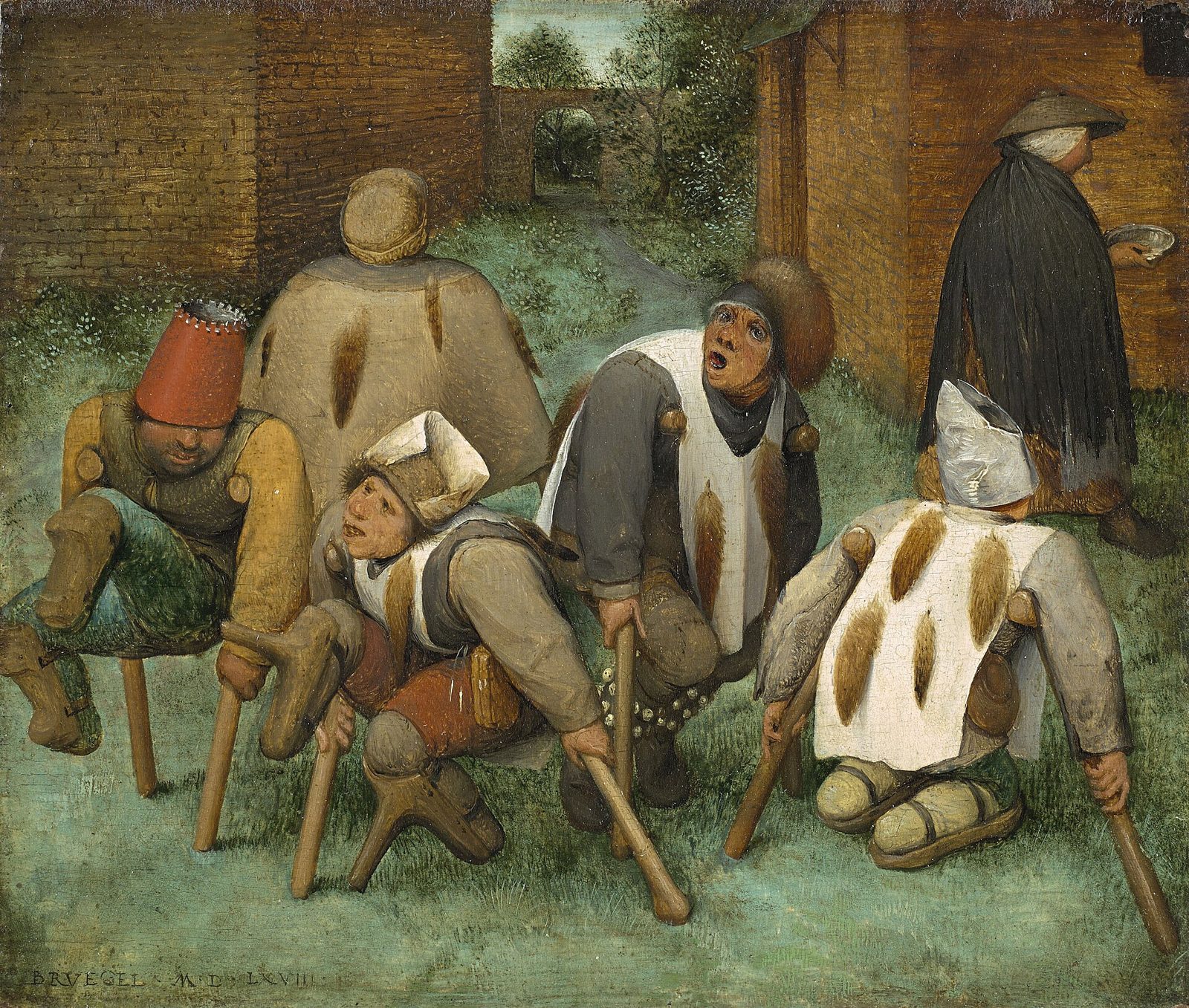
As you stand before "The Beggars" by Pieter Bruegel the Elder, take a moment to really look at the figures in front of you. Notice how each of the five disabled beggars wears a unique headpiece: a cardboard crown, a paper shako, a beret, a cap, and a mitre. These aren’t just random costumes; they represent different social classes, from the king to the peasant, all gathered in one scene.
Now, why does this matter? Bruegel’s choice to dress these beggars in carnival attire suggests a biting satire on society. It’s as if he’s saying that regardless of their physical state, these individuals mirror the moral decay of their social classes. The fox tails on their clothing, which were symbols of ridicule at the time, hint at a deeper commentary on the political unrest in 16th-century Flanders, where the oppressed were often dismissed and mocked.
Painted in 1568, this work comes at the end of Bruegel’s career, a time when he was increasingly interested in the natural world, as seen in the delicate landscape peeking through the background. This juxtaposition of beauty and suffering invites you to reflect on the complexities of humanity.
So, as you take in this striking scene, consider: what do you think Bruegel wanted us to feel about the beggars? Is it sympathy, disdain, or perhaps a call to recognize our shared humanity?
Pieter Bruegel the Elder, born around 1525-1530, was a pivotal figure in Dutch and Flemish Renaissance painting. Known for his landscapes and peasant scenes, he was a trailblazer in genre painting, presenting these subjects in large formats. His work diverged from the religious themes prevalent in his time, focusing instead on the human experience and the everyday lives of common people. After training under Pieter Coecke van Aelst, Bruegel traveled to Italy, where he absorbed influences that would shape his distinctive style.
Settling in Antwerp in 1555, he became a prolific print designer before dedicating himself to painting. His most renowned works emerged in the last decade of his life, a period marked by innovation and depth. Bruegel's art has left a lasting legacy, inspiring countless artists, writers, and filmmakers, including W.H. Auden and Andrei Tarkovsky. His ability to capture the essence of humanity in its myriad forms secured his place as a foundational figure in the evolution of European art, influencing generations long after his untimely death in 1569.
Pieter Bruegel the Elder painted 'The Beggars' in 1568, a pivotal year marking the end of his prolific career. This piece, now housed in the Louvre, was gifted to the museum in 1892, making it a unique highlight of their collection as it is the only Bruegel painting in Paris. The beggars in the painting, adorned in carnival attire, symbolize various social classes, hinting at a deeper critique of societal norms. Interestingly, the back of the painting bears inscriptions from the 16th century, one in Flemish and another in Latin, expressing admiration for Bruegel's ability to surpass nature in his art, suggesting that even in his time, he was recognized for his innovative approach to painting.
As you gaze at 'The Beggars,' pay attention to Bruegel's masterful brushwork and the way he handles light and color. The figures are depicted with a sense of restlessness, their postures and expressions conveying a mix of desperation and defiance. The use of bright, carnival colors juxtaposes the somber reality of their condition, creating a striking visual tension. Notice how the composition draws your eye to the beggars, positioned outside the town walls, suggesting their marginalization in society. The fox tails on their clothing, symbols of ridicule, are painted with a deftness that adds to the satirical tone of the piece. The delicate landscape peeking through the background, bathed in soft light, contrasts sharply with the harshness of the beggars' plight, inviting you to reflect on the duality of beauty and suffering in human existence.
One intriguing detail about 'The Beggars' is the symbolism of the foxes' tails on the beggars' clothing. These tails were not just whimsical decorations; they were a pointed political commentary of the time. So, when you see these beggars adorned with such tails, it hints at a deeper layer of satire—suggesting that even those marginalized by society were part of the larger political narrative. Bruegel cleverly intertwined social commentary with his art, making it a reflection of the tumultuous times he lived in.
Bruegel's interest in teratology, or the study of congenital malformations, is evident in the exaggerated physical features of the beggars, showcasing his keen observation of human conditions and societal issues.
The painting may allude to the Koppermaandag, an annual festival where beggars would dress in costumes and collect alms, reflecting the inversion of social roles typical of carnival celebrations.