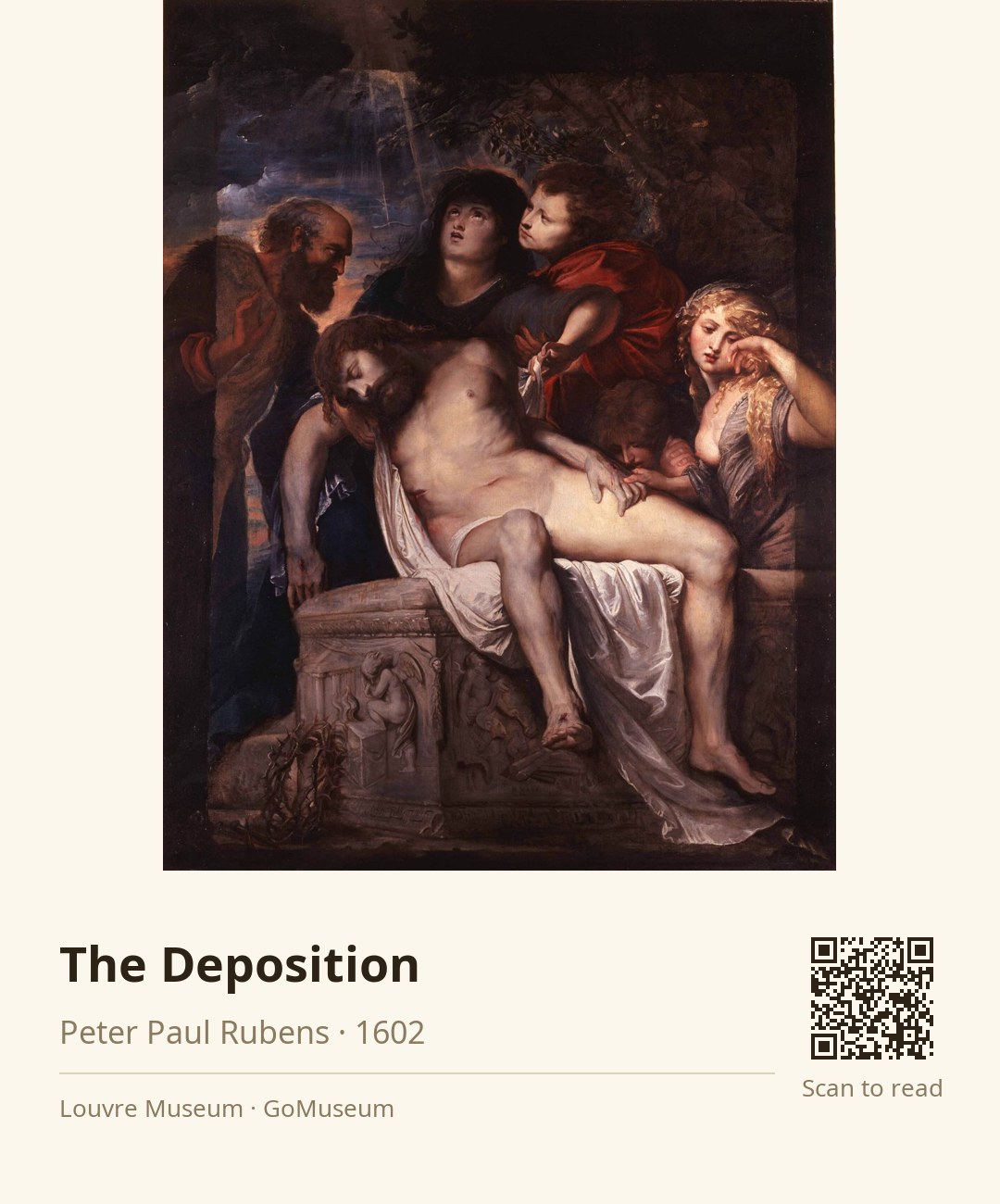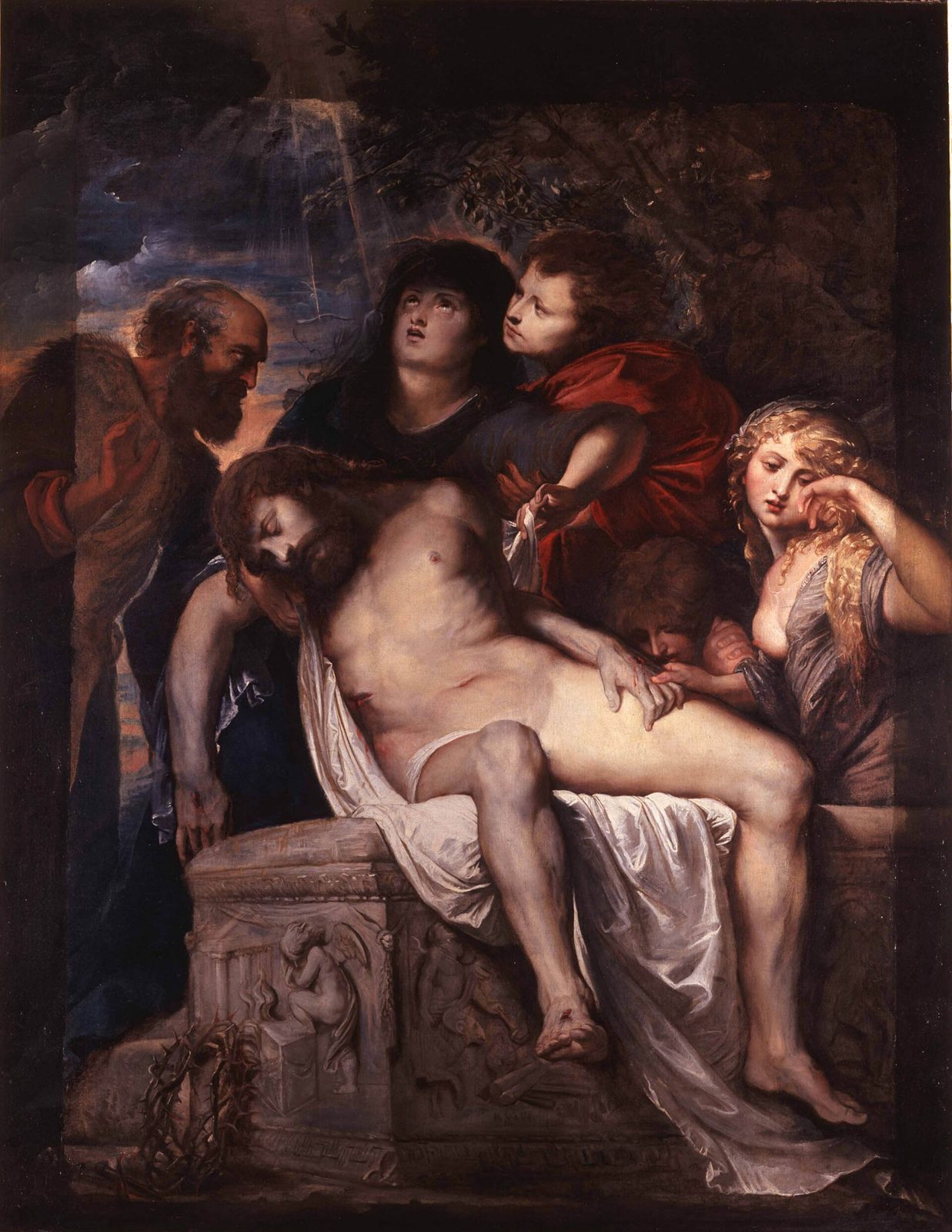
The Deposition
🎧 This work has audio narration — listen in the appTake a moment to really look at Rubens' "The Deposition." Notice how the figures seem to almost spill out of the canvas, their emotions so palpable you can almost feel the weight of their grief. Look closely at the Virgin Mary, her dark attire contrasting sharply with the lifeless body of Christ, her face a portrait of sorrow and longing.
These details matter because they draw you into the emotional heart of the scene. Mary’s gaze upward suggests a search for understanding amidst despair, while John the Evangelist, dressed in vibrant red, embodies love and support, cradling both Christ and Mary in their moment of loss. This isn't just a depiction of a moment; it's a profound exploration of human emotion and faith.
This piece reflects his mastery in conveying movement and emotion, hallmark traits of the Baroque style.
As you stand here, consider how this painting captures a universal experience of loss and hope. What feelings does it stir in you?
Sir Peter Paul Rubens was a Flemish artist and diplomat born on June 28, 1577, in Siegen, Germany. He is celebrated as a leading figure of the Flemish Baroque tradition, renowned for his dynamic compositions that intertwine classical and Christian themes. Rubens's work is characterized by vibrant color, movement, and sensuality, aligning with the dramatic style of the Counter-Reformation. His prolific output includes altarpieces, portraits, landscapes, and history paintings, with a catalog of over 1,400 works.
Raised in Antwerp after fleeing religious persecution, Rubens was a well-educated humanist and skilled diplomat, knighted by both Philip IV of Spain and Charles I of England. He managed a large workshop that produced art for European nobility and collectors, and he was also an influential art dealer. Rubens's designs extended beyond painting; he created tapestries, prints, and even contributed to architectural projects.
His legacy endures in the art world, where he is recognized for his mastery of color and form, and his ability to convey emotion and drama. Rubens's impact on Baroque art is profound, making him a pivotal figure in the evolution of Western art history. He passed away on May 30, 1640, leaving behind a rich artistic heritage that continues to inspire.
Rubens' 'The Deposition' was painted during his first stay in Rome around 1601-1602, a pivotal moment in his career. Initially attributed to Anthony van Dyck, it was later re-attributed to Rubens by art historian Rudolf Oldenbourg in 1916. The painting was first recorded in the 1833 Borghese Collection inventory, where it was referred to as 'the Deposition of the Cross.' Its journey to the Borghese Collection remains somewhat mysterious; some suggest it was commissioned by Cardinal Peretti di Montalto, while others believe it was purchased by Camillo Borghese in the early 19th century. The work was acquired by the Italian state in 1902, ensuring its preservation and continued appreciation in the Galleria Borghese, Rome.
As you gaze at 'The Deposition,' notice how Rubens employs dynamic diagonal lines to create a sense of movement and urgency. The figures are arranged in a triangular composition, drawing your eye toward the central figure of Christ. The brushwork is vigorous, with thick, expressive strokes that convey the emotional turmoil of the scene. The rich color palette, dominated by deep reds and somber blacks, enhances the gravity of the moment. Light plays a crucial role, illuminating the faces of the mourners, highlighting their grief and despair. The contrast between the dark attire of Mary and the pale body of Christ creates a striking visual tension, emphasizing the tragedy of loss. This masterful handling of paint and form invites you to feel the weight of the moment, making the sorrow almost tangible.
Interestingly, 'The Deposition' was once mistakenly attributed to Anthony van Dyck due to an inscription on the canvas from the 18th or 19th century. This confusion highlights the complexities of art attribution and how the legacy of artists can sometimes overshadow their contemporaries. It wasn't until the early 20th century that scholars began to reassess and correctly attribute this powerful work to Rubens.
The sarcophagus in the painting is adorned with classical figures, symbolizing the transition from the Antique culture to Christ's new message. It also alludes to the sacrament of the altar, connecting the scene to the Eucharist.
Mary Magdalene, depicted with long blond hair and an exposed breast, adds a layer of personal grief to the scene, intensifying the collective sorrow of the mourners. Her presence highlights the deep emotional turmoil surrounding Christ's death.