Crucifixion with St Dominic praying
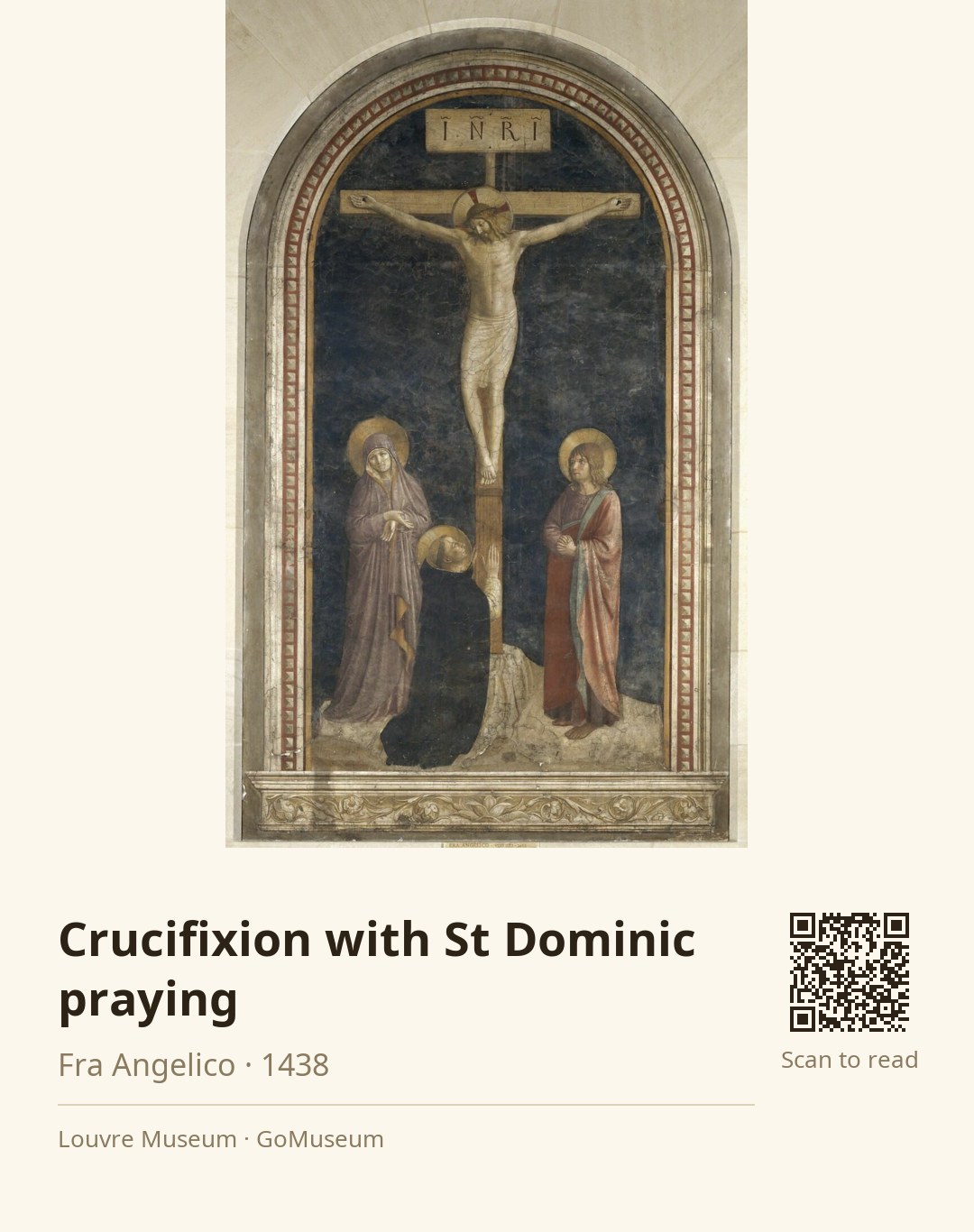
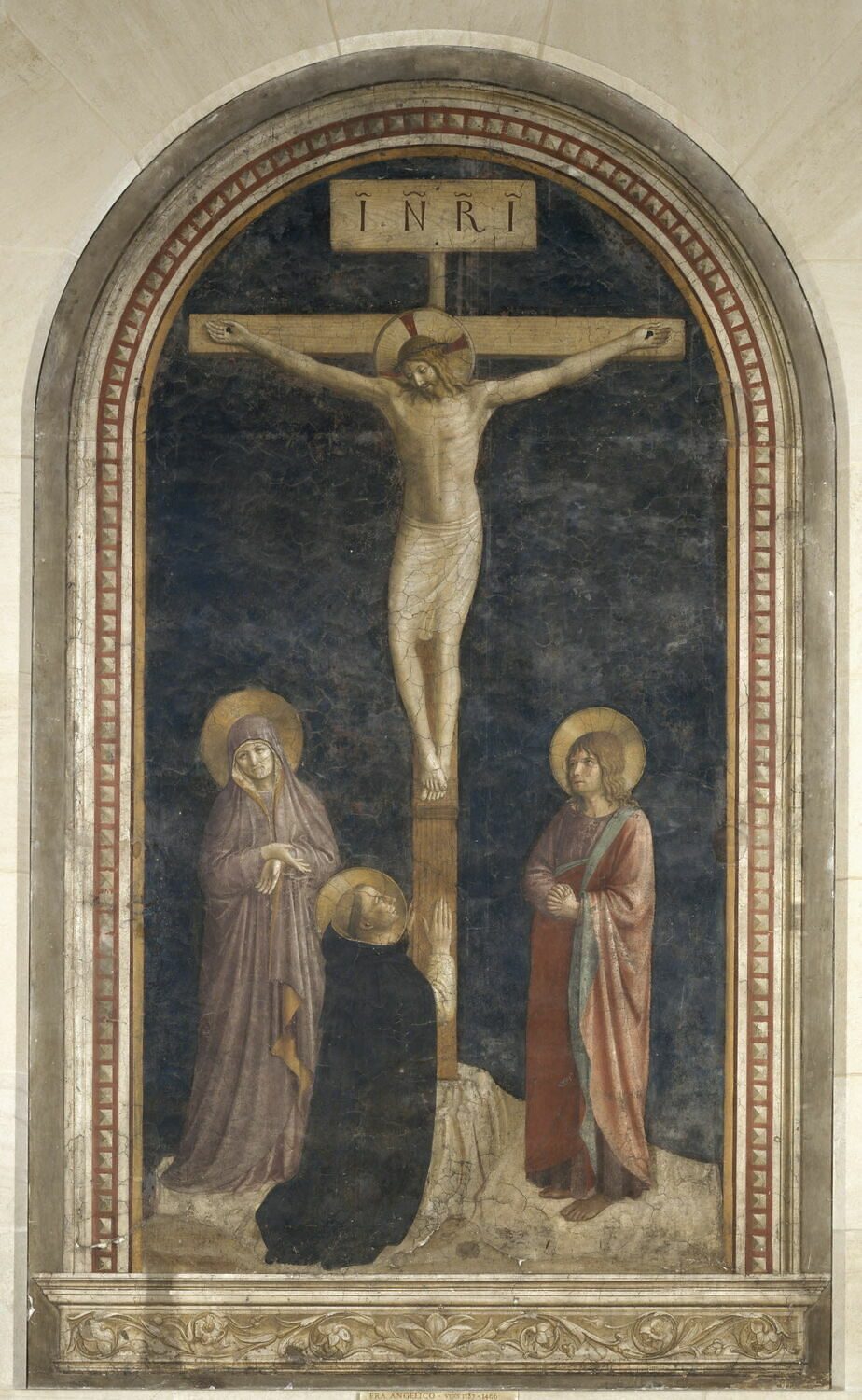
🎧 This work has audio narration — listen in the appTake a moment to really absorb the scene in front of you. Notice how St. Dominic kneels at the foot of the cross, his hands clasped in prayer, a figure of humility amidst the profound sorrow of the crucifixion. Look closely at the way his robes flow, almost merging with the earth beneath him, grounding him in this moment of grief.
Now, consider the expression on Christ’s face, his head gently bowed, embodying a serene acceptance of his fate. Fra Angelico, a Dominican friar himself, infuses this work with deep spiritual significance, drawing us into a moment of contemplation that transcends time.
Created in 1438, this fresco fragment was originally part of the refectory at the Convent of San Domenico in Fiesole, Italy. It’s a testament to the early Renaissance's blend of artistic beauty and religious devotion, showcasing Angelico's mastery of light and form.
As you stand here, think about what this scene evokes for you. How does the image of St. Dominic praying resonate in your own life?
Fra Giovanni da Fiesole, known posthumously as Fra Angelico, was an Italian Dominican friar and painter born around 1395 in Mugello, Tuscany. His early life was marked by a deep commitment to his faith, which he expressed through his art. Joining the Dominican Order, he adopted the name Fra Giovanni and dedicated his career to creating religious works. His most notable contributions include frescoes for the convent of San Marco in Florence, commissioned by Cosimo de' Medici, and masterpieces like the San Marco Altarpiece and the Deposition of Christ.
Angelico's artistry was characterized by a pioneering use of linear perspective and a profound attention to light and form, setting him apart from the late Medieval styles. His works were imbued with a mystical quality, reflecting his personal humility and spirituality. He completed significant commissions in Rome under papal patronage, further solidifying his place in art history.
Beatified by Pope John Paul II in 1982, Fra Angelico is celebrated as the patron of Catholic artists. His legacy endures as a bridge between Medieval traditions and the emerging Renaissance, embodying the spiritual and artistic aspirations of his time.
Dominic Praying" was created around 1438 and originally adorned the refectory of the Convent of San Domenico in Fiesole, Italy. After the Napoleonic suppression, the work was removed and taken to France, where it became part of the Louvre's collection. Interestingly, after the Bourbon Restoration, it was one of many artworks that were not returned to Italy, a decision attributed to logistical challenges rather than artistic value. The painting's journey reflects the turbulent history of art during this period, as it transitioned from a place of worship to a museum piece, altering its context and meaning.
As you gaze at this fresco, notice the way Fra Angelico employs light and color to evoke emotion. The soft, ethereal quality of the light bathes St. Dominic and the figures around the cross, creating a sense of divine presence. The brushwork is delicate yet purposeful, with flowing lines that guide your eye across the composition. The arrangement of figures—Christ at the center, flanked by Mary and John—creates a triangular composition that draws your focus to the crucifixion. This structure not only enhances the narrative but also reflects the harmony and balance characteristic of early Renaissance art. The scale of the figures, while monumental, invites intimacy, allowing you to feel the weight of the moment.
This work exemplifies the shift towards a more humanistic representation of sacred themes, where figures like Saint Dominic are portrayed with emotional depth and realism. Angelico's innovative use of perspective and light influenced countless artists who followed, paving the way for the dramatic expressions of the Baroque period. His ability to blend spiritual reverence with artistic technique made him a beacon for future generations, proving that art could be both a tool for devotion and a profound exploration of the human experience. Remember, this painting isn't just about the crucifixion; it's about how Angelico's vision transformed the way we perceive divine moments in art.
Did you know that this painting, originally a fresco, was part of a refectory wall in a convent? After the Napoleonic occupation, it was taken to France and never returned to Italy, along with many other works. Imagine the artists and patrons, like Fra Angelico, grappling with the loss of their heritage. It’s a poignant reminder of how art can transcend borders, yet also be caught in the tides of history.
After the Bourbon Restoration, logistical challenges related to the painting's dimensions were cited as reasons for its failure to return to Italy. This highlights how practical considerations can impact the fate of significant artworks, often overshadowing their artistic value.
Before his artistic career, Fra Angelico was trained as a manuscript illuminator, which influenced his later painting style. His early experiences in creating illuminated manuscripts helped him develop a keen sense of color and detail, which became hallmarks of his frescoes.