 Image: Wilfredor
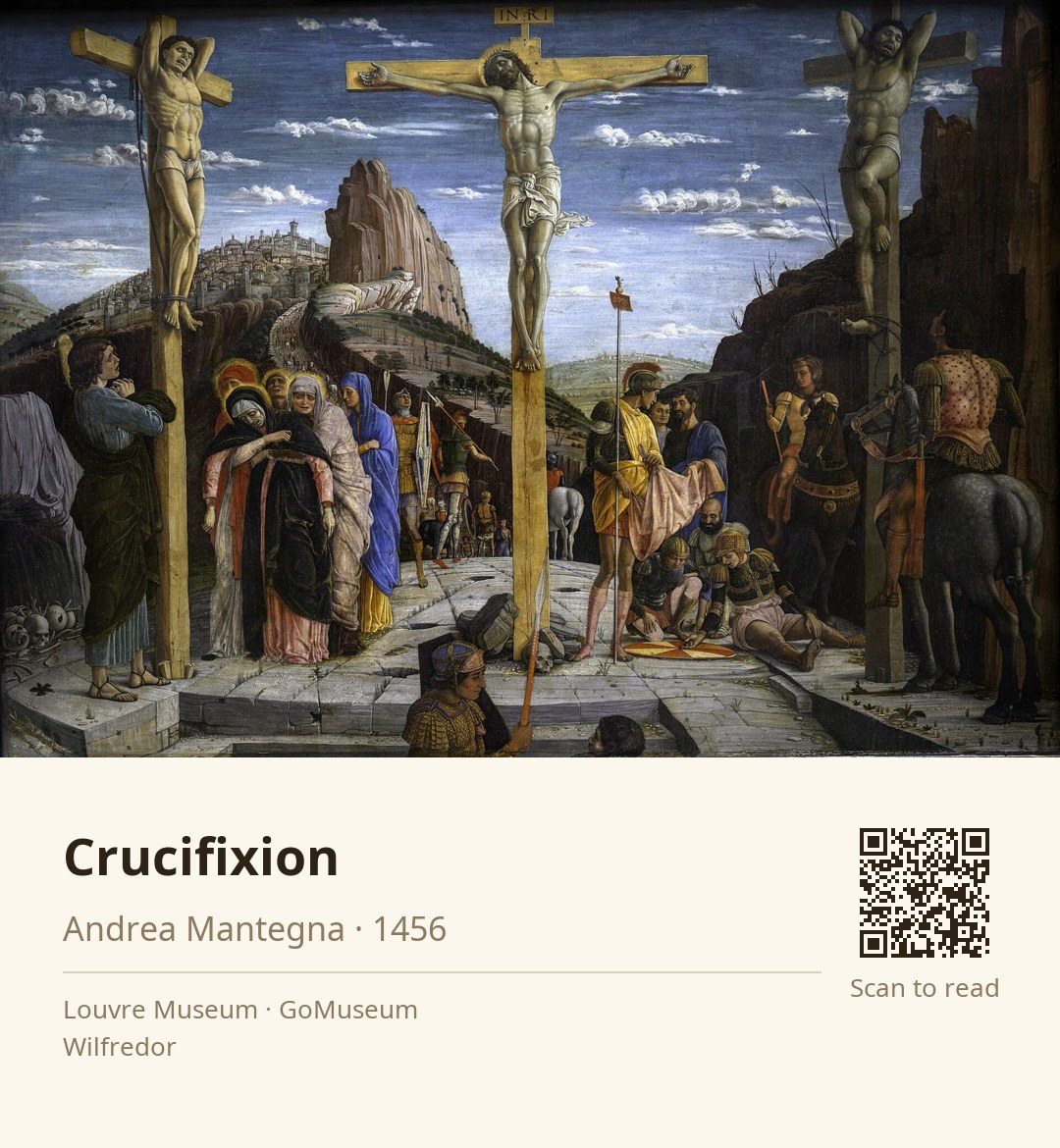
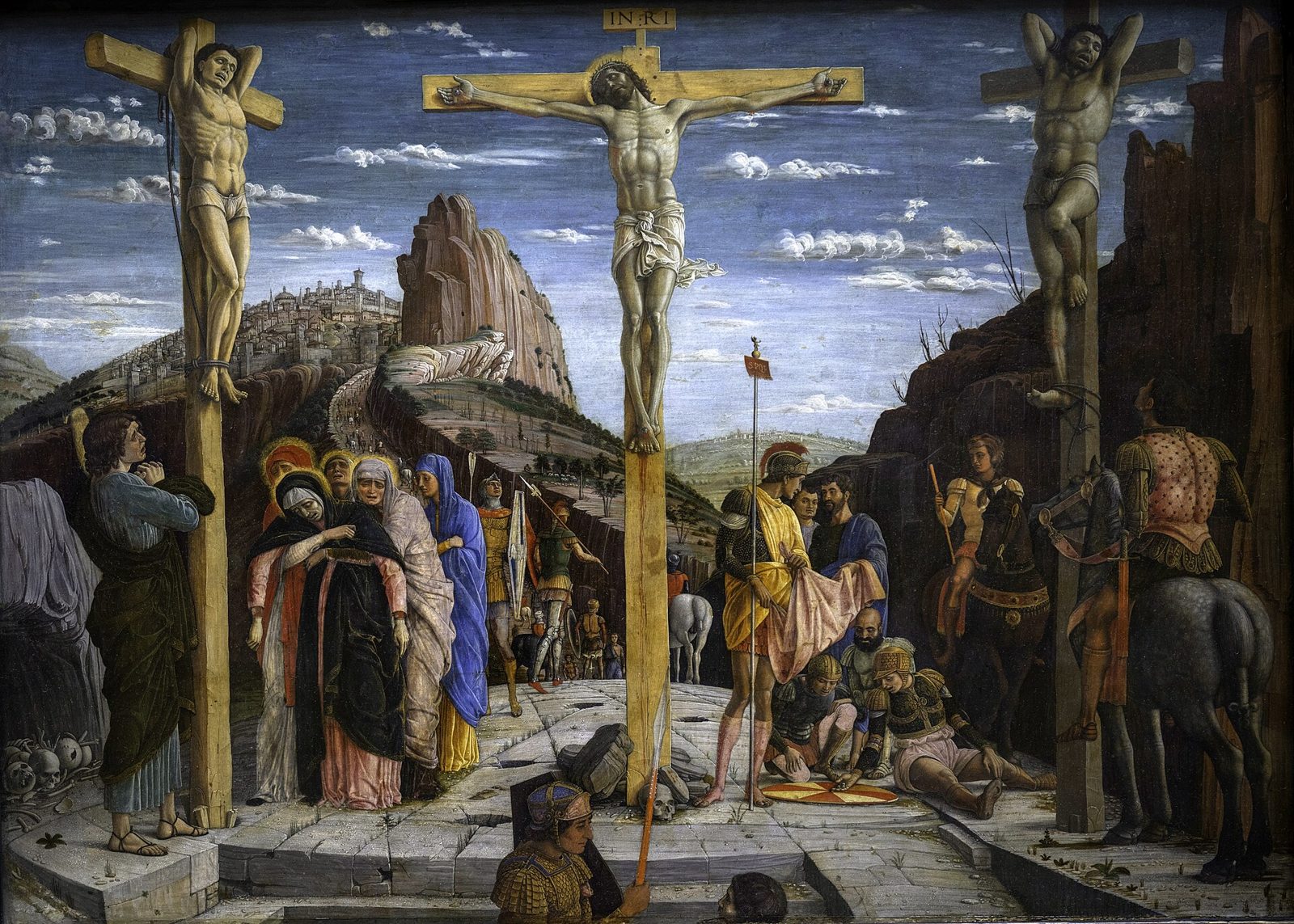
Take a moment to really look at Mantegna's "Crucifixion." Notice how the figures seem to almost leap out from the panel, their expressions a mix of sorrow and awe. Check out the Roman soldiers at the foot of the crosses; their armor is meticulously detailed, each piece reflecting Mantegna's deep fascination with antiquity.
These details matter because they ground the scene in a specific historical context, pulling you into the moment of Christ's crucifixion. Mantegna was not just painting a biblical event; he was infusing it with the weight of history, showcasing his commitment to realism at a time when many artists were more focused on idealized forms.
His ability to create a sense of depth and dimension was revolutionary, making viewers feel as if they were witnessing the event firsthand.
As you stand here, think about the emotions this scene evokes. What do you feel when you see the pain and sacrifice depicted? How does Mantegna's approach to this moment in history change your understanding of the story?
Andrea Mantegna, born around 1431 in Isola di Carturo, was a pivotal figure in the Italian Renaissance, renowned for his innovative approach to perspective and his sculptural style. Apprenticed to Francesco Squarcione, he absorbed a passion for classical antiquity, which profoundly influenced his artistic vision. Mantegna's early works, including the frescoes in the Ovetari Chapel, showcased his mastery of dramatic perspectives and detailed architectural elements, although many were tragically lost during World War II.
His marriage to Nicolosia, daughter of Jacopo Bellini, further anchored him in the vibrant artistic community of Venice. Mantegna's distinct style, characterized by flinty landscapes and statuesque figures, often drew criticism for its rigidity, yet it marked a significant departure from Gothic traditions. He was instrumental in elevating the status of the artist in society, embodying the Renaissance ideal of the creative genius. Mantegna's legacy endures, influencing generations of artists and cementing his place in art history as a master of both painting and printmaking. He passed away in 1506, leaving behind a rich body of work that continues to inspire.
This piece was the centerpiece of the predella, a series of panels that adorned the altar. The painting made its public debut in the Louvre in 1798, where it was exhibited immediately. However, its journey was tumultuous; in 1806, two panels were sent to the museum in Tours, only to be reclaimed in 1815 and returned to Italy. After a brief period in the city museum of Verona, it found its way back to San Zeno in 1918, where it remains today, albeit not easily visible.
As you gaze at the 'Crucifixion,' pay attention to Mantegna's masterful brushwork. The figures are rendered with a sculptural quality, each muscle and expression meticulously defined, creating a sense of immediacy and drama. Notice how the light falls across the scene; it enhances the three-dimensionality of the figures, making them feel almost alive. Mantegna's use of perspective is particularly striking; he employs a steep visual angle that draws your eye into the composition, making you feel as though you are part of the unfolding drama.
By meticulously detailing the Roman soldiers' equipment and employing a steep visual perspective, Mantegna broke away from the more stylized approaches of his Florentine contemporaries. This attention to historical accuracy and depth not only showcased his archaeological passion but also set a new standard for narrative realism in religious art. His innovative techniques influenced generations of artists, paving the way for a more profound exploration of perspective and human emotion in painting. Remember, Mantegna wasn’t just painting; he was redefining how we perceive space and storytelling on canvas.
While many artists of the era focused on the aesthetic beauty of ancient forms, Mantegna meticulously studied historical artifacts, striving for accuracy in his depictions. This dedication to authenticity was so intense that it was likened to the work of an archaeologist, setting him apart from his contemporaries who often prioritized style over historical fidelity.
Gregorio Correr, the abbot of San Zeno, was a key figure in the commissioning of Mantegna's 'Crucifixion,' which reflects the importance of religious patronage during the Renaissance. This commission not only provided Mantegna with a prestigious platform but also aligned him with the church's efforts to inspire devotion through art.
Growing up in a modest family and being apprenticed to Francesco Squarcione, Mantegna was immersed in the study of ancient art and archaeology from a young age. This background instilled in him a passion for historical accuracy and detail, which became hallmarks of his artistic style.