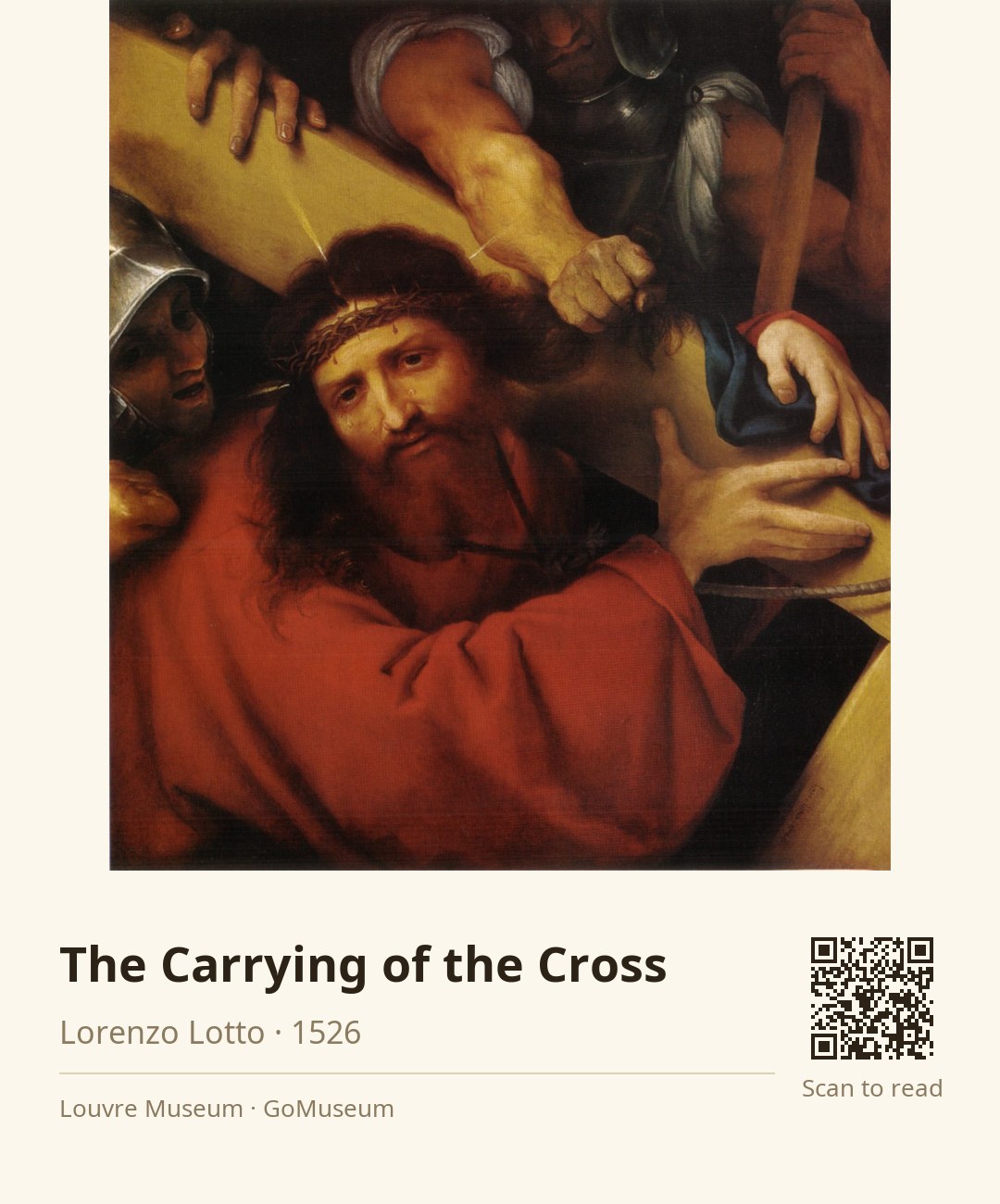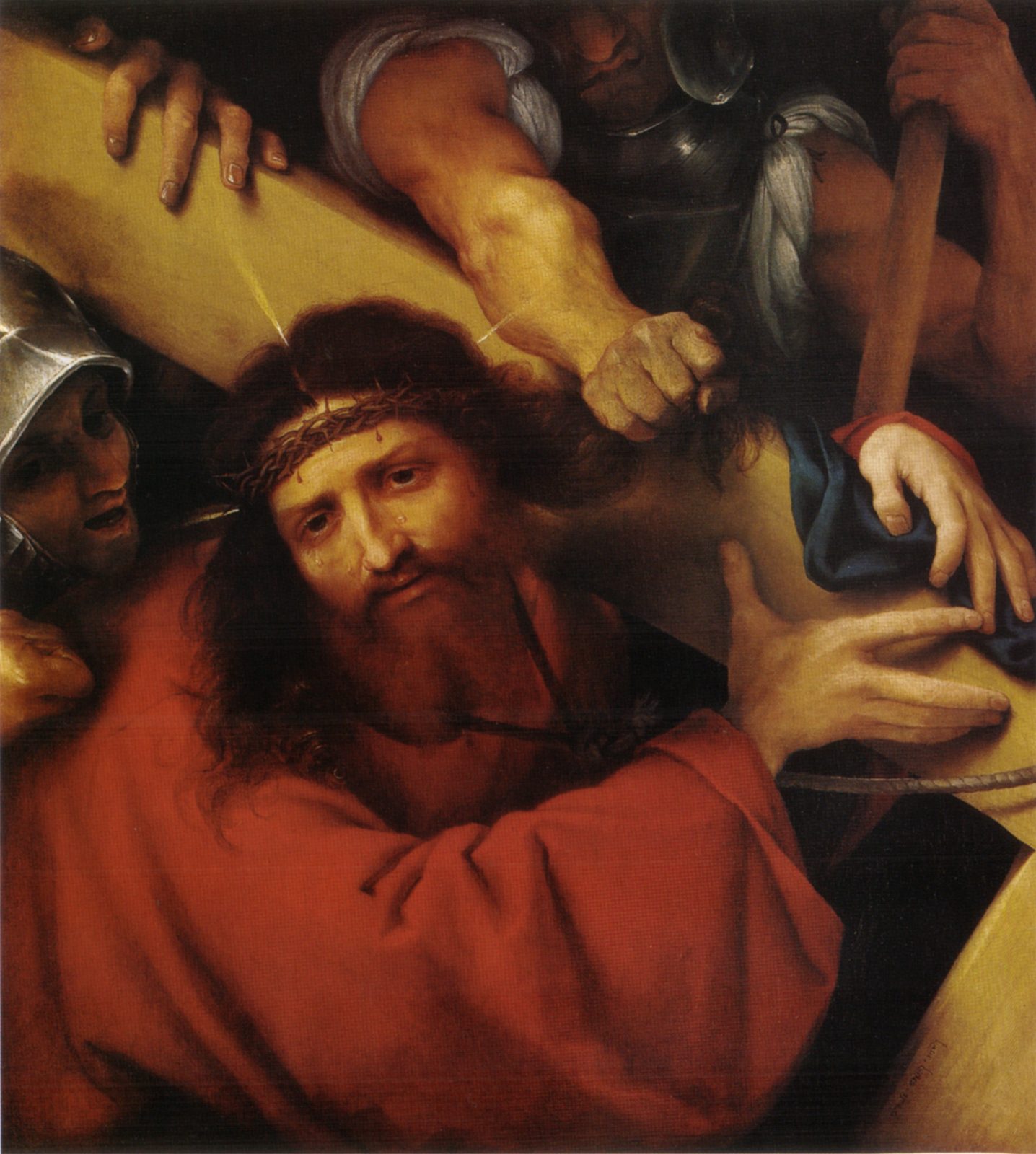
The Carrying of the Cross
🎧 This work has audio narration — listen in the appTake a moment to really look at "The Carrying of the Cross" by Lorenzo Lotto. Notice how Christ’s face is awash with emotion—those tears glistening in his eyes tell a story of suffering and humanity. And look at the soldier gripping his hair; the tension in that moment is palpable, isn’t it?
These details matter because they draw you into the emotional core of the scene. This painting, created in 1526, reflects not just a biblical event but the artist's deep understanding of human pain and resilience.
Lotto, influenced by his time in Venice, was known for his unique style that blended vibrant colors with dramatic expressions. He wasn't just painting a story; he was inviting you to feel it, to experience it alongside Christ.
As you stand here, think about the weight of the cross—not just the physical burden, but the emotional and spiritual weight it represents. What does this moment of struggle mean to you? How does it resonate in your own life?
Lorenzo Lotto, born around 1480 in Venice and passing away in 1556, was a notable Italian Renaissance painter whose career spanned various northern Italian cities. Although often associated with the Venetian school, his unique style and independent approach set him apart from contemporaries like Titian and Giorgione. Lotto's work primarily encompassed altarpieces, religious themes, and portraits, reflecting a distinctive blend of High Renaissance ideals with a personal touch that hinted at the emerging Mannerist style.
His artistic journey began in Treviso, where he gained recognition under the patronage of Bishop Bernardo de' Rossi. Lotto's early works, such as "Allegory of Virtue and Vice," showcased his ability to convey psychological depth through intricate symbolism. His time in Rome was marked by an invitation from Pope Julius II to decorate the papal apartments, although this opportunity did not yield lasting results.
Lotto's most fruitful period occurred in Bergamo, where he produced some of his finest works, characterized by rich color and dramatic compositions. Despite his initial acclaim, Lotto's reputation waned after his death, leading to a gradual obscurity. Today, he is celebrated for his idiosyncratic style and contributions to the transition between Renaissance and Mannerism, earning him a unique place in art history.
Lorenzo Lotto's 'The Carrying of the Cross' was painted in 1526 and is now housed in the Louvre. Historical records suggest that there were two versions of this subject by Lotto, one of which was owned by a nobleman named Jacopo Pighetti. This particular painting was later moved to Rome before making its way to France, where it was acquired by the Louvre in 1982.
As you gaze at 'The Carrying of the Cross,' pay attention to Lotto's masterful brushwork. The way he layers paint creates a palpable texture, giving life to the figures. Notice how the light falls dramatically across Christ’s face, accentuating his emotional turmoil. The vibrant reds and earthy tones Lotto employs not only draw your eye but also evoke a visceral response. The composition is tightly structured, with figures almost crowding around Christ, amplifying the sense of struggle. This deliberate arrangement invites you to feel the weight of the moment, as if you are part of the scene. The scale of the painting, almost square, enhances the intimacy of the encounter, making the viewer feel close to the action. Lotto's choices in color and form work together to create a dynamic tension that resonates with the viewer, pulling you into the emotional core of the narrative.
This painting not only reflects Lotto's unique style, influenced by his time in Venice, but also marks a departure from the more traditional depictions of Christ's suffering. Lotto's ability to convey raw emotion through the figures, particularly Christ's tearful expression, has inspired countless artists to explore the human experience within religious narratives. His work stands as a bridge between the High Renaissance and the emerging Mannerist style, influencing future generations to embrace emotional expression and individualism in their art.
Did you know that this painting, The Carrying of the Cross, has a fascinating backstory? After Lotto completed it in 1526, it traveled quite a bit before finding its home in the Louvre. It was taken to Rome and then sold in France, eventually making its way to the Louvre in 1982. Imagine the journey this artwork has taken through history, from a noble's home to one of the world's most famous museums!
Before reaching the Louvre in 1982, this painting was taken to Rome after being owned by the nobleman Jacopo Pighetti, highlighting its connection to both Italian nobility and the art market of the time.