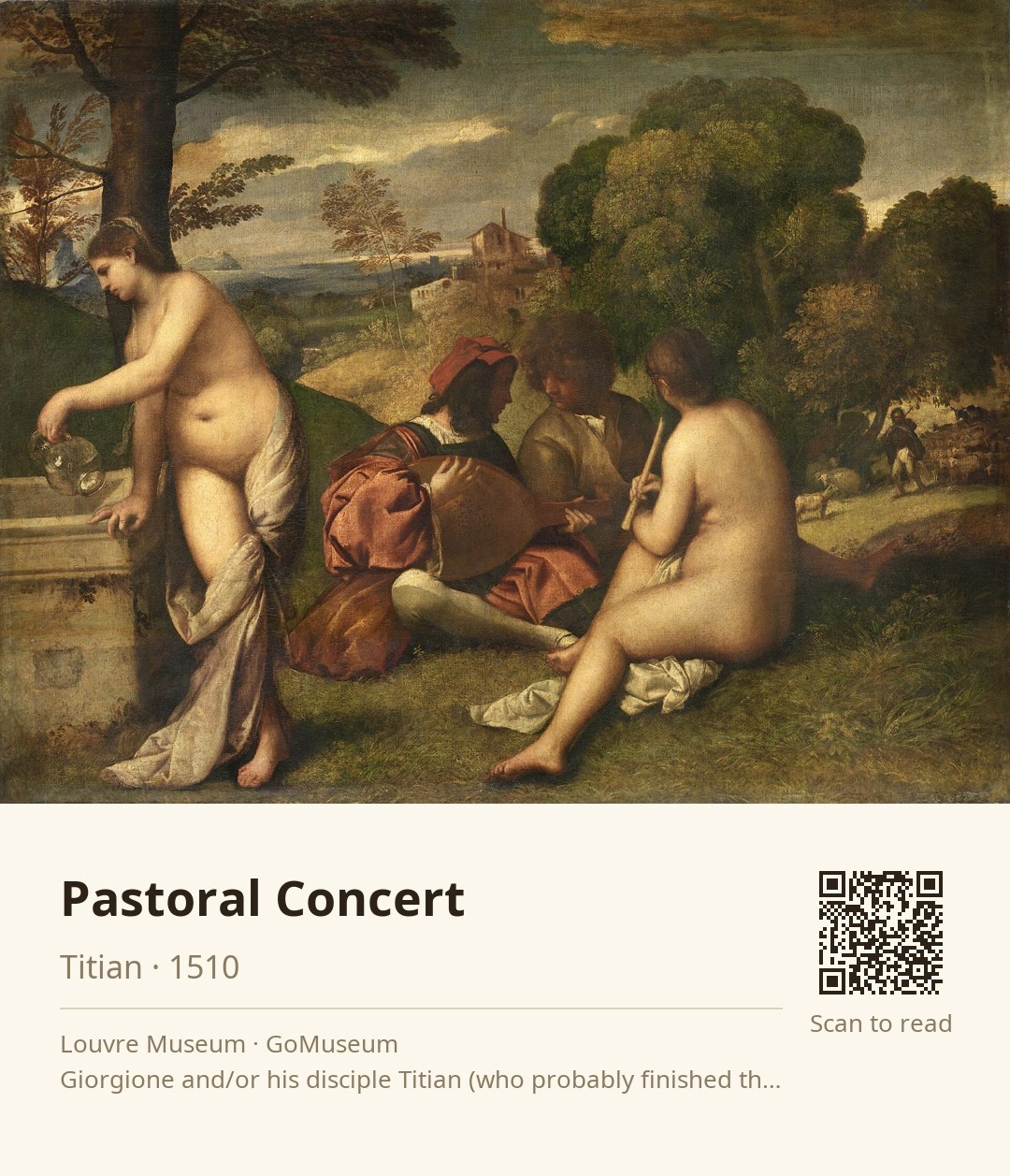
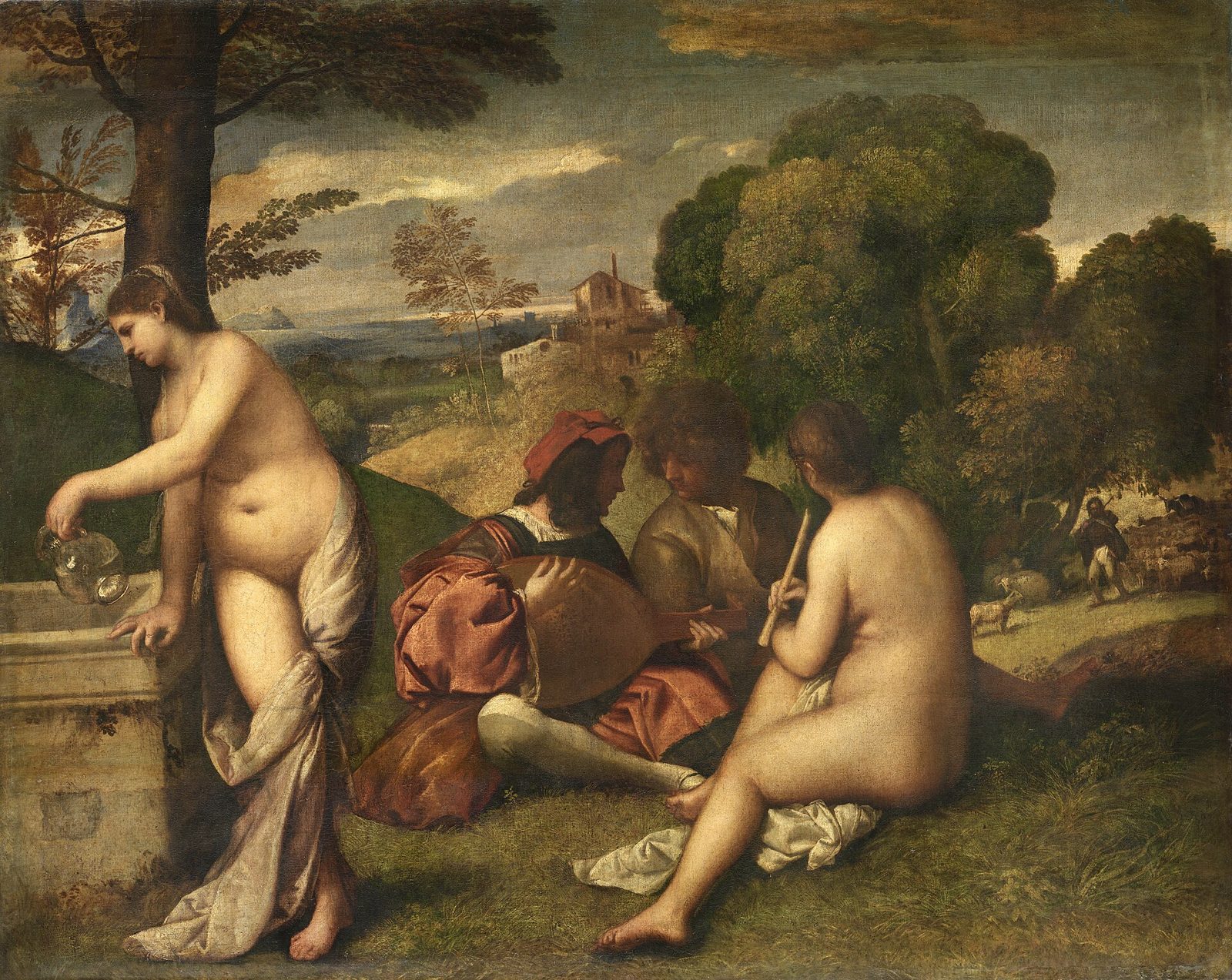
 Image: Giorgione and/or his disciple Titian (who probably finished the painting after Giorgione's death in 1510).
Pastoral Concert
🎧 This work has audio narration — listen in the appTake a moment to really absorb the scene in Titian's "Pastoral Concert." Notice how the two young men are seated on the lush grass, one strumming a lute while the other leans in, captivated. Their relaxed postures contrast sharply with the standing woman pouring water from a marble basin, her drapery artfully cascading down. This juxtaposition of the serene and the dynamic invites you to ponder the balance between nature and art.
These details matter because they encapsulate the essence of the Renaissance—a celebration of beauty, music, and the human experience. The young men, dressed in contemporary Venetian attire, represent the vibrant culture of 16th-century Venice, while the nude women evoke classical ideals of beauty and inspiration, possibly serving as muses for the artists. This painting is more than just a gathering; it’s a visual symphony that harmonizes the natural world with artistic expression.
Created around 1510, during a tumultuous time in Venice marked by war, Titian offers us an idyllic escape through this pastoral scene. It’s believed that he was influenced by the poetic traditions of his time, reflecting the humanist values that celebrated classical themes and the beauty of the natural world.
As you stand here, think about what this idyllic gathering means to you. Is it a moment of peace amidst chaos, or a reminder of the beauty that art can bring into our lives? What stories do you imagine these figures might share?
Titian, born Tiziano Vecellio around 1488 in Pieve di Cadore, was a pivotal figure in the Italian Renaissance, particularly in Venetian painting. Renowned for his versatility, he excelled in portraits, landscapes, and mythological themes, becoming a sought-after artist among patrons, including the Habsburgs and the papacy. His innovative use of color and brushwork transformed the art of painting, liberating it from the rigid constraints of line and form that characterized earlier periods.
Titian's career began in Venice, where he trained under notable masters such as Giovanni Bellini and Giorgione. His early works reflected the influence of these artists, but he quickly developed a distinctive style that emphasized color and emotional depth. His masterpiece, "Assumption of the Virgin," showcased his ability to blend religious themes with dynamic composition, setting a new standard in Christian art.
Throughout his life, Titian's artistic evolution mirrored his personal experiences, including the loss of his wife and the challenges of his time. He became a prominent portraitist, capturing the essence of his subjects with remarkable realism. His legacy endures, influencing countless artists and solidifying his place as one of the greatest painters in Western art history. Titian passed away in 1576, leaving behind a rich body of work that continues to inspire and captivate audiences today.
Originally attributed to Giorgione, this painting was a point of contention among art historians until Titian's mastery was recognized. The painting entered the Louvre in 1792, where it was re-titled as a Fête champêtre, a genre that captures gatherings in idyllic landscapes. This work emerged during the League of Cambrai's War, a conflict that deeply affected Venice, and art historians suggest it serves as a serene escape from the chaos of the era, embodying the humanist values of beauty and nature. The term "Concert Champêtre" was coined in 1754, highlighting its significance in the evolution of pastoral themes in art.
As you gaze at "Pastoral Concert," pay attention to Titian's masterful use of color and light, hallmarks of the Venetian school. The warm glow that envelops the figures is achieved through a technique known as colorito, where layers of translucent paint create depth and vibrancy. Notice how the brushwork feels both fluid and dynamic, especially in the drapery of the standing woman, which cascades gracefully, contrasting with the relaxed poses of the seated men. The composition draws your eye across the canvas, from the musicians to the lush landscape, inviting you to explore the pastoral setting. The balance between the serene figures and the lively background, including the shepherd, enhances the sense of harmony that defines this idyllic scene. Titian's choices in scale and placement not only highlight the figures but also immerse you in a dreamlike world that feels both real and fantastical.
This painting not only showcases the lush, vibrant colorito technique that defines Venetian art but also lays the groundwork for the pastoral genre, influencing countless artists in the centuries that followed. Imagine the idyllic scenes it inspired—young men and women in serene landscapes, a theme that would flourish in 18th-century French art. Titian's ability to blend mythological elements with natural beauty reflects the Renaissance's embrace of humanism, making this work a timeless dialogue between art and poetry.
An intriguing aspect of "Pastoral Concert" is its unclear patronage. While Isabella d'Este is often mentioned as a possible commissioner, the true identity of the patron remains a mystery.
The painting was originally attributed to Giorgione, which sparked considerable debate among art historians regarding its true creator.
While Isabella d'Este is often suggested as a possible patron, the true identity of the commissioner remains unknown, adding an intriguing layer to the painting's history.